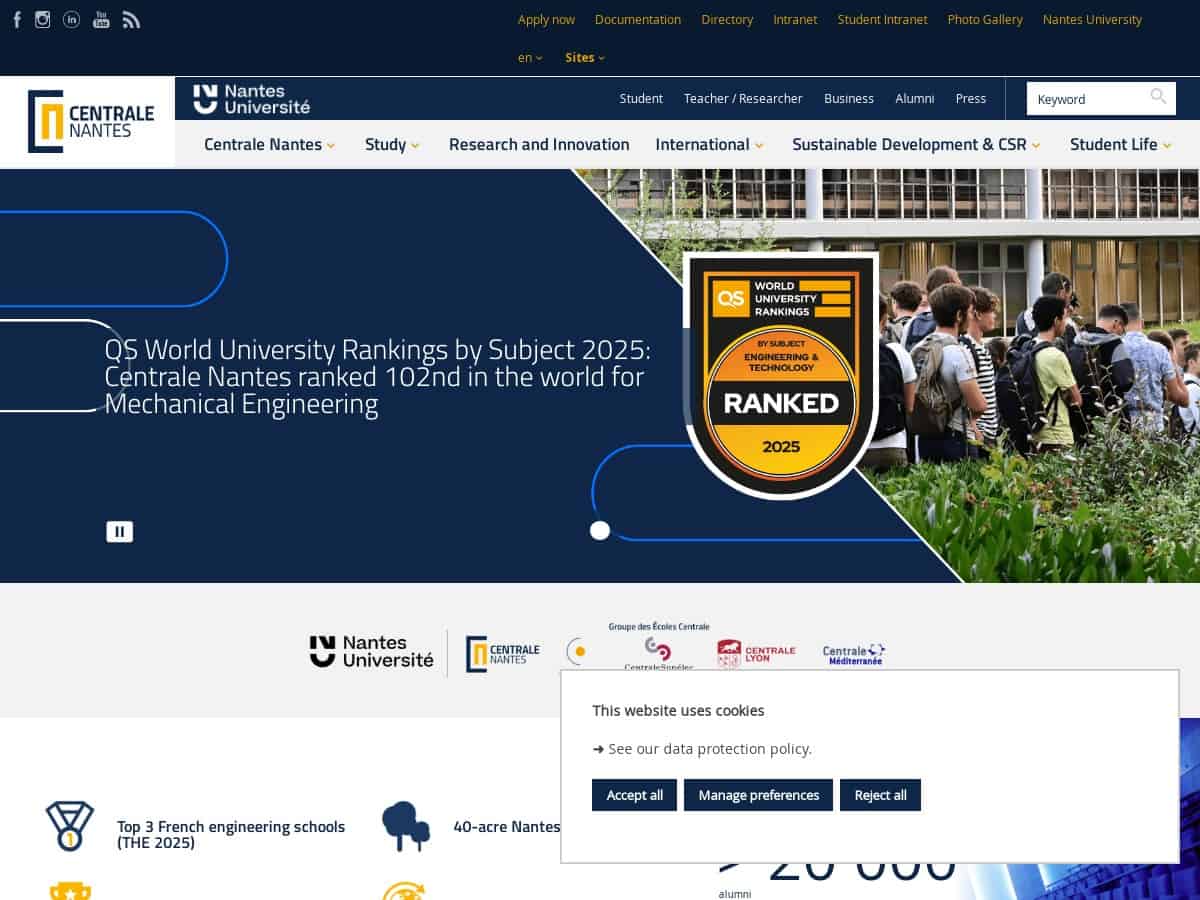
Centrale Nantes trains engineers on a campus beside the Erdre river in Nantes, in western France. The school began in 1919 as the Institut Polytechnique de l’Ouest, created after a vote of the Nantes city council on 15 July of that year. It has been part of the Écoles Centrale Group since 1991, when it took its present name.
Its status changed in the late 1940s, when it was recognised as a national engineering school under the name École Nationale Supérieure de Mécanique. The move from the city centre to the present Erdre site followed in the late 1970s. Since January 2022 the school has been a component institution of Nantes Université, of which it is also a founding member.
Teaching leads to the French engineering diploma, to master’s degrees and to doctorates, and a Bachelor of Science in Engineering has been added at undergraduate level. Research is organised in laboratories such as LHEEA, which studies hydrodynamics, energetics and the atmospheric environment, GeM for civil and mechanical engineering, LS2N for digital sciences and the Jean Leray mathematics laboratory. The school also operates ocean test tanks, and its alumni network counts more than 20,000 graduates.
Domains taught:
Aerospace, AI and Machine Learning, Automation, Civil Engineering, Computer Vision, Data Analytics, Ecology and Sustainability, Electrical and Electronics, Engineering, Fluid Dynamics, Industrial Design, Manufacturing, Marine Science, Materials, Mathematics, Mechanical Engineering, Process Control, Project Management, Robotics, Signal Processing, Software Engineering, Statistics, Structural Engineering, Telecommunications, Thermodynamics, Transportations
Diplomas*:
Doctor, Master
Status:
Public
Partnerships:
Part of Nantes Université and Groupe des Écoles Centrales. Member of T.I.M.E. network. Strong industry links (e.g., Naval Group, Chantiers de l’Atlantique, Airbus).
Research:
Ocean engineering and hydrodynamics, Advanced manufacturing and robotics, Composite materials and structures, Renewable marine energies, Digital engineering.
Famous Alumnis:
N/A
International recognition**:
Number of staff***:
600
Current students***:
2500
Foreign students***:
30%
Cumulative former students***:
15000
Pros
Excellence in marine and mechanical engineering, advanced research facilities (ocean test basins), strong industry connections.
Cons
Highly selective, demanding programs, specific focus areas.
Best For
Leading engineering school for mechanical engineering, marine technologies, and advanced manufacturing.
École Centrale de Lyon is a fellow member of the Centrale group, a public engineering school with general engineering, mechanical engineering and acoustics.
École Centrale de Lille, also public, offers general engineering with data science and AI and industrial engineering.
CentraleSupélec, a public school in the Île-de-France region, trains generalist engineers with energy and computer science among its specialisms.
École Navale is a public naval school in Brittany, with naval engineering and hydrography close to the maritime strand of the Nantes profile.
ISAE-ENSMA, a public engineering school in Nouvelle-Aquitaine, is known for aeromechanics, energetics and thermal engineering.
Most Similar Schools Abroad
Università degli Studi di Genova in Italy lists naval and maritime engineering, robotics and computer science, close to the ocean-engineering side of the Nantes profile.
Dalian Maritime University, also in China, is a public institution focused on navigation technology, marine engineering and maritime logistics.
Universität Rostock in Germany pairs maritime systems and ocean technology with electrical and life-science fields, as a public university.
Universität Bremen, a public university in Germany, is listed for marine and environmental sciences and for materials science and production engineering.
Yokohama National University in Japan is a public university with engineering in mechanical, electrical, civil and naval subjects.
*our own picks (our criteria: a mix between domains, diploma delivered, reputation and size), but obviously too many criteria for an apple-to-apple ranking.
FAQ
How did the school get started?
It was founded in 1919 as the Institut Polytechnique de l'Ouest after Nantes city council approved its creation on 15 July. Later it became a national engineering school and, in 1991, École Centrale de Nantes.
What is its link with Nantes Université?
Since January 2022 Centrale Nantes has been a component of Nantes Université and one of its founding members. It keeps its own engineering diploma and its own campus.
Which degrees can a student prepare there?
The programmes include the engineering diploma, master's courses, a Bachelor of Science in Engineering, a business-oriented bachelor in data, AI and management, and doctorates. Details of each route are published on the school's official English-language pages.
What do the research laboratories study?
LHEEA covers hydrodynamics and energetics, GeM deals with civil and mechanical engineering, LS2N with digital sciences and the Jean Leray laboratory with mathematics. The school also has ocean test facilities.
Does the school belong to a wider network?
Yes, it is a member of the Écoles Centrale Group, which also includes CentraleSupélec, Centrale Lille, Centrale Lyon, Centrale Méditerranée and Centrale Beijing.
How big is the graduate community?
The school reports more than 20,000 alumni. That figure is published on the school's English-language website.
Where can applicants find fees and entry conditions?
These depend on the programme and on the applicant's status, so the official admissions pages of Centrale Nantes are the reliable reference. They explain application calendars for the engineering diploma, master's courses and the bachelor.
*: without any judgment of the quality, readers are strongly encouraged to check the official status of the exact diploma envisioned as many universities have a mix of recognized diplomas, not recognized, “co-delivered,” “equivalent to”, “some pathways” (…), can change over time, and can be named differently from one country to another.
**: international reputation: is based on some criteria that do not mean much in some domains or specialties (number of researchers, of scientific publications, on budget ….). Our approximate 1-4 scale:
known locally
known locally and internationally
is listed in some of the world university’s classifications
is listed among the 20 firsts in some of world university’s classifications
***: estimated numbers, based on online sources and/or feedbacks. The numbers can vary greatly depending on school organisation (ex.: school is part of a group, it employs internal staff or external consultants or has public staff without employing them …). Refer to all the links provided to have accurate and updated numbers.
Innovation.world is not affiliated with this school/university. We recommend to contact them directly on their website for any special request.
To complete or correct any information here or share your opinion, please comment below or > send us a direct message <.