Product Design, Manufacturing & Innovation Resources
Home » Triangle Angle Sum Theorem

Triangle Angle Sum Theorem

-300
  • Euclid of Alexandria
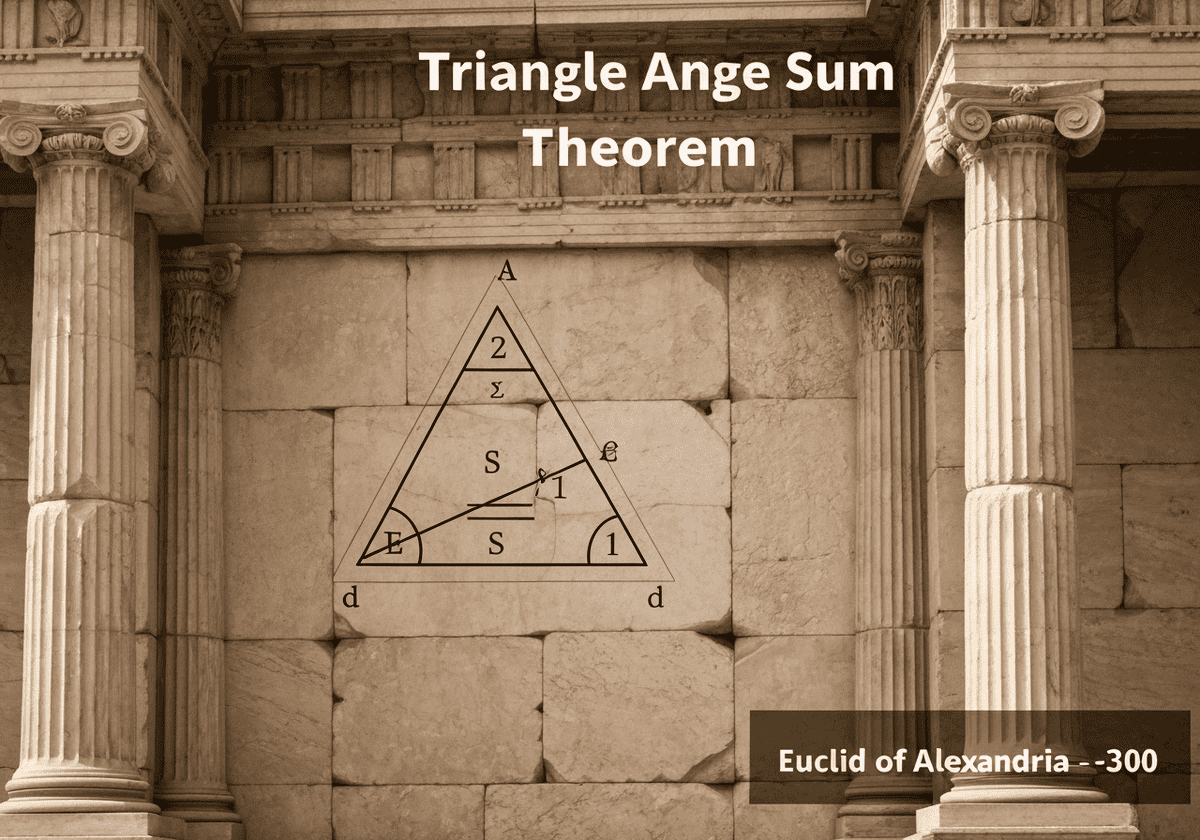
Stone carving of Triangle Angle Sum Theorem illustrating angle measures in Euclidean geometry.

(generated image for illustration only)

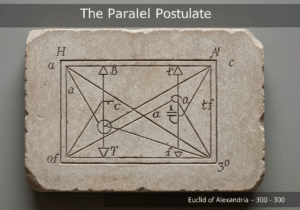
A fundamental theorem in Euclidean geometry states that the sum of the measures of the three interior angles of any triangle is always equal to two right angles, or 180 degrees. This property, \(\alpha + \beta + \gamma = 180^\circ\), is a direct consequence of the parallel postulate and holds true for all triangles, regardless of their size or shape, within a flat, Euclidean plane.

The proof of the triangle angle sum theorem is a classic example of deductive reasoning in Euclidean geometry and relies critically on the parallel postulate. To prove it, one can draw a line through one vertex of the triangle that is parallel to the opposite side. Because of the properties of parallel lines intersected by a transversal (the other two sides of the triangle), the alternate interior angles are equal. The three angles at the vertex on the straight line—two of which are equal to the other two angles of the triangle—sum to 180 degrees, as they form a straight angle. Therefore, the three interior angles of the triangle must also sum to 180 degrees.

This theorem is a defining characteristic of Euclidean space. In non-Euclidean geometries, this property does not hold. In hyperbolic geometry (with negative curvature, like a saddle), the sum of angles in a triangle is always less than 180 degrees. In elliptic or spherical geometry (with positive curvature, like the surface of a sphere), the sum is always greater than 180 degrees. This makes the angle sum of a triangle a simple test for the nature of the space it inhabits, a concept that became crucial in physics with the advent of general relativity.

UNESCO Nomenclature: 1204
– Geometry

Type

Abstract System

Disruption

Foundational

Usage

Widespread Use

Precursors

  • Euclid’s Parallel Postulate
  • Concepts of angles and parallel lines from earlier Greek mathematics
  • The axiomatic method established in Euclid’s Elements

Applications

  • surveying and geodesy for calculating distances and positions
  • astronomy for measuring stellar parallax
  • architecture for designing stable truss structures
  • computer graphics for rendering 3d models
  • navigation for plotting courses

Patents:

NA

Potential Innovations Ideas

Due to scrapping bot traffic, currently more than 40k per day, this content is reserved to community members.
> Login < or > Register < (100% free) to access this, so as all other restricted content and tools.

Related to: triangle, angle sum, 180 degrees, Euclidean geometry, parallel postulate, proof, trigonometry, non-Euclidean geometry.

Historical Context

Triangle Angle Sum Theorem

-300
-300
-300
-400
-550
1635
1650
1736
-300
-300
-350
-500
150
1640
1650

(if date is unknown or not relevant, e.g. "fluid mechanics", a rounded estimation of its notable emergence is provided)

Related Invention, Innovation & Technical Principles

Full size images and downloads are only available, 100% free, for registered members.

> Login <