Product Design, Manufacturing & Innovation Resources
Home » Superconductivity

Superconductivity

1911-04-08
  • Heike Kamerlingh Onnes
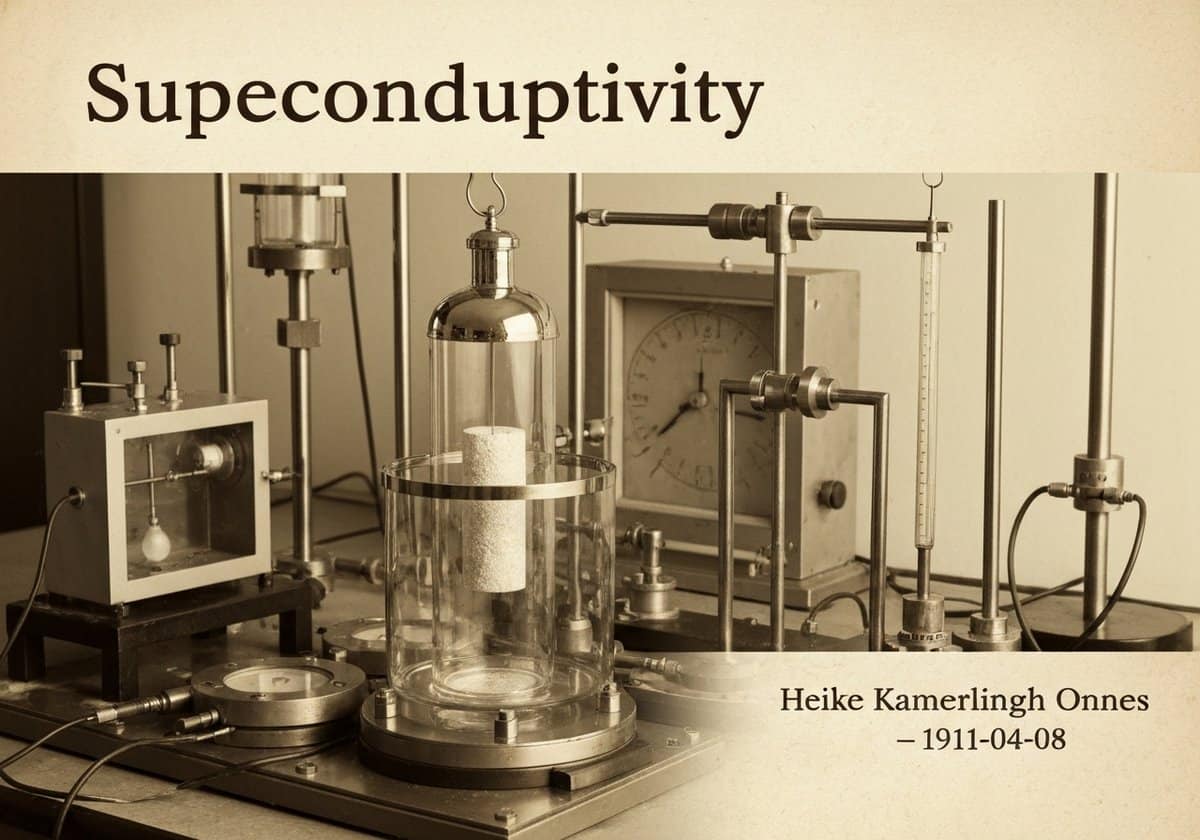
Cryogenic laboratory setup demonstrating superconductivity with solid mercury.

(generated image for illustration only)

In 1911, Heike Kamerlingh Onnes discovered superconductivity while studying the resistance of solid mercury at cryogenic temperatures. He observed that the electrical resistance of mercury abruptly dropped to zero at a critical temperature (\(T_c\)) of 4.2 K. This phenomenon, termed superconductivity, represents a state of matter with exactly zero electrical resistance and expulsion of magnetic fields.

The discovery was a direct consequence of Onnes’s pioneering work in low-temperature physics, specifically his successful liquefaction of helium in 1908. This achievement opened up a new temperature regime for experimental investigation, down to about 1 K. Onnes was initially investigating how the electrical resistance of pure metals behaved at these extremely low temperatures. Prevailing theories suggested that resistance would either level off to a constant value or increase again as electron motion ceased. However, when his team cooled a sample of solid mercury, they observed a sudden, complete disappearance of resistance at 4.2 K. Onnes initially suspected a short circuit but soon confirmed the phenomenon was real and intrinsic to the material. He called this new state “supraconductivity” (later superconductivity). This discovery was revolutionary because classical physics could not explain how electrons could move through a material lattice without any energy loss. It marked the birth of a new field of physics and demonstrated the existence of macroscopic quantum phenomena, where quantum effects become visible on a large scale. The zero-resistance state implies that a current induced in a superconducting loop could persist indefinitely without a power source, a concept later verified in persistent current experiments.

The implications were profound, suggesting possibilities for lossless energy transmission and the creation of extremely powerful magnets. However, the extremely low temperatures required (liquid helium temperatures) made practical applications challenging for many decades. The discovery spurred a global research effort to find materials with higher critical temperatures and to develop a theoretical understanding of the underlying mechanism, a puzzle that would remain unsolved for nearly 50 years until the advent of the BCS theory.

UNESCO Nomenclature: 2211
– Solid state physics

Type

Physical Property

Disruption

Revolutionary

Usage

Widespread Use

Precursors

  • liquefaction of helium (1908)
  • development of cryogenics
  • Drude model of electrical conduction
  • studies on electrical resistance at low temperatures

Applications

  • magnetic resonance imaging (mri)
  • particle accelerators
  • maglev trains
  • superconducting quantum interference devices (squids)
  • power transmission lines

Patents:

NA

Potential Innovations Ideas

Due to scrapping bot traffic, currently more than 40k per day, this content is reserved to community members.
> Login < or > Register < (100% free) to access this, so as all other restricted content and tools.

Related to: superconductivity, Heike Kamerlingh Onnes, critical temperature, zero resistance, mercury, cryogenics, low-temperature physics, phase transition, condensed matter, quantum mechanics.

Historical Context

Superconductivity

1907
1909
1910
1911-04-08
1913
1915
1916
1904
1907
1909
1910
1912
1915
1915-11
1916

(if date is unknown or not relevant, e.g. "fluid mechanics", a rounded estimation of its notable emergence is provided)

Related Invention, Innovation & Technical Principles

Full size images and downloads are only available, 100% free, for registered members.

> Login <