Product Design, Manufacturing & Innovation Resources
Home » Ferromagnetism and Magnetic Domains

Ferromagnetism and Magnetic Domains

1907
  • Pierre-Ernest Weiss
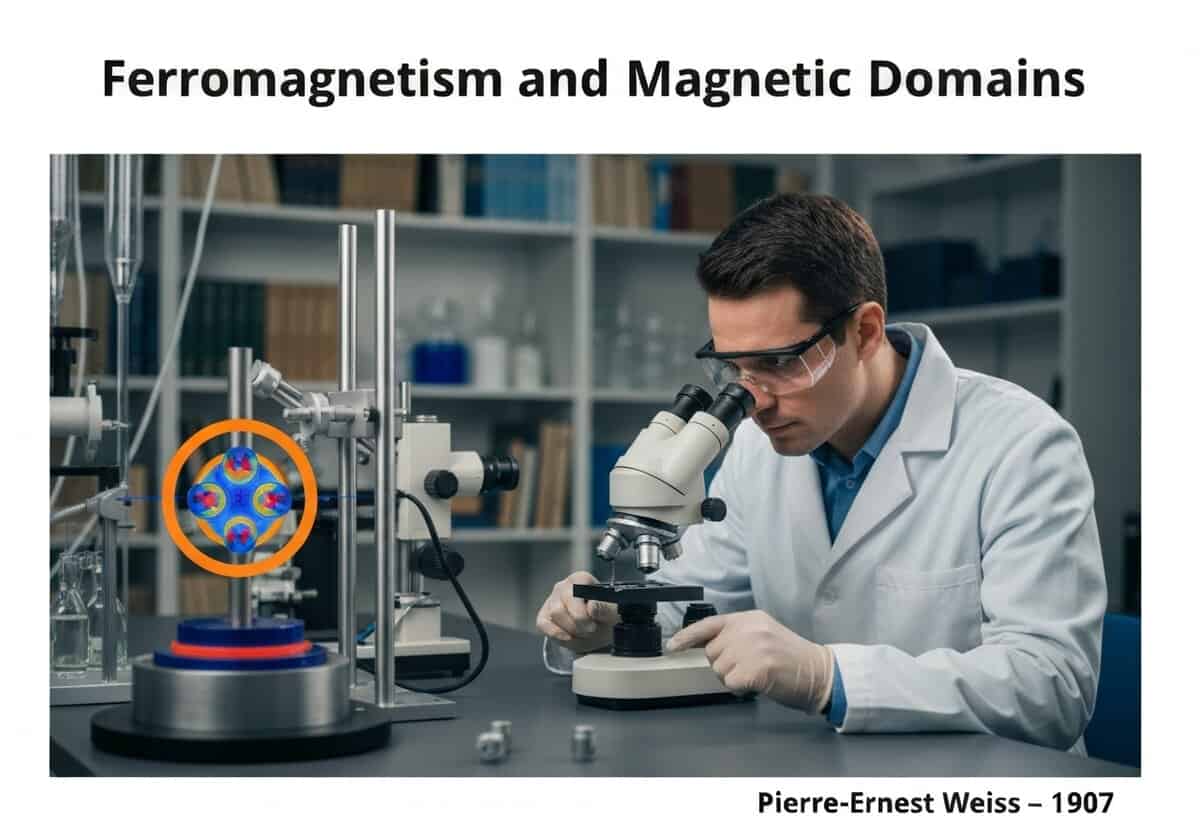
Ferromagnetic material analysis in solid state physics laboratory.

(generated image for illustration only)

Ferromagnetism is the mechanism by which certain materials, like iron, form permanent magnets. It arises from a quantum mechanical exchange interaction that causes atomic magnetic moments to align spontaneously in regions called magnetic domains. Below the Curie temperature, these domains can be aligned by an external magnetic field, creating a strong, persistent magnet even after the external field is removed.
Pierre Weiss proposed the concept of magnetic domains in 1907 to explain the properties of ferromagnetic materials. He theorized that within a ferromagnetic material, there are small regions, now known as Weiss domains, where the atomic magnetic moments are all aligned in the same direction, resulting in strong local magnetization. In an unmagnetized piece of ferromagnetic material, the domains are randomly oriented, so their magnetic fields cancel each other out, and the material as a whole has no net magnetic field.

When an external magnetic field is applied, two processes can occur: the domains that are already aligned with the field can grow at the expense of their neighbors (domain wall motion), and the magnetic moments within other domains can rotate to align with the external field. When the external field is strong enough, nearly all domains become aligned, and the material is said to be saturated. For hard magnetic materials, this alignment can persist even after the external field is removed, creating a permanent magnet. This persistence is called remanence. The strength of the reverse field needed to demagnetize the material is called its coercivity.

UNESCO Nomenclature: 2211
– Solid state physics

Type

Physical Property

Disruption

Foundational

Usage

Widespread Use

Precursors

  • discovery of naturally magnetic lodestone
  • understanding of atomic magnetic moments
  • development of quantum mechanics
  • observation of magnetic hysteresis

Applications

  • permanent magnets in motors and speakers
  • magnetic data storage (hard drives, magnetic tape)
  • transformers and inductors
  • magnetic shielding
  • sensors

Patents:

NA

Potential Innovations Ideas

  • domain-wall memory (racetrack memory)
  • programmable magnetic materials with tunable domains
  • high-efficiency magnetic refrigeration systems
  • self-healing materials using magnetic domain realignment
  • ultra-low power spintronic logic devices
  • magnetic inks for secure documents and currency
  • biomedical sensors based on domain wall motion
  • advanced magnetic actuators for soft robotics
  • high-frequency inductors with engineered domain structures
  • magnetic field visualization films
Related to: ferromagnetism, magnetic domain, Weiss domain, exchange interaction, Curie temperature, permanent magnet, hysteresis, remanence, coercivity, solid-state physics.

Historical Context

Ferromagnetism and Magnetic Domains

1900-12-14
1902
1904
1907
1909
1910
1912
1900
1902
1902
1907
1909
1910
1911-04-08
1913

(if date is unknown or not relevant, e.g. "fluid mechanics", a rounded estimation of its notable emergence is provided)

10th year anniversary

Full size images and downloads are only available, 100% free, for registered members.

> Login <