Product Design, Manufacturing & Innovation Resources
» Superconductivity

Superconductivity

1911-04-08
  • Heike Kamerlingh Onnes
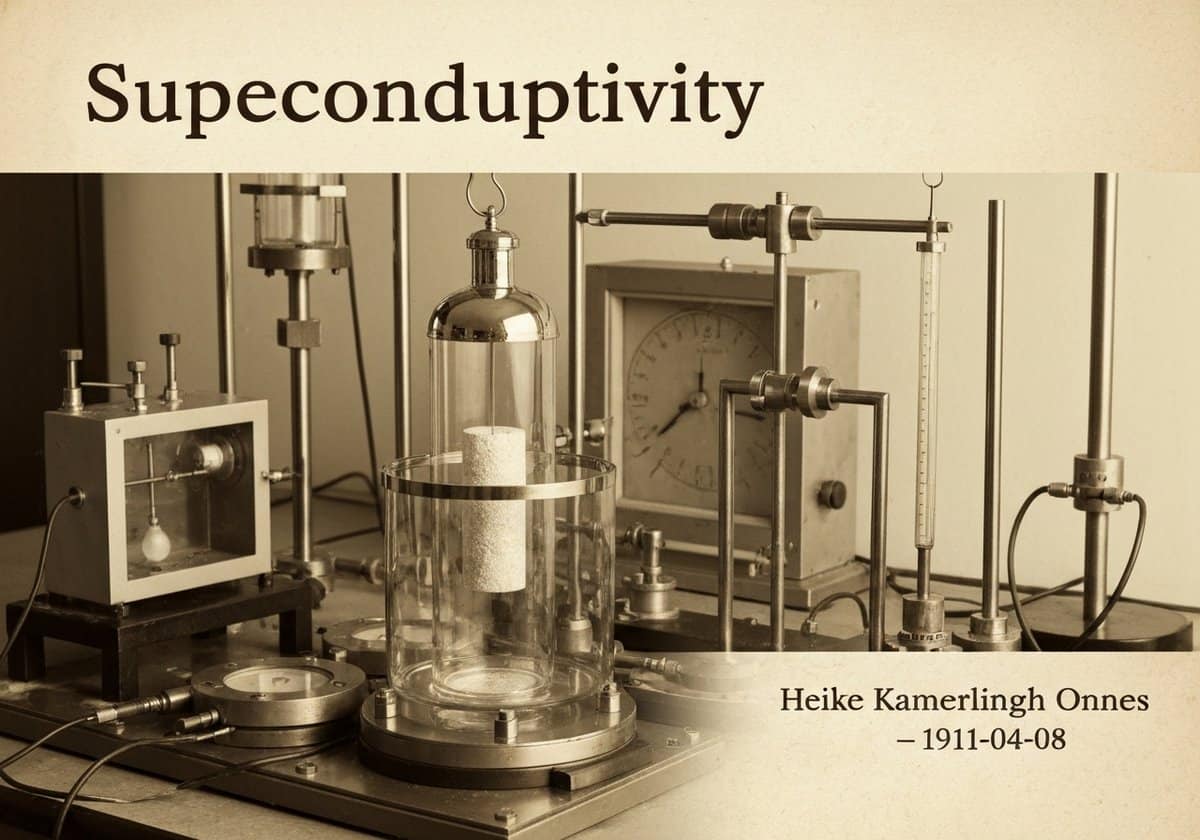
Cryogenic laboratory setup demonstrating superconductivity with solid mercury.

(画像はイメージです)

In 1911, Heike Kamerlingh Onnes discovered superconductivity while studying the resistance of solid mercury at 極低温 temperatures. He observed that the electrical resistance of mercury abruptly dropped to zero at a critical temperature ([latex]T_c[/latex]) of 4.2 K. This phenomenon, termed superconductivity, represents a state of matter with exactly zero electrical resistance and expulsion of magnetic fields.

The discovery was a direct consequence of Onnes’s pioneering work in low-temperature physics, specifically his successful liquefaction of helium in 1908. This achievement opened up a new temperature regime for experimental investigation, down to about 1 K. Onnes was initially investigating how the electrical resistance of pure metals behaved at these extremely low temperatures. Prevailing theories suggested that resistance would either level off to a constant value or increase again as electron motion ceased. However, when his team cooled a sample of solid mercury, they observed a sudden, complete disappearance of resistance at 4.2 K. Onnes initially suspected a short circuit but soon confirmed the phenomenon was real and intrinsic to the material. He called this new state “supraconductivity” (later superconductivity). This discovery was revolutionary because classical physics could not explain how electrons could move through a material lattice without any energy loss. It marked the birth of a new field of physics and demonstrated the existence of macroscopic quantum phenomena, where quantum effects become visible on a large scale. The zero-resistance state implies that a current induced in a superconducting loop could persist indefinitely without a power source, a concept later verified in persistent current experiments.

The implications were profound, suggesting possibilities for lossless energy transmission and the creation of extremely powerful magnets. However, the extremely low temperatures required (liquid helium temperatures) made practical applications challenging for many decades. The discovery spurred a global research effort to find materials with higher critical temperatures and to develop a theoretical understanding of the underlying mechanism, a puzzle that would remain unsolved for nearly 50 years until the advent of the BCS theory.

UNESCO Nomenclature: 2211
固体物理学

タイプ

物理的資産

混乱

革命的

使用法

広く普及している

前駆物質

  • liquefaction of helium (1908)
  • development of cryogenics
  • Drude model of electrical conduction
  • studies on electrical resistance at low temperatures

アプリケーション

  • 磁気共鳴画像法(MRI)
  • 粒子加速器
  • 磁気浮上式鉄道
  • superconducting quantum interference devices (squids)
  • power transmission lines

特許:

NA

潜在的なイノベーションのアイデア

ボットによるトラフィック(現在1日あたり4万件以上)を排除するため、このコンテンツはコミュニティメンバー限定となっています。
> ログイン < または > 登録 < (100%無料)でこれにアクセスできます。他のすべての制限付きコンテンツとツールも同様です。

Related to: superconductivity, Heike Kamerlingh Onnes, critical temperature, zero resistance, mercury, cryogenics, low-temperature physics, phase transition, condensed matter, quantum mechanics.

歴史的背景

Superconductivity

1907
1909
1910
1911-04-08
1913
1915
1916
1904
1907
1909
1910
1912
1915
1915-11
1916

(日付が不明または関連性がない場合、例えば「流体力学」などでは、その注目すべき出現時期の概算値が提示されます。)

関連する発明、革新、および技術原理

フルサイズの画像とダウンロードは、登録会員のみが100%無料で利用できます。