Solid Modeling: B-rep and CSG
1970
- Ian Braid
- Bruce Baumgart
- MAGI (Mathematical Applications Group, Inc.)
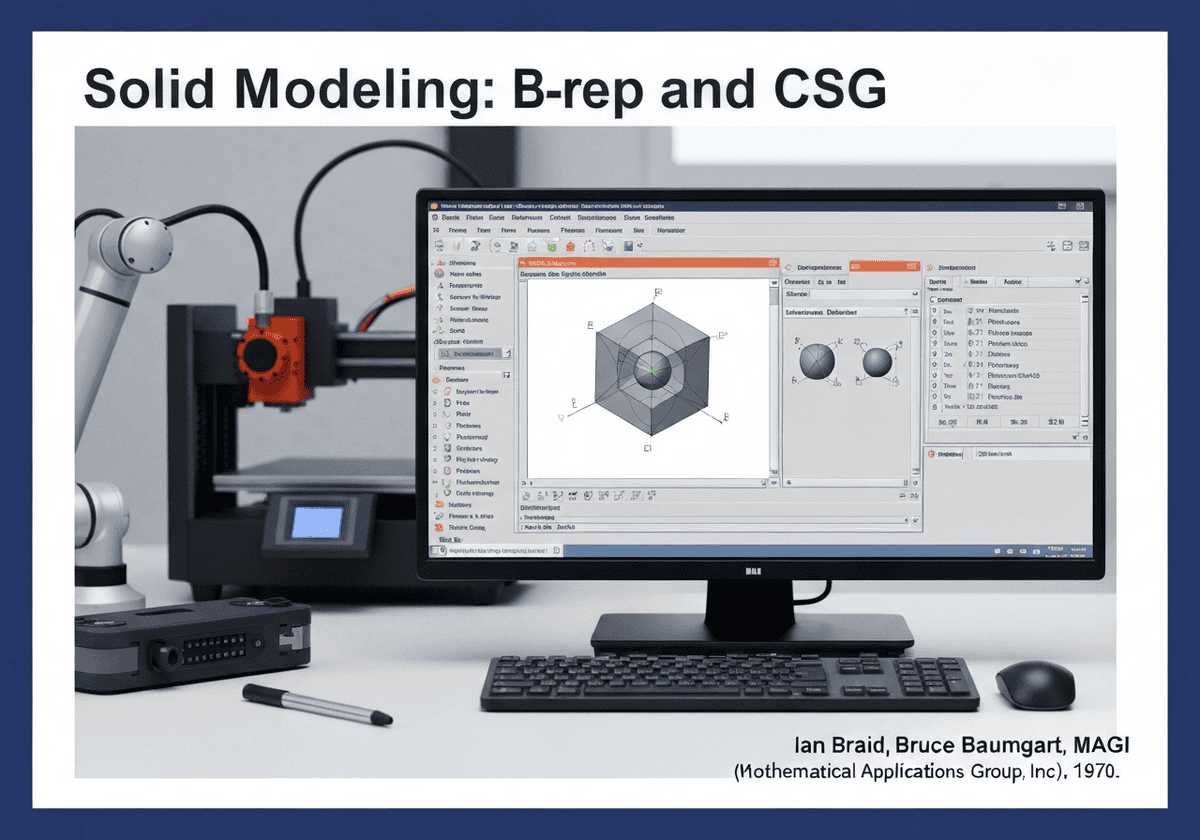
Solid modeling in CAD represents objects as unambiguous, voluminous 3D shapes. Two primary techniques dominate: Boundary Representation (B-rep), which defines a solid by its bounding surfaces (faces, edges, vertices), and Constructive Solid Geometry (CSG), which builds complex shapes by applying Boolean operations (union, subtract, intersect) to simpler primitive solids like cubes, spheres, and cylinders.
Boundary Representation (B-rep) and Constructive Solid Geometry (CSG) are the two foundational methodologies for representing solid objects in a computer. B-rep is arguably the more common approach in modern CAD systems for detailed design. It describes a solid by explicitly defining the hierarchy of its topological elements: faces, edges, and vertices, along with the geometric information for each (e.g., the surface equation for a face, the curve equation for an edge). This explicit boundary definition makes it very suitable for generating realistic renderings and for calculating surface properties, which is crucial for manufacturing processes like CNC machining.
Constructive Solid Geometry, on the other hand, takes a more procedural approach. It represents a complex object as a tree structure where the leaf nodes are simple geometric primitives (e.g., block, cylinder, sphere, cone) and the internal nodes are Boolean set operators (union, intersection, difference). For example, a hollow pipe could be created by subtracting a smaller cylinder from a larger, concentric one. CSG models are typically very compact and guarantee that the resulting object is a valid solid. However, retrieving boundary information like specific faces or edges can be computationally expensive, as it requires ‘evaluating’ the entire CSG tree. Many modern CAD systems use a hybrid approach, allowing users to build models using CSG-like operations, but storing the final result as a B-rep model for efficient manipulation and analysis.
UNESCO Nomenclature: 3305
– Computer science
Precursors
- set theory and boolean algebra
- wireframe modeling
- surface modeling techniques (e.g., bézier surfaces)
- advances in data structures for representing graphs and topology
Applications
- finite element analysis (fea)
- computer-aided manufacturing (cam) toolpath generation
- 3d printing and additive manufacturing
- collision detection in robotics and animation
- photorealistic rendering and visualization
Potential Innovations Ideas
Due to scrapping bot traffic, currently more than 40k per day, this content is reserved to community members.
> Login < or > Register < (100% free) to access this, so as all other restricted content and tools.
Related to: solid modeling, boundary representation, b-rep, constructive solid geometry, csg, boolean operations, cad kernel, 3d modeling.