Product Design, Manufacturing & Innovation Resources
بيت » النمذجة الصلبة: B-rep وCSG

النمذجة الصلبة: B-rep وCSG

1970
  • Ian Braid
  • Bruce Baumgart
  • MAGI (Mathematical Applications Group, Inc.)
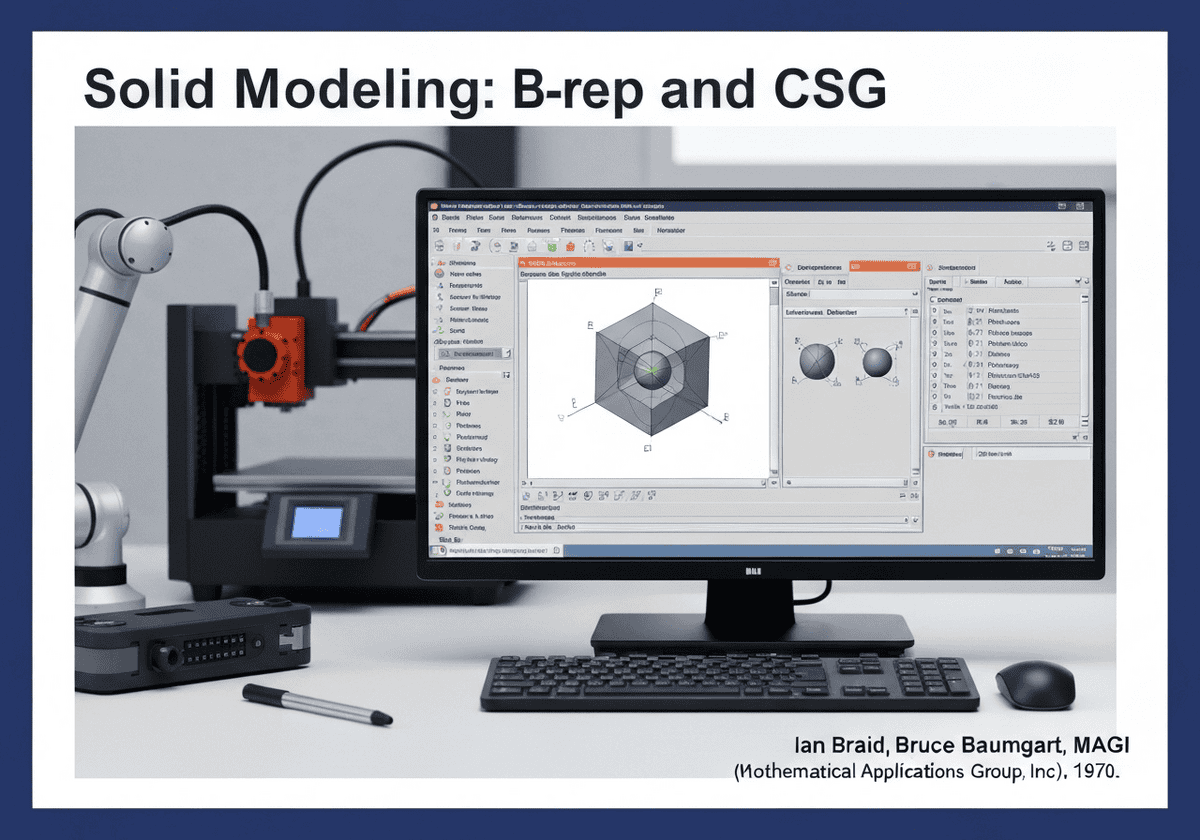
محطة عمل CAD تعرض تقنيات النمذجة الصلبة B-rep و CSG مع الأشكال الهندسية.

(صورة توضيحية فقط)

Solid modeling in كاد represents objects as unambiguous, voluminous 3D shapes. Two primary techniques dominate: Boundary Representation (B-rep), which defines a solid by its bounding surfaces (faces, edges, vertices), and Constructive Solid Geometry (CSG), which builds complex shapes by applying Boolean operations (union, subtract, intersect) to simpler primitive solids like cubes, spheres, and cylinders.

تمثيل الحدود (B-rep) وهندسة الأجسام البنائية (CSG) هما المنهجيتان الأساسيتان لتمثيل الأجسام الصلبة في الحاسوب. ويُعتبر تمثيل الحدود (B-rep) الأكثر شيوعًا في أنظمة التصميم بمساعدة الحاسوب (CAD) الحديثة للتصميم التفصيلي. يصف هذا التمثيل الجسم الصلب من خلال تحديد هرمي واضح لعناصره الطوبولوجية: الوجوه، والحواف، والرؤوس، بالإضافة إلى المعلومات الهندسية لكل منها (مثل معادلة السطح للوجه، ومعادلة المنحنى للحافة). هذا التعريف الواضح للحدود يجعله مناسبًا جدًا لإنشاء رسومات واقعية وحساب خصائص السطح، وهو أمر بالغ الأهمية لعمليات التصنيع مثل التصنيع باستخدام الحاسب الآلي.

Constructive Solid Geometry, on the other hand, takes a more procedural approach. It represents a complex object as a tree structure where the leaf nodes are simple geometric primitives (e.g., block, cylinder, sphere, cone) and the internal nodes are Boolean set operators (union, intersection, difference). For example, a hollow pipe could be created by subtracting a smaller cylinder from a larger, concentric one. CSG models are typically very compact and guarantee that the resulting object is a valid solid. However, retrieving boundary information like specific faces or edges can be computationally expensive, as it requires ‘evaluating’ the entire CSG tree. Many modern CAD systems use a hybrid approach, allowing users to build models using CSG-like operations, but storing the final result as a B-rep model for efficient manipulation and analysis.

UNESCO Nomenclature: 3305
– Computer science

يكتب

نظام مجرد

خلل

أساسيات

الاستخدام

استخدام واسع النطاق

مقدمات

  • set theory and boolean algebra
  • نمذجة الإطار السلكي
  • surface modeling techniques (e.g., bézier surfaces)
  • التطورات في هياكل البيانات لتمثيل الرسوم البيانية والطوبولوجيا

التطبيقات

  • العناصر المحدودة analysis (fea)
  • إنشاء مسار أداة التصنيع بمساعدة الكمبيوتر (CAM)
  • 3d printing and additive manufacturing
  • كشف الاصطدام في الروبوتات والرسوم المتحركة
  • تقديم وتصور واقعي للصور

براءات الاختراع:

NA

أفكار ابتكارية محتملة

  • نوى بيكسل هجينة (فوكسل) من نوع b-rep/volumetric للطباعة ثلاثية الأبعاد متعددة المواد
  • عمليات csg في الوقت الفعلي المُسرّعة بواسطة وحدة معالجة الرسومات للنحت الافتراضي التفاعلي
  • خوارزميات التعلم الآلي لتحويل بيانات السحابة النقطية مباشرة إلى نماذج b-rep مُحسّنة
  • 4d solid models that incorporate material phase changes over time
  • نوى النمذجة السطحية الضمنية للأشكال البيولوجية العضوية والمعقدة
  • خوارزميات كمية لحل العمليات المنطقية المعقدة على الهندسة المعقدة للغاية
  • نوى النمذجة الصلبة اللامركزية باستخدام دفاتر الأستاذ الموزعة للتصميم التعاوني
  • neuromorphic computing hardware designed to accelerate geometric constraint solving
Related to: solid modeling, boundary representation, b-rep, constructive solid geometry, csg, boolean operations, cad kernel, 3d modeling.

السياق التاريخي

النمذجة الصلبة: B-rep وCSG

1962
1963
1965-12-21
1970
1970
1970
1970
1960
1962-10-09
1964
1970
1970
1970
1970
1972

(إذا كان التاريخ غير معروف أو غير ذي صلة، على سبيل المثال "ميكانيكا الموائع"، يتم توفير تقدير تقريبي لظهوره الملحوظ)

أحدث الإضافات

أهم المنشورات والمقالات

أفضل الأدوات الأصلية

السنة العاشرة عيد

الصور والتنزيلات بالحجم الكامل متاحة فقط، ومجانية تمامًا، للأعضاء المسجلين.