Product Design, Manufacturing & Innovation Resources
घर » Pulse-Echo Ultrasonic Testing

Pulse-Echo Ultrasonic Testing

1940
  • Floyd Firestone
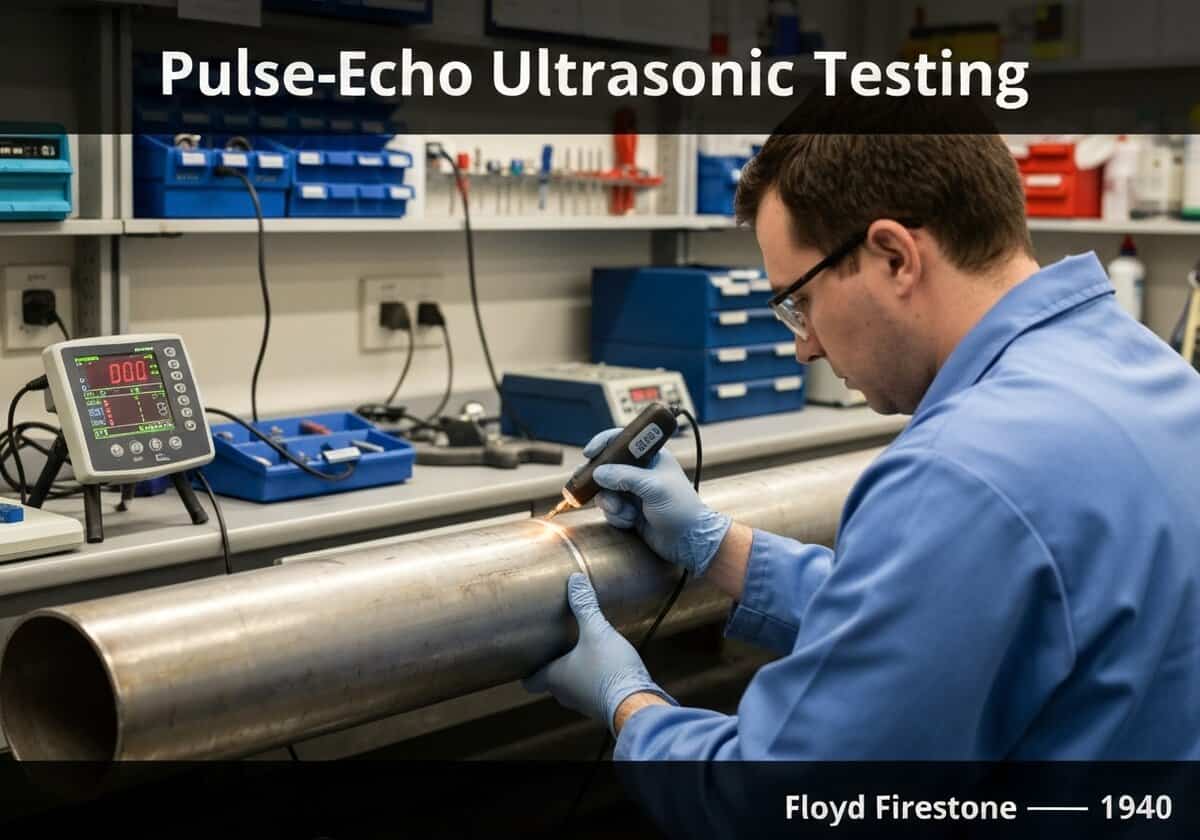
एक प्रयोगशाला में एक धातु के पाइप पर पल्स-इको अल्ट्रासोनिक परीक्षण करते हुए तकनीशियन।.

(यह छवि केवल उदाहरण के लिए बनाई गई है)

The pulse-echo method is the foundation of most ultrasonic testing. A transducer emits a short, high-frequency sound pulse into a material. This pulse travels until it hits a boundary or flaw, reflecting some energy back as an echo. The same transducer detects this echo, and the time-of-flight is used to calculate the reflector’s depth, enabling flaw detection and thickness measurement.

The pulse-echo technique operates on a simple principle of timing sound waves. A specialized device called a pulser-receiver generates a high-voltage electrical pulse. This pulse is sent to a transducer, which contains a piezoelectric element that vibrates in response, creating a high-frequency अल्ट्रासोनिक wave. This wave propagates through the test material. When it encounters an interface with a different ध्वनिक प्रतिबाध, such as a crack, void, or the back wall of the material, a portion of the wave’s energy is reflected.

The reflected wave, or echo, travels back to the transducer. The piezoelectric element converts this returning ध्वनिक energy back into an electrical signal. The receiver component of the pulser-receiver amplifies this weak signal. The system’s internal clock measures the precise time elapsed between the initial pulse transmission and the reception of the echo. This is known as the ‘time-of-flight’ (ToF).

परीक्षण किए जा रहे पदार्थ में ध्वनि का वेग (c) ज्ञात होने पर, परावर्तक तक की दूरी (d) की गणना निम्न सूत्र का उपयोग करके की जा सकती है: d = (c × ToF) / 2। दो से भाग देना आवश्यक है क्योंकि मापा गया समय परावर्तक तक ध्वनि के आने-जाने में लगने वाले समय को ध्यान में रखता है। परिणाम आमतौर पर स्क्रीन पर A-स्कैन के रूप में प्रदर्शित होते हैं, जो सिग्नल आयाम को समय के सापेक्ष दर्शाता है, जिससे एक प्रशिक्षित ऑपरेटर आंतरिक दोषों के स्थान, आकार और अभिविन्यास की पहचान कर सकता है।

UNESCO Nomenclature: 3322
सामग्री विज्ञान

Type

परीक्षण विधि

व्यवधान

क्रांतिकारी

उपयोग

व्यापक उपयोग

शगुन

  • sonar development for underwater detection
  • discovery of the piezoelectric effect by Jacques and Pierre Curie
  • fundamental understanding of sound wave propagation in solids
  • industrial need for internal flaw detection in manufacturing and infrastructure

आवेदन

  • weld inspection in critical structures
  • thickness gauging of pipes and tanks
  • medical ultrasonography for imaging organs
  • aerospace composite material inspection for delamination
  • संक्षारण mapping in the oil and gas industry

पेटेंट:

  • US2280226

संभावित नवाचार विचार

  • drone-based autonomous thickness gauging of large storage tanks
  • implantable bio-sensors for monitoring bone fracture healing in real-time
  • in-situ quality control for 3d metal printing using embedded transducers
  • handheld devices for homeowners to detect termites within walls
  • ultrasonic systems for monitoring food and beverage levels in sealed containers
  • non-invasive pipeline blockage detection for municipal water systems
  • पहनने योग्य technology to monitor muscle fatigue and strain in athletes
  • automated rail inspection systems mounted on high-speed trains
  • subsea robotic crawlers for inspecting underwater structures
  • acoustic analysis of fruit ripeness on automated harvesting lines
संबंधित विषय: पल्स-इको, अल्ट्रासोनिक परीक्षण, एनडीटी, दोष पहचान, टाइम-ऑफ-फ्लाइट, ट्रांसड्यूसर, परावर्तन, निरीक्षण, सामग्री परीक्षण, फ्लॉयड फायरस्टोन।

ऐतिहासिक संदर्भ

Pulse-Echo Ultrasonic Testing

1930
1934
1940
1940
1940
1940
1940
1930
1930
1940
1940
1940
1940
1940
1940

(यदि तिथि अज्ञात है या प्रासंगिक नहीं है, उदाहरण के लिए "द्रव यांत्रिकी", तो इसके उल्लेखनीय उद्भव का एक अनुमानित आंकड़ा प्रदान किया गया है)

नवीनतम परिवर्धन

शीर्ष पोस्ट और लेख

शीर्ष मूल उपकरण

10वां वर्ष सालगिरह

पंजीकृत सदस्यों के लिए पूर्ण आकार की छवियाँ और डाउनलोड 100% निःशुल्क उपलब्ध हैं।