Product Design, Manufacturing & Innovation Resources
Home » Ptolemy’s Theorem and Trigonometric Identities

Ptolemy’s Theorem and Trigonometric Identities

150
  • Claudius Ptolemy
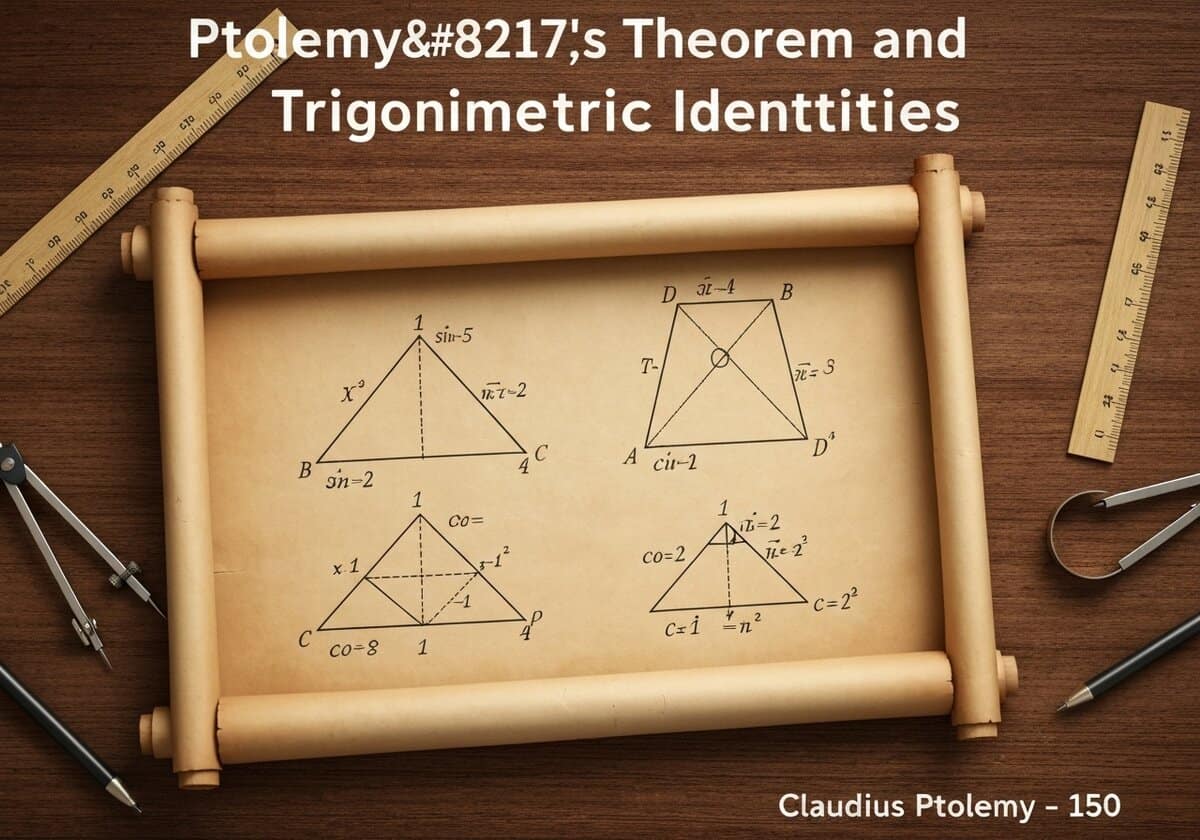
Ancient scroll depicting Ptolemy's Theorem with geometric diagrams for trigonometric identities.

(generated image for illustration only)

Ptolemy’s theorem provides an elegant geometric proof for the sum and difference formulas in trigonometry. By inscribing a quadrilateral in a circle with one side as the diameter, the side lengths can be expressed as sines and cosines of the inscribed angles. Applying the theorem \(AC \cdot BD = AB \cdot CD + BC \cdot DA\) directly yields identities like \(sin(alpha + beta) = \sin\alpha\cos\beta + \cos\alpha\sin\beta\).


The historical importance of Ptolemy’s theorem is deeply connected to the development of trigonometry. Ptolemy’s goal in the Almagest was to create a mathematical model of the cosmos, which required a tool to calculate the positions of celestial bodies. This tool was the table of chords, which listed the length of a chord subtending a given angle in a circle of a fixed radius. The chord function, crd(θ), is related to the modern sine function by \(\sin(\theta) = \frac{\text{crd}(2\theta)}{2R}\), where R is the circle’s radius.

To derive the sum and difference formulas, one can construct a cyclic quadrilateral ABCD where the diagonal AC is a diameter of the circumcircle, which we can set to have length 1 for simplicity. Let \(\angle CAD = \alpha\) and \(\angle CAB = \beta\). Because angles subtended by a diameter are right angles, \(\triangle ADC\) and \(\triangle ABC\) are right-angled triangles. The side lengths can be expressed trigonometrically: \(CD = \sin\alpha\), \(AD = \cos\alpha\), \(BC = \sin\beta\), and \(AB = \cos\beta\). The angle \(\angle DAB = \alpha+\beta\). Using the law of sines in \(\triangle DAB\), the other diagonal \(BD = \sin(\alpha+\beta)\). Plugging these into Ptolemy’s theorem \(AC \cdot BD = AB \cdot CD + BC \cdot DA\) gives \(1 \cdot \sin(\alpha+\beta) = (\cos\beta)(\sin\alpha) + (\sin\beta)(\cos\alpha)\), which is the angle addition formula for sine. Similar constructions yield the other sum and difference identities, forming the bedrock of trigonometry.

UNESCO Nomenclature: 1209
– Mathematical analysis

Type

Abstract System

Disruption

Foundational

Usage

Widespread Use

Precursors

  • Ptolemy’s theorem
  • definitions of sine and cosine (or chord function)
  • properties of inscribed angles in a circle
  • properties of right-angled triangles in a circle

Applications

  • trigonometry
  • astronomy (historical basis for chord tables)
  • signal processing (via fourier analysis which relies on these identities)
  • physics and engineering calculations involving waves and oscillations
  • computer graphics for rotation matrices

Patents:

NA

Potential Innovations Ideas

Due to scrapping bot traffic, currently more than 40k per day, this content is reserved to community members.
> Login < or > Register < (100% free) to access this, so as all other restricted content and tools.

Related to: trigonometry, angle addition formula, sine, cosine, Ptolemy’s theorem, table of chords, almagest, cyclic quadrilateral, geometric proof, astronomy.

Historical Context

Ptolemy’s Theorem and Trigonometric Identities

-300
-350
-500
150
1640
1650
1747
-300
-300
-400
-550
1635
1650
1736
1750

(if date is unknown or not relevant, e.g. "fluid mechanics", a rounded estimation of its notable emergence is provided)

Related Invention, Innovation & Technical Principles

Full size images and downloads are only available, 100% free, for registered members.

> Login <