Product Design, Manufacturing & Innovation Resources
Home » The Prime Number Theorem

The Prime Number Theorem

1896
  • Jacques Hadamard
  • Charles-Jean de la Vallée Poussin
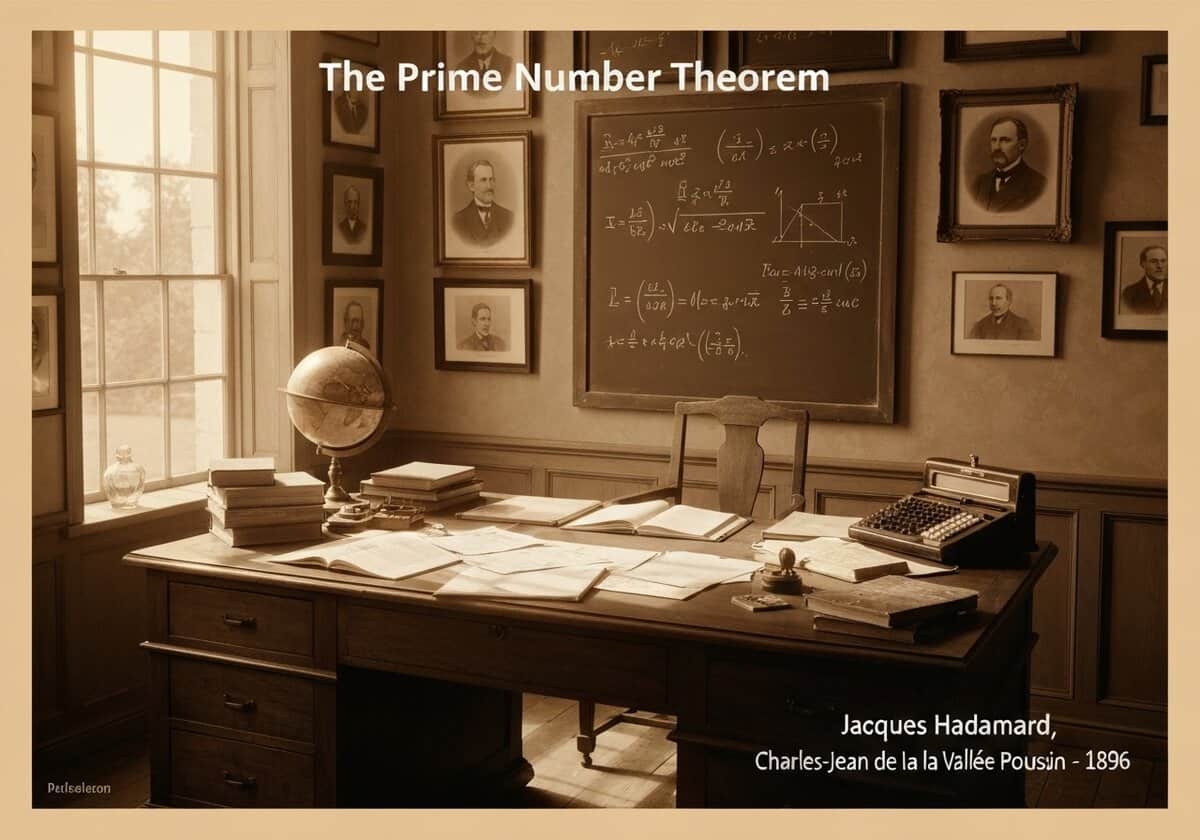
Vintage office with mathematical papers and antique calculator related to prime number theory.

(generated image for illustration only)

The Prime Number Theorem describes the asymptotic distribution of prime numbers among the integers. It states that the prime-counting function \(\pi(x)\), which gives the number of primes less than or equal to \(x\), is asymptotically equivalent to \(x / \ln(x)\). Formally, \(\lim_{x \to \infty} \frac{\pi(x)}{x/\ln(x)} = 1\). This provides a fundamental link between primes and the natural logarithm.

The Prime Number Theorem (PNT) is a cornerstone of number theory that provides an approximate description of how prime numbers are distributed. The prime-counting function, \(\pi(x)\), is a step function that jumps by 1 at each prime number. While the exact location of primes appears random, the PNT reveals a regular asymptotic behavior. The theorem doesn’t say that the difference between \(\pi(x)\) and \(x/\ln(x)\) is small, but rather that their ratio approaches 1 as \(x\) becomes arbitrarily large. This means that for a large number \(x\), the probability that a randomly chosen integer near \(x\) is prime is about \(1/\ln(x)\).

The idea was first conjectured in the late 18th century by Adrien-Marie Legendre (1798) and Carl Friedrich Gauss (1792), based on empirical evidence from tables of primes. They both proposed that \(\pi(x)\) is approximately \(x/(\ln(x) – C)\) for some constant C. However, proving this relationship required significant advances in mathematics, particularly in complex analysis. The first rigorous proofs were independently achieved by Jacques Hadamard and Charles-Jean de la Vallée Poussin in 1896. Their proofs were non-elementary, relying crucially on the properties of the Riemann zeta function in the complex plane, specifically showing it has no zeros on the line where the real part is 1.

UNESCO Nomenclature: 1208
– Number theory

Type

Abstract System

Disruption

Substantial

Usage

Widespread Use

Precursors

  • Euclid’s proof of the infinitude of primes (c. 300 BC)
  • Euler’s product formula connecting primes and the zeta function (1737)
  • Tables of prime numbers compiled by mathematicians
  • Legendre’s conjecture on prime density (1798)
  • Gauss’s conjecture on the logarithmic integral (1792)
  • Chebyshev’s work providing bounds for \(\pi(x)\) (1852)
  • Riemann’s 1859 paper on the zeta function

Applications

  • analytic number theory
  • cryptography (e.g., estimating the density of suitable primes for RSA)
  • theoretical computer science for analyzing algorithms involving primes
  • research into the Riemann hypothesis
  • development of sieve methods

Patents:

    Potential Innovations Ideas

    Due to scrapping bot traffic, currently more than 40k per day, this content is reserved to community members.
    > Login < or > Register < (100% free) to access this, so as all other restricted content and tools.

    Related to: prime number theorem, prime-counting function, asymptotic distribution, number theory, primes, Jacques Hadamard, Charles-Jean de la Vallée Poussin, Gauss, Legendre, analytic number theory.

    Historical Context

    The Prime Number Theorem

    1850
    1854
    1884
    1896
    1900
    1903
    1914
    1850
    1854
    1854
    1895
    1899
    1900
    1911
    1922

    (if date is unknown or not relevant, e.g. "fluid mechanics", a rounded estimation of its notable emergence is provided)

    Full size images and downloads are only available, 100% free, for registered members.

    > Login <