Product Design, Manufacturing & Innovation Resources
Home » Zermelo–Fraenkel Set Theory (ZFC)

Zermelo–Fraenkel Set Theory (ZFC)

1922
  • Ernst Zermelo
  • Abraham Fraenkel
  • Thoralf Skolem
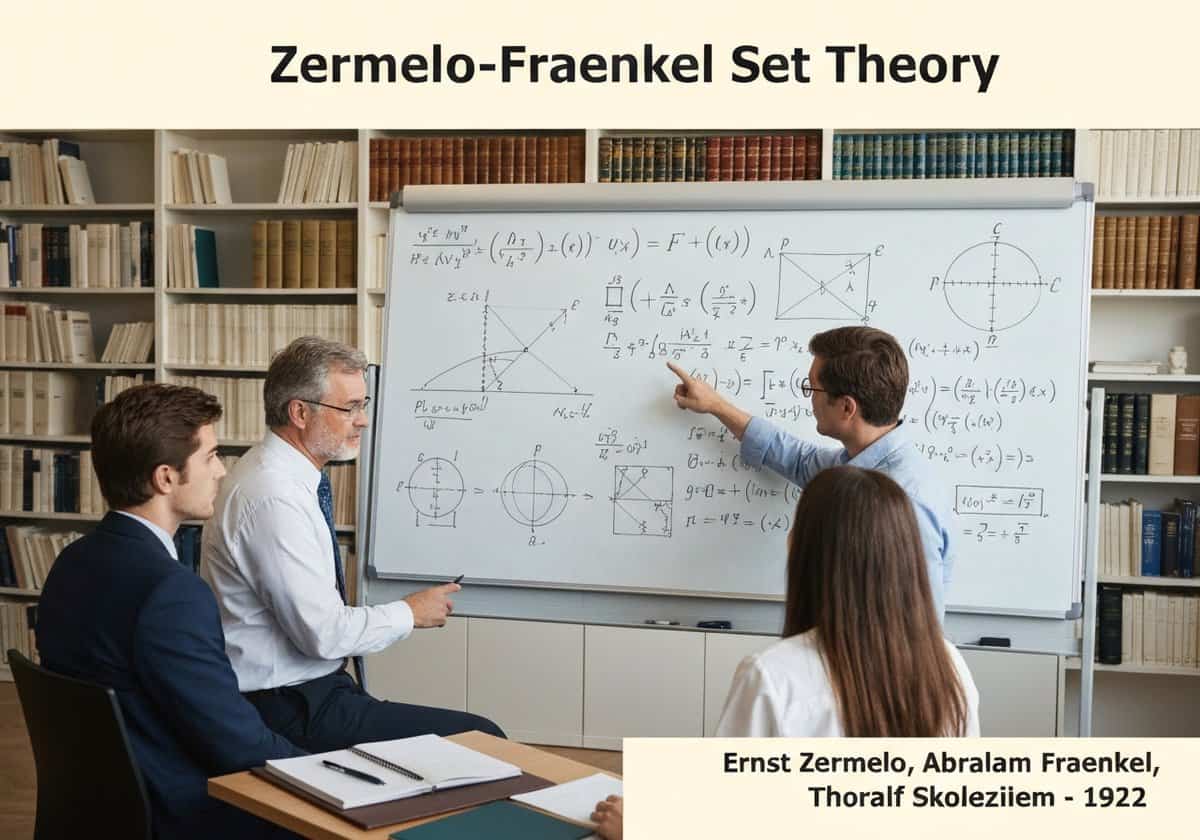
Mathematics office showcasing Zermelo–Fraenkel set theory discussions.

(generated image for illustration only)

Zermelo–Fraenkel set theory, commonly abbreviated as ZFC (with the axiom of choice), is the standard axiomatic system for contemporary mathematics. It consists of a collection of axioms, expressed in first-order logic, that formalize the properties of sets. Nearly all mathematical theorems in use today can be formulated and proven within ZFC.

ZFC was developed in the early 20th century to put set theory on a rigorous axiomatic footing, thereby avoiding paradoxes like Russell’s paradox that arose from naive set theory. The axioms define the universe of sets. Key axioms include the Axiom of Extensionality (two sets are equal if they have the same elements), the Axiom of Union (the union of the elements of a set is a set), the Axiom of Power Set (the set of all subsets of a set is a set), and the Axiom Schema of Specification (which allows defining a subset by a property). Abraham Fraenkel and Thoralf Skolem independently proposed the Axiom Schema of Replacement, which is more powerful and necessary for constructing certain large infinite sets. The ‘C’ in ZFC stands for the Axiom of Choice, a powerful and once-controversial axiom stating that for any collection of non-empty sets, it is possible to choose one element from each set. While most mathematicians accept ZFC as the standard foundation, its consistency cannot be proven within ZFC itself, a consequence of Gödel’s second incompleteness theorem.

UNESCO Nomenclature: 1201
– Logic

Type

Abstract System

Disruption

Foundational

Usage

Widespread Use

Precursors

  • Georg Cantor’s original (naive) set theory
  • Richard Dedekind’s work on the foundations of arithmetic
  • Discovery of paradoxes in naive set theory (e.g., Russell’s paradox)
  • Ernst Zermelo’s initial axiomatization of set theory (1908)

Applications

  • provides the foundational framework for virtually all modern mathematics
  • defines fundamental concepts like numbers, functions, and relations
  • used in formal verification and automated theorem proving
  • underpins fields like analysis, topology, and algebra

Patents:

NA

Potential Innovations Ideas

Due to scrapping bot traffic, currently more than 40k per day, this content is reserved to community members.
> Login < or > Register < (100% free) to access this, so as all other restricted content and tools.

Related to: ZFC, set theory, axiom of choice, foundations of mathematics, axiom, Zermelo, Fraenkel, first-order logic, Russell’s paradox, modern mathematics.

Historical Context

Zermelo–Fraenkel Set Theory (ZFC)

1899
1900
1911
1922
1925
1928
1930
1896
1900
1903
1914
1924
1925
1930
1931

(if date is unknown or not relevant, e.g. "fluid mechanics", a rounded estimation of its notable emergence is provided)

Related Invention, Innovation & Technical Principles

Full size images and downloads are only available, 100% free, for registered members.

> Login <