Product Design, Manufacturing & Innovation Resources
Home » Pitting Corrosion

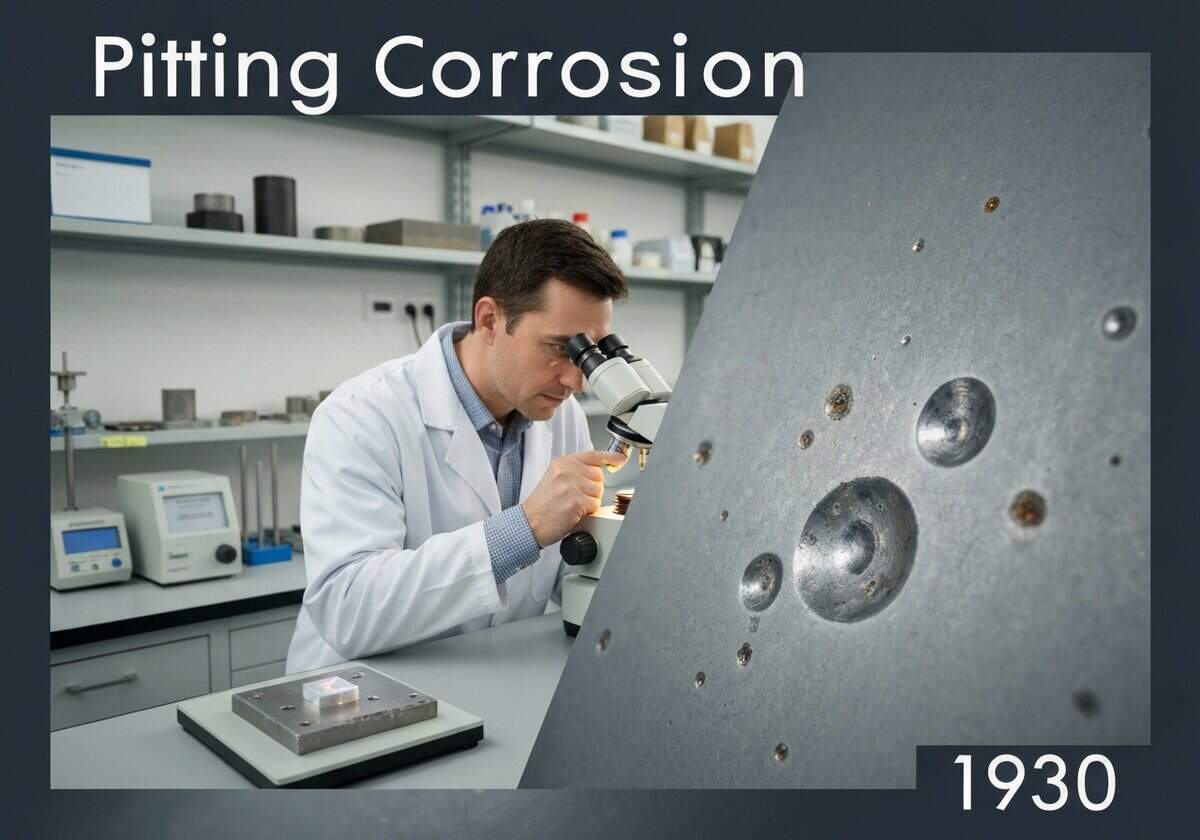
Pitting Corrosion

1930
Metal sample exhibiting pitting corrosion in a materials science laboratory.

(generated image for illustration only)

Pitting corrosion is a localized form of corrosion that leads to the creation of small holes, or ‘pits,’ in a metal. It is one of the most destructive forms because it is difficult to detect, predict, and design against. Pitting can cause catastrophic failure of a structure with only a small percentage of total mass loss.
Pitting is an autocatalytic process. It typically initiates at small surface defects, inclusions, or scratches, especially on passive metals like stainless steel or aluminum. The process begins with the local breakdown of the passive film, often triggered by aggressive anions, most notably chloride (\(Cl^-\)). Once the film is breached, an active corrosion cell is established. The small area of exposed metal becomes the anode, and the large surrounding passive surface becomes the cathode.

Inside the pit, metal dissolution occurs, for example \(Fe \\rightarrow Fe^{2+} + 2e^-\). The resulting positive metal ions attract negative chloride ions from the solution into the pit to maintain charge neutrality. This leads to the formation of metal chlorides, such as \(FeCl_2\), which then hydrolyze with water: \(FeCl_2 + 2H_2O \\rightarrow Fe(OH)_2 + 2HCl\). This reaction produces hydrochloric acid, which dramatically lowers the pH inside the pit, making the local environment highly acidic and aggressive. This increased acidity further accelerates metal dissolution and prevents the passive film from reforming, creating a self-sustaining cycle that causes the pit to grow deeper. The exterior surface remains protected, masking the severe damage occurring beneath.

UNESCO Nomenclature: 3314
– Materials science

Type

Chemical Process

Disruption

Substantial

Usage

Widespread Use

Precursors

  • Discovery and use of passive metals like stainless steel
  • Understanding of electrochemical cells and passivation
  • Increased use of materials in chloride-rich environments (e.g., marine, chemical industry)

Applications

  • failure analysis in chemical processing plants
  • inspection protocols for pipelines and storage tanks
  • materials selection for marine environments
  • design of medical implants to avoid in-vivo pitting

Patents:

NA

Potential Innovations Ideas

Due to scrapping bot traffic, currently more than 40k per day, this content is reserved to community members.
> Login < or > Register < (100% free) to access this, so as all other restricted content and tools.

Related to: pitting corrosion, localized corrosion, passive film, chloride, stainless steel, autocatalytic, failure analysis, corrosion pit.

Historical Context

Pitting Corrosion

1920
1922
1925-01-01
1930
1930
1930
1930
1920
1922
1924
1927
1930
1930
1930
1930

(if date is unknown or not relevant, e.g. "fluid mechanics", a rounded estimation of its notable emergence is provided)

Related Invention, Innovation & Technical Principles

Full size images and downloads are only available, 100% free, for registered members.

> Login <