Product Design, Manufacturing & Innovation Resources
Home » Phases of Clinical Trials

Phases of Clinical Trials

1960
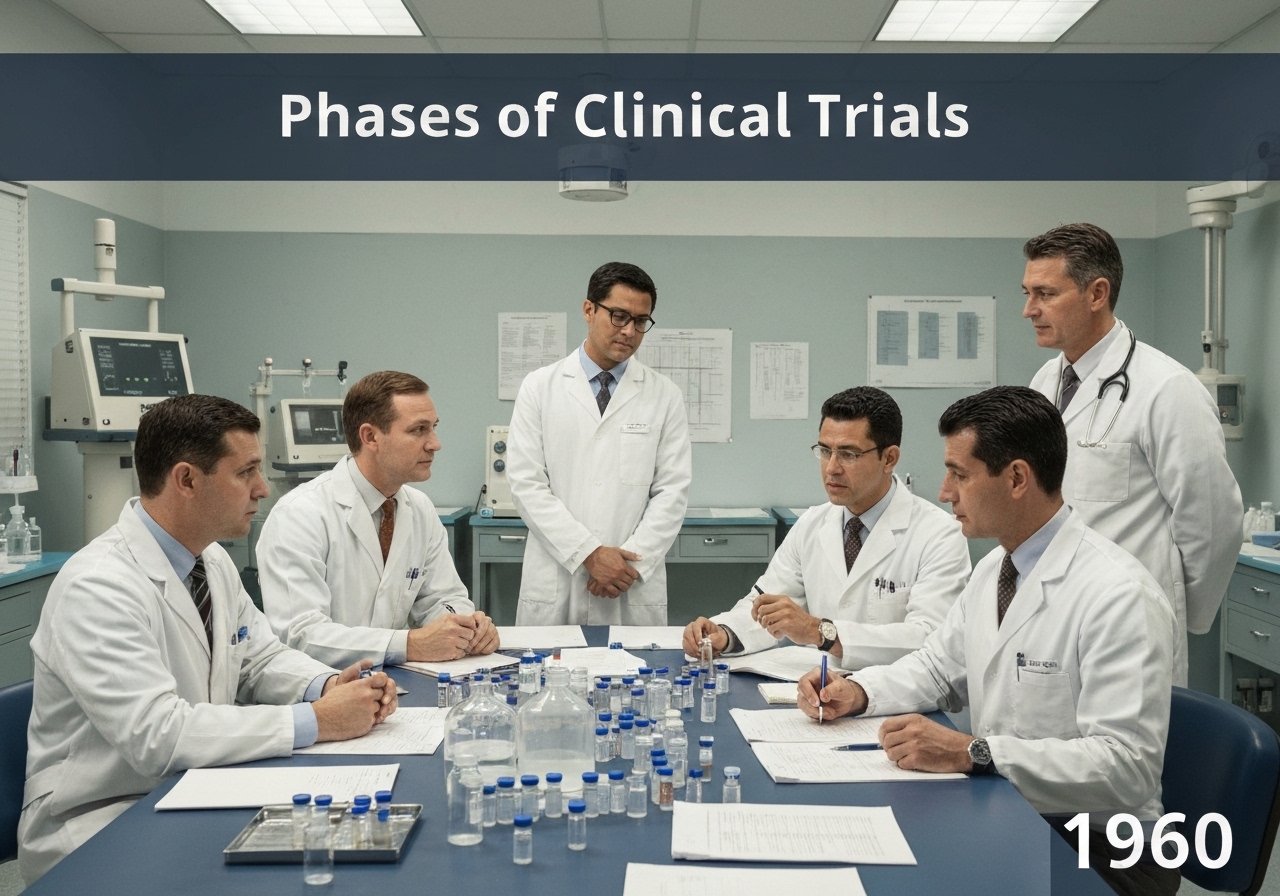
Clinical trial setting with researchers discussing drug development processes in pharmacology.

(generated image for illustration only)

Clinical trials for new drugs are conducted in a structured, multi-phase process. Phase I assesses safety and dosage in a small group of healthy volunteers. Phase II evaluates efficacy and side effects in a larger group of patients. Phase III confirms efficacy, monitors side effects, and compares it to standard treatments in a large patient population before regulatory submission. Each phase refines the risk benefit ratio of the treatment, and a trial can be stopped when that ratio becomes unfavorable.


The modern clinical trial system is a cornerstone of evidence-based medicine, designed to rigorously test the safety and efficacy of new therapeutic interventions before they are made widely available. The process begins after extensive preclinical research on animals and in vitro models suggests a compound is promising. Phase I trials are the first-in-human studies, typically involving 20-100 healthy volunteers. The primary goal is to determine the drug’s safety profile, including the safe dosage range and identifying acute side effects. Pharmacokinetics (how the body absorbs, distributes, metabolizes, and excretes the drug) is also a key focus. Phase II trials expand the study to several hundred patients who have the condition the drug is intended to treat. This phase aims to provide a preliminary assessment of the drug’s efficacy and to further evaluate its safety. Often, Phase II studies are randomized and include a placebo or standard treatment control group. Phase III trials are large-scale, pivotal studies involving several hundred to several thousand patients. These are typically multi-center, randomized, double-blind, controlled trials designed to provide the definitive evidence of the drug’s efficacy and safety required for regulatory approval. The data gathered in Phase III is used to compare the new drug against existing treatments or a placebo. If successful, the drug sponsor can file a New Drug Application (NDA) with regulatory bodies like the FDA. Phase IV, or post-marketing surveillance, occurs after the drug is approved and on the market. These studies monitor the drug’s long-term safety and effectiveness in a broad, diverse population, and can identify rare or long-term side effects not seen in the earlier, more controlled trials.

UNESCO Nomenclature: 3209
– Pharmacology

Type

Medical Procedure

Disruption

Foundational

Usage

Widespread Use

Precursors

  • james lind’s 1747 scurvy trial, one of the first controlled clinical experiments
  • the nuremberg code (1947) establishing ethical principles for human experimentation
  • the declaration of helsinki (1964) providing ethical guidelines for medical research involving human subjects
  • the 1962 kefauver harris amendment to the fd&c act, requiring proof of efficacy

Applications

  • development of all modern prescription drugs
  • approval process for vaccines
  • testing of new medical devices
  • post-market surveillance studies (phase iv)

Patents:

NA

Potential Innovations Ideas

  • adaptive clinical trial designs that modify parameters based on interim data
  • use of real-world evidence (rwe) from electronic health records to supplement trial data
  • decentralized clinical trials (dcts) using wearable tech and telemedicine
  • ai-powered patient recruitment and data analysis for faster trials
  • development of ‘digital twin’ patient models to simulate trial outcomes
  • platform trials testing multiple drugs for a single disease simultaneously
  • basket trials testing one drug on multiple diseases with a common biomarker
  • integration of genomic data for personalized trial enrollment
  • use of blockchain for secure and transparent trial data management
  • development of novel endpoints using digital biomarkers from sensors
Related to: clinical trials, phase i, phase ii, phase iii, drug development, fda, efficacy, safety, pharmacology, new drug application.

Historical Context

Phases of Clinical Trials

1960
1960
1969
1976-05-28
1980
1990
1960
1965
1970
1980
1980
1990

(if date is unknown or not relevant, e.g. "fluid mechanics", a rounded estimation of its notable emergence is provided)

10th year anniversary

Full size images and downloads are only available, 100% free, for registered members.

> Login <