Product Design, Manufacturing & Innovation Resources
Home » The Parallel Postulate (Euclid’s 5th postulate)

The Parallel Postulate (Euclid’s 5th postulate)

-300
  • Euclid of Alexandria
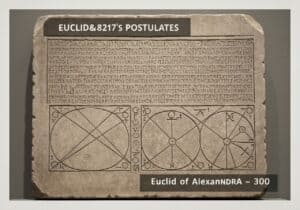
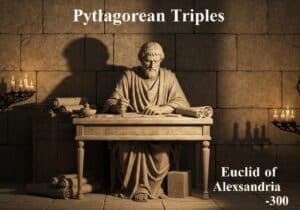
Carved stone tablet with Euclid's Parallel Postulate and geometric diagram.

(generated image for illustration only)

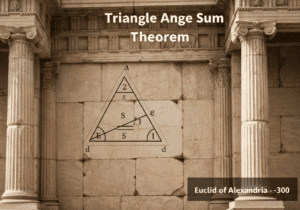
Euclid’s fifth postulate, the parallel postulate, is the axiom that defines Euclidean geometry: it states that if a line intersects two other lines, and the interior angles on one side sum to less than two right angles (\(\alpha + \beta < 180^\circ\)), then the two lines will eventually intersect on that side. This postulate guarantees a unique parallel line through a point not on a given line.
The Parallel Postulate is arguably the most influential single axiom in the history of geometry. Its perceived complexity compared to the other four led to over two millennia of attempts to prove it from them. This quest was ultimately futile, but it was not a failure. In the early 19th century, mathematicians began to consider the consequences of negating the postulate. This led to the development of two major forms of non-Euclidean geometry.

Hyperbolic geometry, developed by Lobachevsky and Bolyai, assumes that through a point not on a line, there are infinitely many lines parallel to the given line. In this geometry, the sum of angles in a triangle is less than 180 degrees. Elliptic (or Riemannian) geometry, developed by Riemann, assumes there are no parallel lines. Here, the sum of angles in a triangle is greater than 180 degrees. The surface of a sphere is a common model for elliptic geometry. The discovery that these consistent, alternative geometries could exist was a paradigm shift. It demonstrated that Euclidean geometry was not an absolute truth about physical space but one of several possible mathematical structures. This realization was crucial for the development of Albert Einstein’s theory of general relativity, which models spacetime as a curved, non-Euclidean manifold.

UNESCO Nomenclature: 1204
– Geometry

Type

Abstract System

Disruption

Foundational

Usage

Widespread Use

Precursors

  • Thales’s work on geometry
  • Pythagorean mathematics
  • Plato’s emphasis on axiomatic systems
  • Earlier Greek geometric concepts of lines and angles

Applications

  • urban grid planning
  • perspective drawing in art
  • computer-aided design (CAD) for mechanical parts
  • surveying and cartography
  • robotics path planning on flat surfaces

Patents:

NA

Potential Innovations Ideas

Due to scrapping bot traffic, currently more than 40k per day, this content is reserved to community members.
> Login < or > Register < (100% free) to access this, so as all other restricted content and tools.

Related to: parallel postulate, Euclid’s fifth postulate, non-Euclidean geometry, Playfair’s axiom, hyperbolic geometry, elliptic geometry, axioms, geometry.

Historical Context

The Parallel Postulate (Euclid’s 5th postulate)

-300
-300
-350
-500
150
1640
1650
-300
-300
-300
-400
-550
1635
1650
1736

(if date is unknown or not relevant, e.g. "fluid mechanics", a rounded estimation of its notable emergence is provided)

Related Invention, Innovation & Technical Principles

Full size images and downloads are only available, 100% free, for registered members.

> Login <