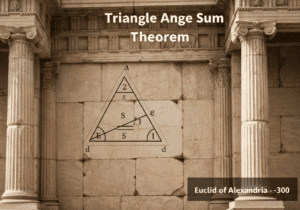
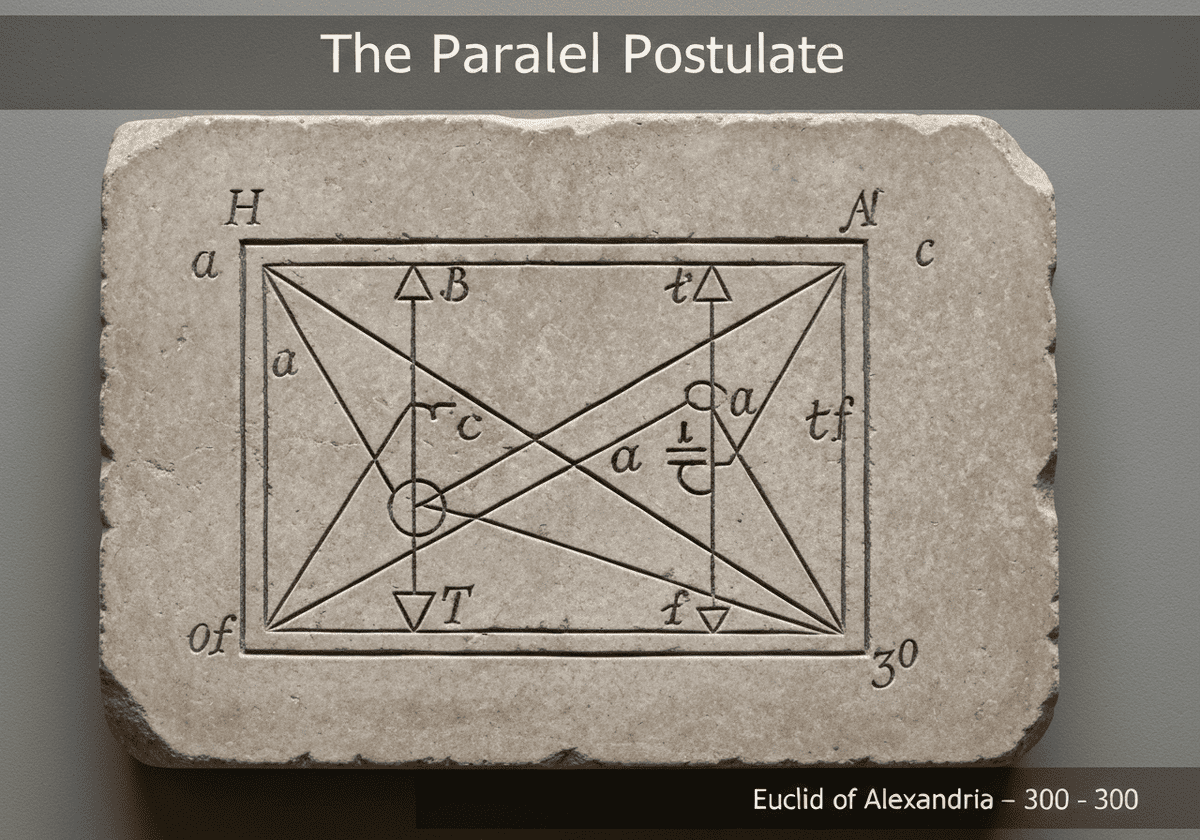
Hyperbolic geometry, developed by Lobachevsky and Bolyai, assumes that through a point not on a line, there are infinitely many lines parallel to the given line. In this geometry, the sum of angles in a triangle is less than 180 degrees. Elliptic (or Riemannian) geometry, developed by Riemann, assumes there are no parallel lines. Here, the sum of angles in a triangle is greater than 180 degrees. The surface of a sphere is a common model for elliptic geometry. The discovery that these consistent, alternative geometries could exist was a paradigm shift. It demonstrated that Euclidean geometry was not an absolute truth about physical space but one of several possible mathematical structures. This realization was crucial for the development of Albert Einstein’s theory of general relativity, which models spacetime as a curved, non-Euclidean manifold.