Product Design, Manufacturing & Innovation Resources
Home » Osseointegration of Titanium Implants

Osseointegration of Titanium Implants

1965
  • Per-Ingvar Brånemark
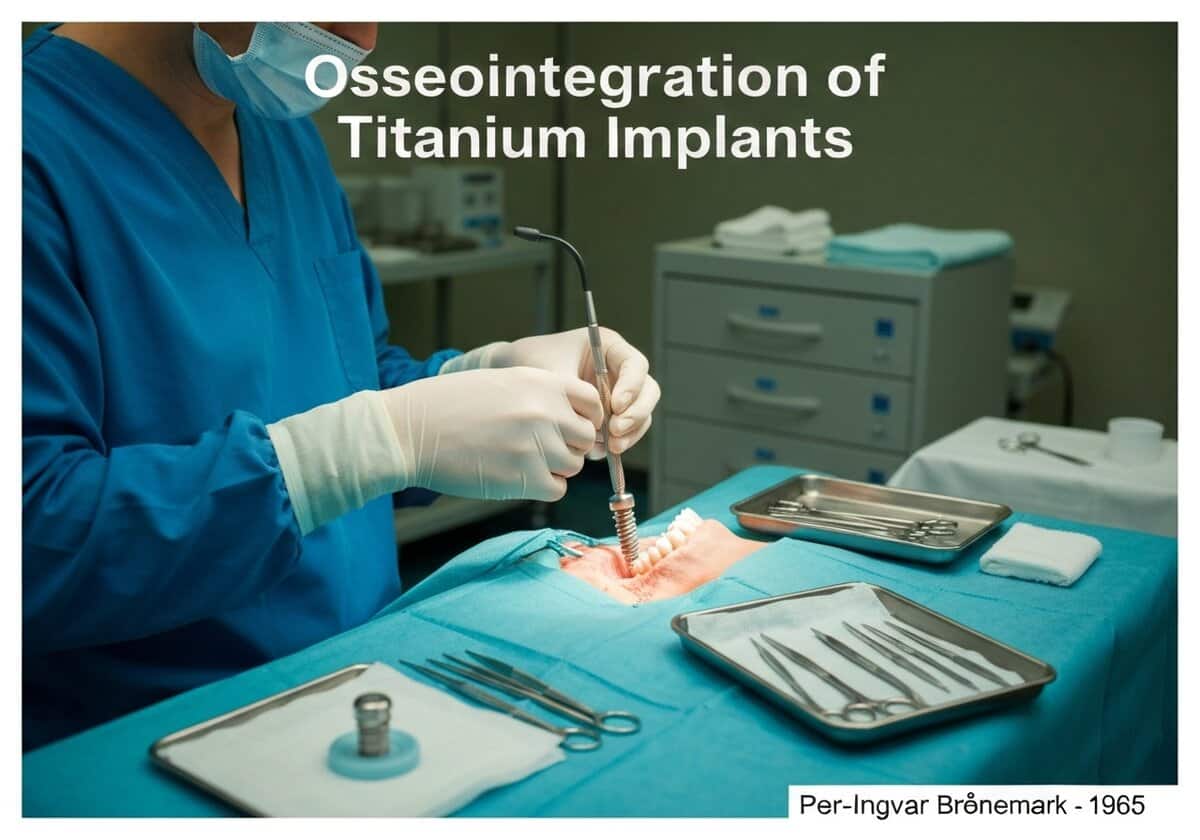
Surgical placement of titanium dental implant demonstrating osseointegration in biomedical engineering.

(generated image for illustration only)

Osseointegration is the direct structural and functional connection between living bone and the surface of a load-bearing artificial implant, typically made of titanium. Discovered by Per-Ingvar Brånemark, this phenomenon occurs without the growth of fibrous soft tissue at the bone-implant interface, creating a stable and lasting anchor for prosthetics like dental implants and artificial joints.

The discovery of osseointegration was serendipitous. In the 1950s, Per-Ingvar Brånemark was studying blood flow in rabbit fibula using an optical chamber with a titanium frame. When he tried to remove the chamber, he found the bone had grown so intimately into the titanium that it was impossible to separate. This led to the realization that titanium, unlike other materials, was not rejected by the body and could fuse directly with bone. The key to this process is the formation of a titanium dioxide layer on the implant’s surface upon exposure to air. This oxide layer is highly biocompatible and allows bone-forming cells, or osteoblasts, to attach and deposit new bone matrix directly onto the implant surface. For successful osseointegration, several conditions must be met: the implant must be made of a biocompatible material (like commercially pure titanium), it must be machined with a specific surface topography, it must be placed with minimal trauma to the bone, and it must remain immobile and unloaded during the initial healing period. This process has revolutionized dentistry and orthopedics, providing a stable foundation for replacing missing teeth and limbs with a high degree of success and longevity.

UNESCO Nomenclature: 3201
– Biomedical engineering

Type

Biological Process

Disruption

Revolutionary

Usage

Widespread Use

Precursors

  • discovery of titanium by william gregor in 1791
  • development of sterile surgical techniques
  • advances in microscopy to observe tissue-implant interfaces
  • research into bone healing and regeneration

Applications

  • dental implants
  • bone-anchored hearing aids (BAHA)
  • joint replacement prostheses (hip, knee)
  • amputation prosthetics attached directly to bone
  • craniofacial prosthetics for facial reconstruction

Patents:

  • US4172320A

Potential Innovations Ideas

Due to scrapping bot traffic, currently more than 40k per day, this content is reserved to community members.
> Login < or > Register < (100% free) to access this, so as all other restricted content and tools.

Related to: osseointegration, titanium, Per-Ingvar Brånemark, dental implant, bone integration, biocompatibility, prosthesis, orthopedics, titanium dioxide, osteoblast.

Historical Context

Osseointegration of Titanium Implants

1960
1965
1970
1980
1980
1990
1960
1960
1969
1976-05-28
1980
1990

(if date is unknown or not relevant, e.g. "fluid mechanics", a rounded estimation of its notable emergence is provided)

Related Invention, Innovation & Technical Principles

Full size images and downloads are only available, 100% free, for registered members.

> Login <