Noether’s Theorem and Translational Symmetry
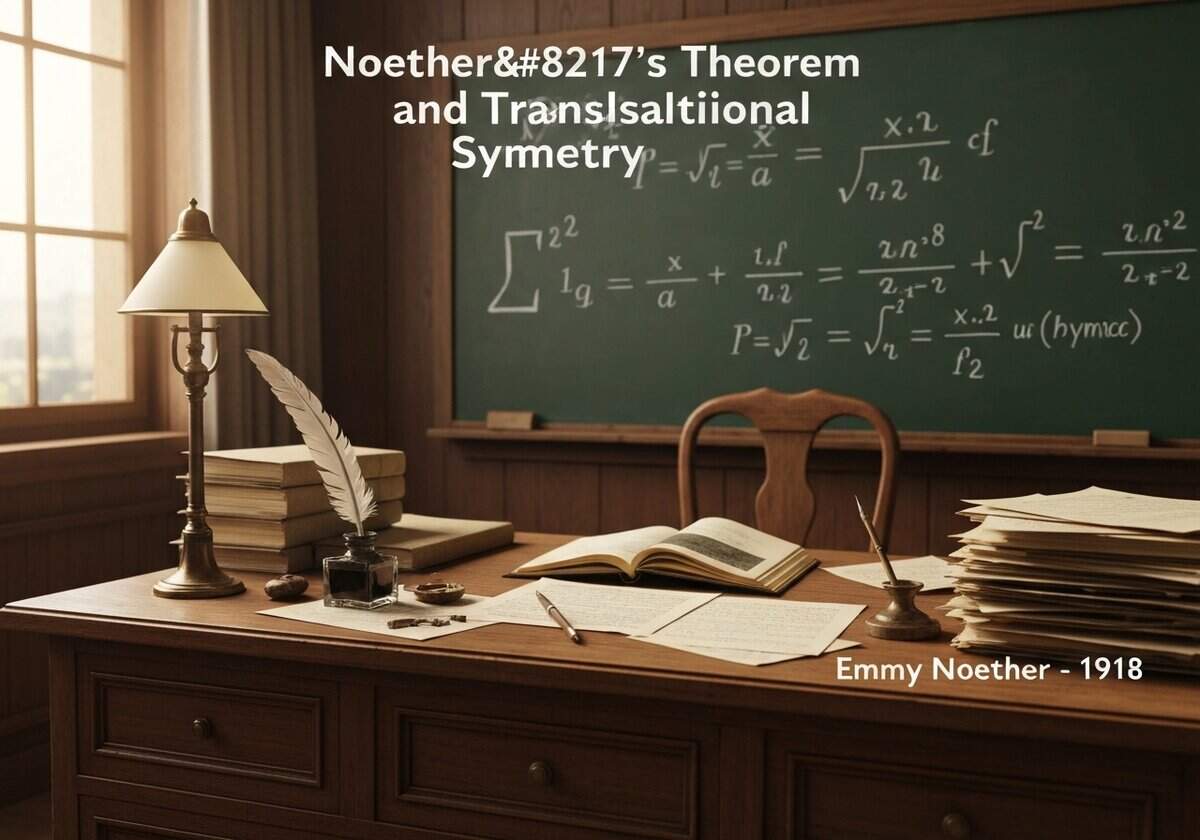
The conservation of momentum is a direct consequence of the homogeneity of space, meaning the laws of physics are invariant under spatial translation. This profound connection is formalized by Noether’s theorem: for every continuous symmetry of a physical system, there exists a corresponding conserved quantity. Translational symmetry implies that the Lagrangian of the system is unchanged by a shift in coordinates.
Emmy Noether’s 1918 theorem provides a deep and elegant connection between symmetries and conservation laws in physics. It is a cornerstone of modern theoretical physics. The theorem states that if a system’s action is invariant under a continuous group of transformations (a symmetry), then there is a corresponding quantity that is conserved over time.
In the context of momentum, the relevant symmetry is translational invariance. This means that if you shift the entire physical system by a constant vector, the laws governing its behavior do not change. The Lagrangian, \(L(q, \dot{q})\), which describes the dynamics of the system, remains unchanged under such a transformation. Applying Noether’s theorem to this specific symmetry of spatial translation directly yields the law of conservation of linear momentum.
This perspective elevates the conservation of momentum from a mere consequence of Newton’s laws to a fundamental principle rooted in the structure of spacetime itself. Similarly, Noether’s theorem shows that conservation of energy arises from time-translation symmetry, and conservation of angular momentum arises from rotational symmetry. This framework is essential in fields beyond classical mechanics, including quantum mechanics and general relativity, where it provides a powerful tool for identifying conserved quantities.
UNESCO Nomenclature: 2209
– Mechanics
Precursors
- Principle of least action
- Lagrangian mechanics (Joseph-Louis Lagrange)
- Hamiltonian mechanics (William Rowan Hamilton)
- David Hilbert’s work on the foundations of physics
Applications
- fundamental particle physics (standard model)
- general relativity
- quantum field theory
- lagrangian and hamiltonian mechanics
- solid-state physics (crystal lattices)
Potential Innovations Ideas
Due to scrapping bot traffic, currently more than 40k per day, this content is reserved to community members.
> Login < or > Register < (100% free) to access this, so as all other restricted content and tools.
Related to: Noether’s theorem, symmetry, conservation law, translational invariance, Lagrangian mechanics, theoretical physics, spacetime, homogeneity, conserved quantity, action principle.