Satz von Noether und Translationssymmetrie
Der Impulserhaltung is a direct consequence of the homogeneity of space, meaning the laws of physics are invariant under spatial translation. This profound connection is formalized by Noether’s theorem: for every continuous symmetry of a physical system, there exists a corresponding conserved quantity. Translational symmetry implies that the Lagrange-Funktion of the system is unchanged by a shift in coordinates.
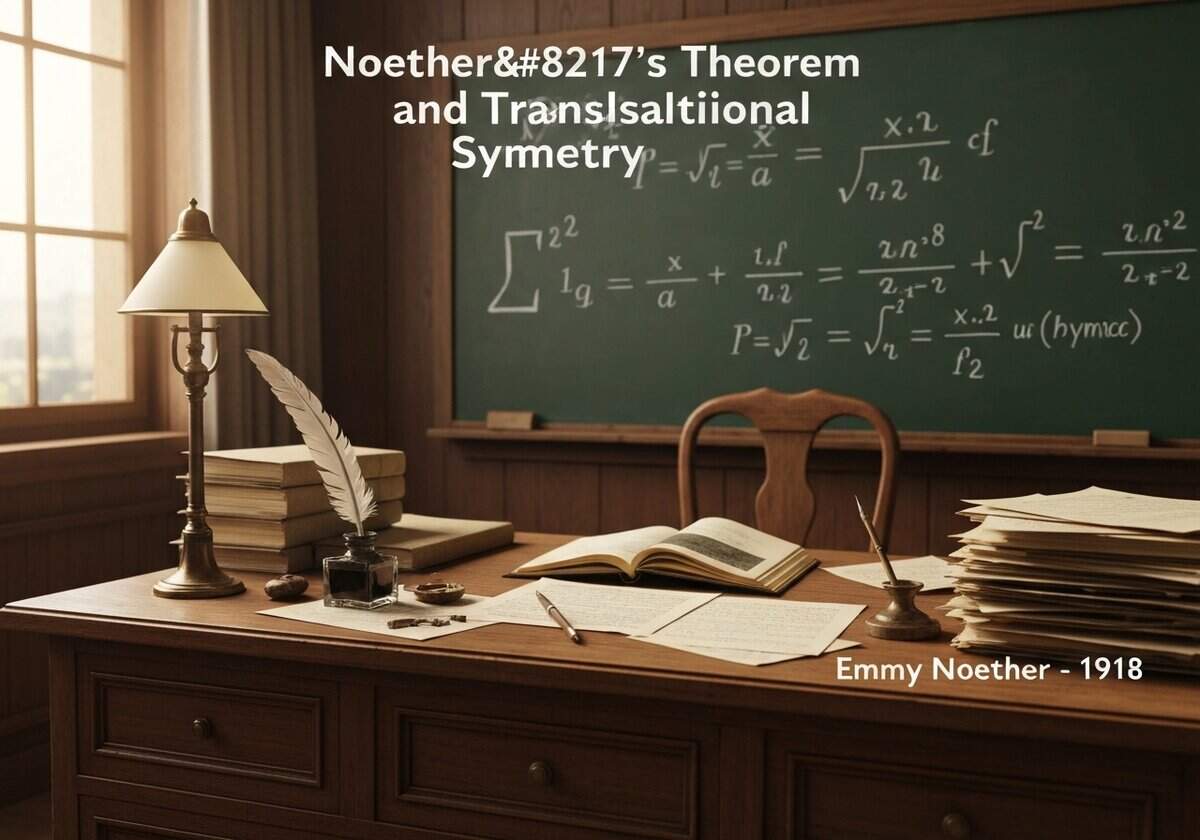
Emmy Noether’s 1918 theorem provides a deep and elegant connection between symmetries and conservation laws in physics. It is a cornerstone of modern theoretical physics. The theorem states that if a system’s action is invariant under a continuous group of transformations (a symmetry), then there is a corresponding quantity that is conserved over time.
In the context of momentum, the relevant symmetry is translational invariance. This means that if you shift the entire physical system by a constant vector, the laws governing its behavior do not change. The Lagrangian, [latex]L(q, \dot{q})[/latex], which describes the dynamics of the system, remains unchanged under such a transformation. Applying Noether’s theorem to this specific symmetry of spatial translation directly yields the law of conservation of linear momentum.
This perspective elevates the conservation of momentum from a mere consequence of Newton’s laws to a fundamental principle rooted in the structure of spacetime itself. Similarly, Noether’s theorem shows that conservation of energy arises from time-translation symmetry, and conservation of angular momentum arises from rotational symmetry. This framework is essential in fields beyond classical mechanics, including quantum mechanics and general relativity, where it provides a powerful tool for identifying conserved quantities.
UNESCO Nomenclature: 2209
- Mechanik
Verwendung
Weitverbreitete Verwendung
Vorläufer
- Prinzip der geringsten Wirkung
- Lagrangesche Mechanik (Joseph-Louis Lagrange)
- Hamiltonsche Mechanik (William Rowan Hamilton)
- David Hilbert’s work on the foundations of physics
Anwendungen
- fundamentale Teilchenphysik (Standardmodell)
- Allgemeine Relativitätstheorie
- Quantenfeldtheorie
- Lagrange- und Hamilton-Mechanik
- Festkörperphysik (Kristallgitter)
Potenzielle Innovationsideen
Aufgrund des hohen Datenverkehrs durch Web-Scraping-Bots, der derzeit mehr als 40.000 Anfragen pro Tag umfasst, ist dieser Inhalt ausschließlich Community-Mitgliedern vorbehalten.
> Anmelden < oder > Registrieren < (100% kostenlos) Zugriff darauf sowie auf alle anderen eingeschränkten Inhalte und Tools.
Related to: Noether’s theorem, symmetry, conservation law, translational invariance, Lagrangian mechanics, theoretical physics, spacetime, homogeneity, conserved quantity, action principle.