Product Design, Manufacturing & Innovation Resources
Home » Natural Killer (NK) Cell Cytotoxicity

Natural Killer (NK) Cell Cytotoxicity

1975
  • Rolf Kiessling
  • Eva Klein
  • Hans Wigzell
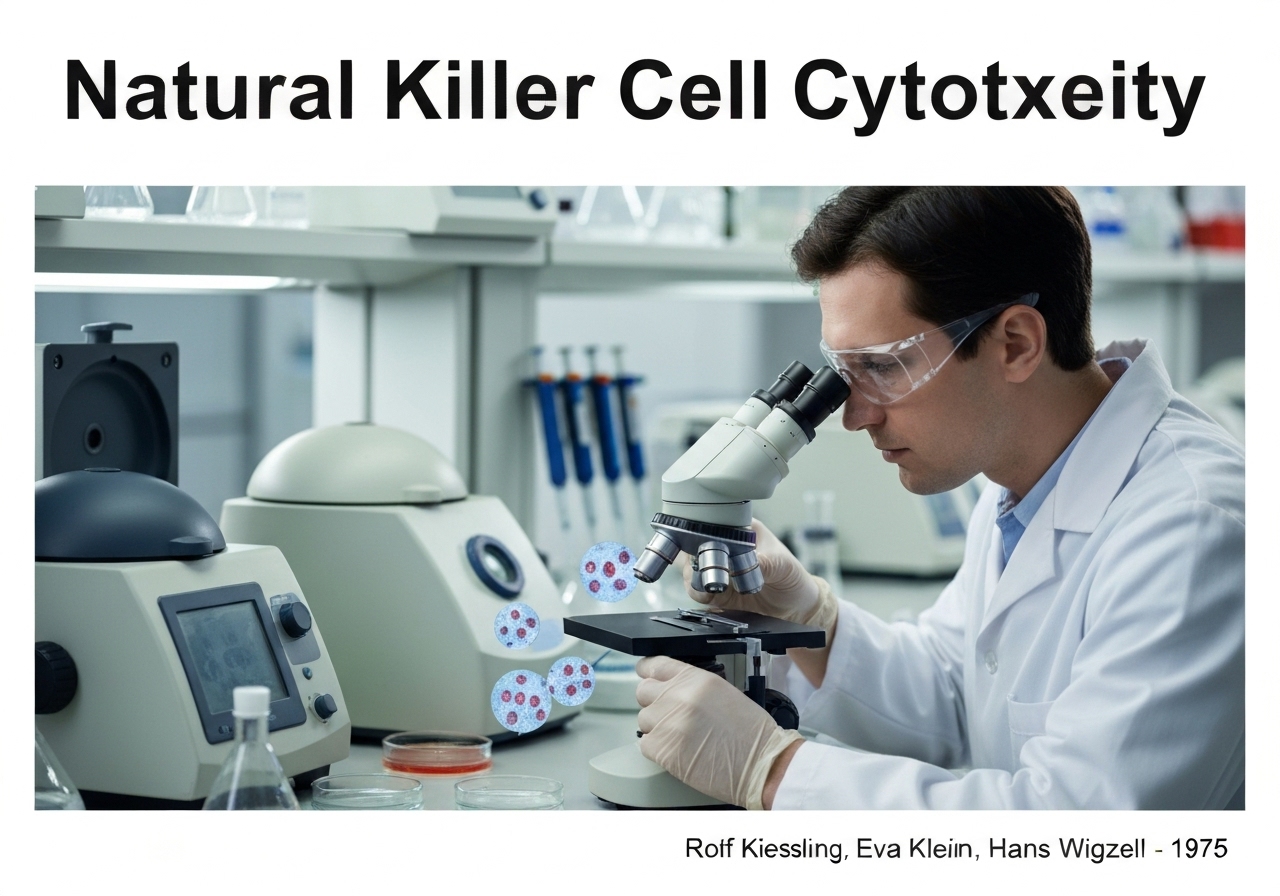
Natural Killer cells in a laboratory setting, examining cytotoxicity mechanisms.

(generated image for illustration only)

Natural Killer (NK) cells are cytotoxic lymphocytes of the innate immune system, critical for early defense against viral infections and cancer. Unlike T cells, they do not require prior sensitization. NK cells identify and kill target cells that have downregulated MHC class I molecules—a common immune evasion tactic by tumors and viruses—through a “missing-self” recognition mechanism, inducing apoptosis via perforin and granzymes.

Natural Killer (NK) cells provide a rapid, first-line defense against cellular threats. Their function is governed by a balance of signals from activating and inhibitory receptors on their surface. Healthy cells express MHC class I molecules, which are recognized by inhibitory receptors on NK cells (like KIRs and NKG2A). This interaction sends a strong “don’t kill me” signal, preventing the NK cell from attacking. This is known as “missing-self” recognition: the absence of the ‘self’ MHC class I signal is what triggers the attack.

When a cell becomes cancerous or is infected by certain viruses, it often reduces the expression of MHC class I molecules to evade detection by cytotoxic T cells. This, however, makes it a prime target for NK cells. The lack of an inhibitory signal, often coupled with the presence of stress-induced ligands recognized by activating NK cell receptors (like NKG2D), tips the balance towards activation. Once activated, the NK cell’s cytotoxic mechanism is very similar to that of a CTL. It releases perforin and granzymes to induce apoptosis in the target cell. NK cells can also induce cell death through other pathways, such as the Fas/FasL interaction, and are key players in antibody-dependent cell-mediated cytotoxicity (ADCC), where they kill target cells coated with antibodies.

UNESCO Nomenclature: 2415
– Immunology

Type

Biological Mechanism

Disruption

Substantial

Usage

Widespread Use

Precursors

  • distinction between innate and adaptive immunity
  • identification of lymphocytes as key immune cells
  • discovery of interferons and their role in antiviral defense
  • development of in vitro cell killing assays
  • understanding of tumor immune evasion mechanisms

Applications

  • NK cell-based cancer immunotherapies
  • therapies for viral infections
  • monitoring immune status in patients
  • understanding pregnancy immunology (NK cells are abundant in the uterus)
  • development of antibody-dependent cell-mediated cytotoxicity (ADCC) drugs

Patents:

NA

Potential Innovations Ideas

Due to scrapping bot traffic, currently more than 40k per day, this content is reserved to community members.
> Login < or > Register < (100% free) to access this, so as all other restricted content and tools.

Related to: natural killer cell, NK cell, innate immunity, missing-self recognition, MHC class I, immunology, cancer surveillance, perforin, granzyme, ADCC.

Historical Context

Natural Killer (NK) Cell Cytotoxicity

1960
1967
1970
1975
1977
1983
1987
1958
1960
1970
1973
1975
1979
1983
1988

(if date is unknown or not relevant, e.g. "fluid mechanics", a rounded estimation of its notable emergence is provided)

Related Invention, Innovation & Technical Principles

Full size images and downloads are only available, 100% free, for registered members.

> Login <