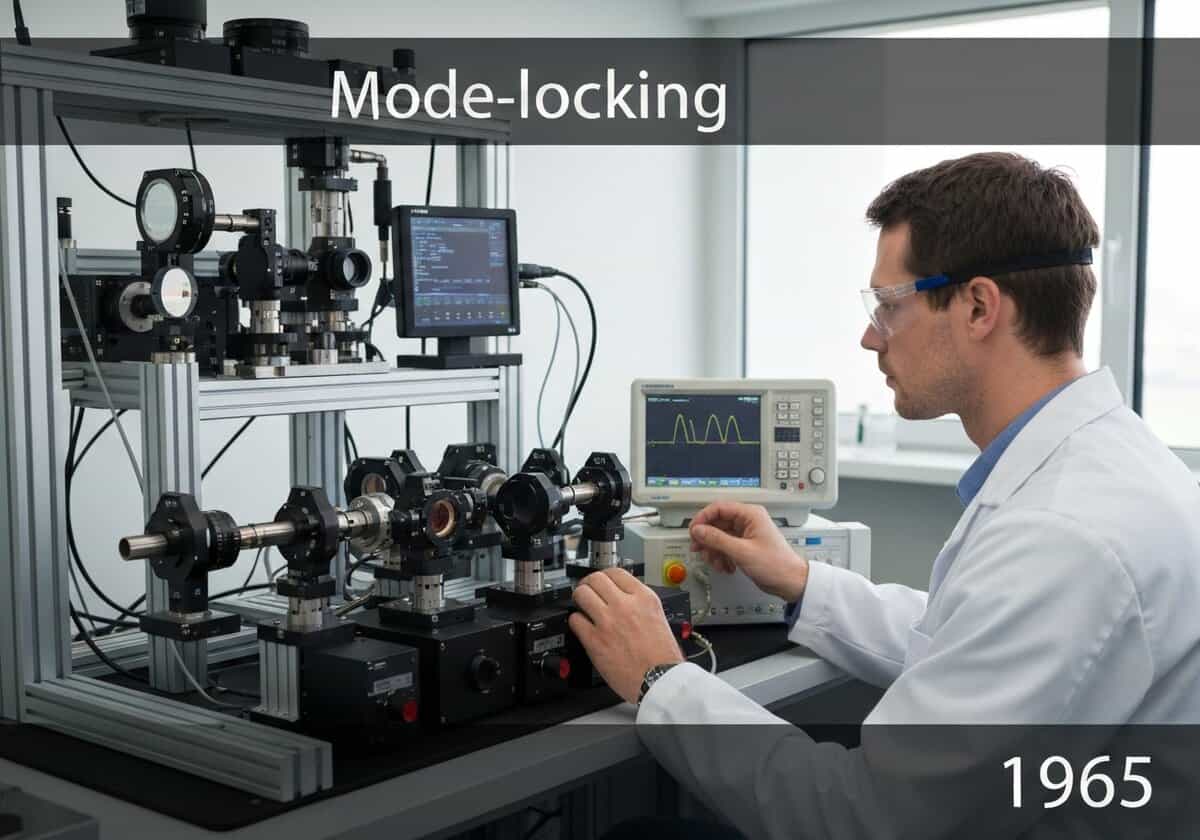
モード同期は、ピコ秒(10⁻¹²秒)からフェムト秒(10⁻¹⁵秒)オーダーの極めて短いレーザーパルスを生成する技術です。この技術は、レーザー共振器内の多数の縦モードを一定の位相関係で振動させることによって機能します。これにより、モードが建設的に干渉し、共振器内を循環する単一の強力な超短パルスが生成されます。

(画像はイメージです)
モード同期は、ピコ秒(10⁻¹²秒)からフェムト秒(10⁻¹⁵秒)オーダーの極めて短いレーザーパルスを生成する技術です。この技術は、レーザー共振器内の多数の縦モードを一定の位相関係で振動させることによって機能します。これにより、モードが建設的に干渉し、共振器内を循環する単一の強力な超短パルスが生成されます。
一般的なレーザー共振器は、それぞれ特定の共振周波数に対応する複数の縦モードをサポートします。通常の自由発振レーザーでは、これらのモードはランダムな位相で独立して振動します。モード同期は、これらのモードの位相を同期させます。モードが同位相になると、時間と空間のある一点で建設的に干渉し、強力で短いパルスを形成します。それ以外のすべての時間では、モードは破壊的に干渉し、強度はほぼゼロになります。その結果、レーザー共振器内を循環する超短パルス列が生成され、往復ごとに1つのパルスが出力カプラから放出されます。
The duration of a mode-locked pulse is inversely proportional to the spectral bandwidth of the gain medium. A wider gain bandwidth supports more longitudinal modes, which can be locked to create a shorter pulse. This is governed by the Fourier uncertainty principle: [latex]\Delta t \Delta u \ge K[/latex], where [latex]\Delta t[/latex] is the pulse duration, [latex]\Delta u[/latex] is the spectral bandwidth, and K is a constant near unity. Techniques for achieving mode-locking can be active (using an external modulator like an acousto-optic modulator) or passive (using a saturable absorber, a material whose absorption decreases at high light intensity). Passive mode-locking, particularly Kerr-lens mode-locking, has produced the shortest pulses to date, reaching the attosecond ([latex]10^{-18}[/latex] s) regime.
ボットによるトラフィック(現在1日あたり4万件以上)を排除するため、このコンテンツはコミュニティメンバー限定となっています。
> ログイン < または > 登録 < (100%無料)でこれにアクセスできます。他のすべての制限付きコンテンツとツールも同様です。
モード同期(レーザー)
(日付が不明または関連性がない場合、例えば「流体力学」などでは、その注目すべき出現時期の概算値が提示されます。)
フルサイズの画像とダウンロードは、登録会員のみが100%無料で利用できます。
> ログイン <