Product Design, Manufacturing & Innovation Resources
Casa » Mode-locking (lasers)

Mode-locking (lasers)

1965
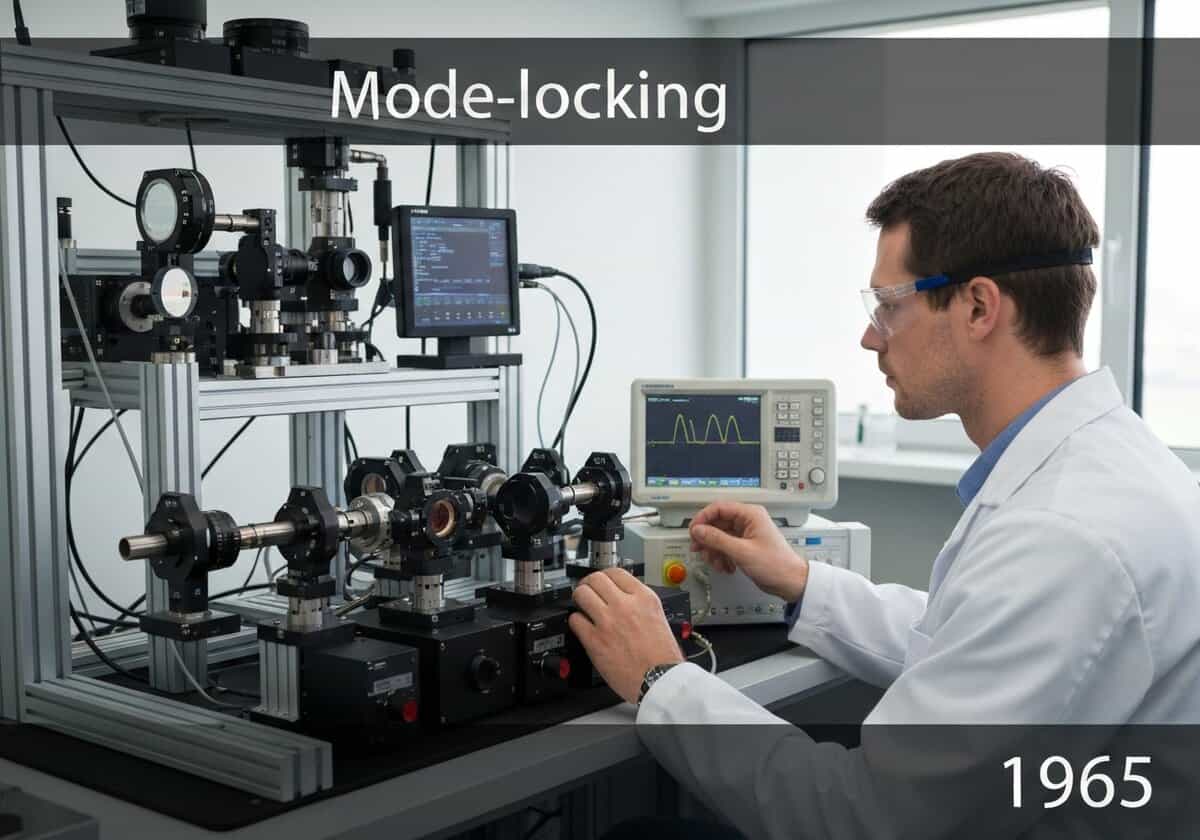
Sistema laser a bloccaggio di modalità in un moderno laboratorio di ottica.

(Immagine generata a solo scopo illustrativo)

Il mode-locking è una tecnica per produrre impulsi laser estremamente brevi, dell'ordine dei picosecondi ([latex]10^{-12}[/latex] s) e dei femtosecondi ([latex]10^{-15}[/latex] s). Funziona forzando i numerosi modi longitudinali della cavità laser a oscillare con una relazione di fase fissa. Questo fa sì che i modi interferiscano in modo costruttivo, creando un singolo impulso intenso e ultracorto che circola nella cavità.
A typical laser cavity supports multiple longitudinal modes, each corresponding to a specific resonant frequency. In a normal, free-running laser, these modes oscillate independently with random phases. Mode-locking synchronizes the phases of these modes. When the modes are locked in phase, they interfere constructively at one point in time and space, forming an intense, short pulse. At all other times, they interfere destructively, resulting in near-zero intensity. The result is a train of ultrashort pulses circulating within the laser cavity, with one pulse emitted from the output coupler for each round trip.

The duration of a mode-locked pulse is inversely proportional to the spectral bandwidth of the gain medium. A wider gain bandwidth supports more longitudinal modes, which can be locked to create a shorter pulse. This is governed by the Fourier uncertainty principle: [latex]\Delta t \Delta u \ge K[/latex], where [latex]\Delta t[/latex] is the pulse duration, [latex]\Delta u[/latex] is the spectral bandwidth, and K is a constant near unity. Techniques for achieving mode-locking can be active (using an external modulator like an acousto-optic modulator) or passive (using a saturable absorber, a material whose absorption decreases at high light intensity). Passive mode-locking, particularly Kerr-lens mode-locking, has produced the shortest pulses to date, reaching the attosecond ([latex]10^{-18}[/latex] s) regime.

UNESCO Nomenclature: 2210
- Ottica

Tipo

Tecnica

Interruzione

Sostanziale

Utilizzo

Uso diffuso

Precursori

  • invention of the laser
  • understanding of laser longitudinal modes
  • development of fast optical modulators and nonlinear optical materials
  • fourier analysis of wave superposition

Applicazioni

  • femtochemistry
  • multiphoton microscopy
  • optical frequency combs for metrology
  • terahertz generation
  • ultrafast spectroscopy
  • laser eye surgery (femtosecond lasik)

Brevetti:

NA

Idee e potenziali innovazioni

A causa dell'eliminazione del traffico generato dai bot, che attualmente supera i 40.000 al giorno, questo contenuto è riservato ai membri della community.
> Accedi O > Registrati L'accesso a questo contenuto, così come a tutti gli altri contenuti e strumenti riservati, è (100% gratuito).

Related to: mode-locking, ultrashort pulse, femtosecond, picosecond, laser, longitudinal modes, phase locking, fourier transform, saturable absorber, kerr-lens modelocking.

Contesto storico

Mode-locking (lasers)

1961
1962
1963
1965
1970
1970
1974-11-15
1960-05-16
1962
1963
1964
1968
1970
1970
1975

(se la data è sconosciuta o non rilevante, ad esempio "meccanica dei fluidi", viene fornita una stima approssimativa della sua notevole comparsa)

Le immagini a grandezza naturale e i download sono disponibili, 100% gratuitamente, solo per i membri registrati.

> Login <