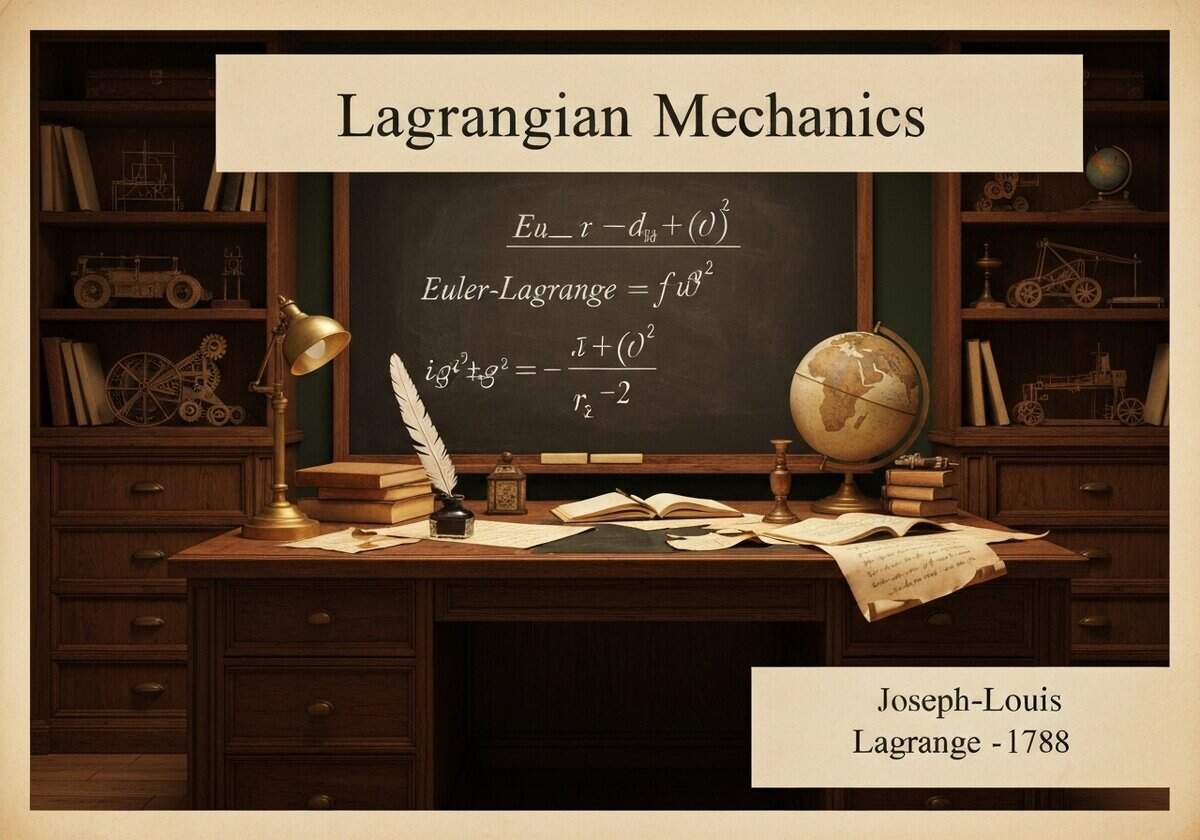
A reformulation of classical mechanics based on the principle of stationary action. It uses a scalar quantity called the Lagrangian, defined as kinetic energy minus potential energy (\(L = T – V\)). The equations of motion are derived from the Euler-Lagrange equation, \(\frac{d}{dt} \left( \frac{\partial L}{\partial \dot{q}_i} \right) – \frac{\partial L}{\partial q_i} = 0\), using generalized coordinates, which simplifies analysis of complex systems with constraints.
Lagrangian mechanics, developed by Joseph-Louis Lagrange, offers a powerful and elegant alternative to the Newtonian formulation. Instead of focusing on forces and accelerations, which are vector quantities, it focuses on energies, which are scalars. This shift in perspective often simplifies problems dramatically, especially those involving constraints.
The central concept is the principle of stationary action. It posits that the path taken by a physical system between two points in time is the one for which the ‘action’ is stationary (a minimum, maximum, or saddle point). The action is defined as the time integral of the Lagrangian function, \(S = \int_{t_1}^{t_2} L(q, \dot{q}, t) \, dt\). The Lagrangian, \(L\), is defined as the kinetic energy \(T\) minus the potential energy \(V\) of the system.
By applying the calculus of variations to find the path that makes the action stationary, one derives the Euler-Lagrange equations. A key advantage of this approach is the use of generalized coordinates (\(q_i\)). These are any set of parameters that uniquely define the configuration of the system. For example, for a double pendulum, the two angles are natural generalized coordinates. This freedom to choose the most convenient coordinate system is a major strength. Furthermore, forces of constraint (like the tension in a pendulum rod) do not appear in the Lagrangian formulation, as they do no work, meaning they can be ignored, greatly simplifying the equations of motion for constrained systems.
This formalism is not only a powerful tool in classical mechanics but also serves as the foundation for more advanced theories, including quantum mechanics (through Feynman’s path integral formulation) and quantum field theory.
Due to scrapping bot traffic, currently more than 40k per day, this content is reserved to community members.
> Login < or > Register < (100% free) to access this, so as all other restricted content and tools.
Related to: lagrangian, analytical mechanics, principle of least action, generalized coordinates, euler-lagrange equation, calculus of variations, kinetic energy, potential energy.