Product Design, Manufacturing & Innovation Resources
Home » ISO 14644-1 Cleanroom Classification Standard

ISO 14644-1 Cleanroom Classification Standard

1999-05-01
  • International Organization for Standardization (ISO)
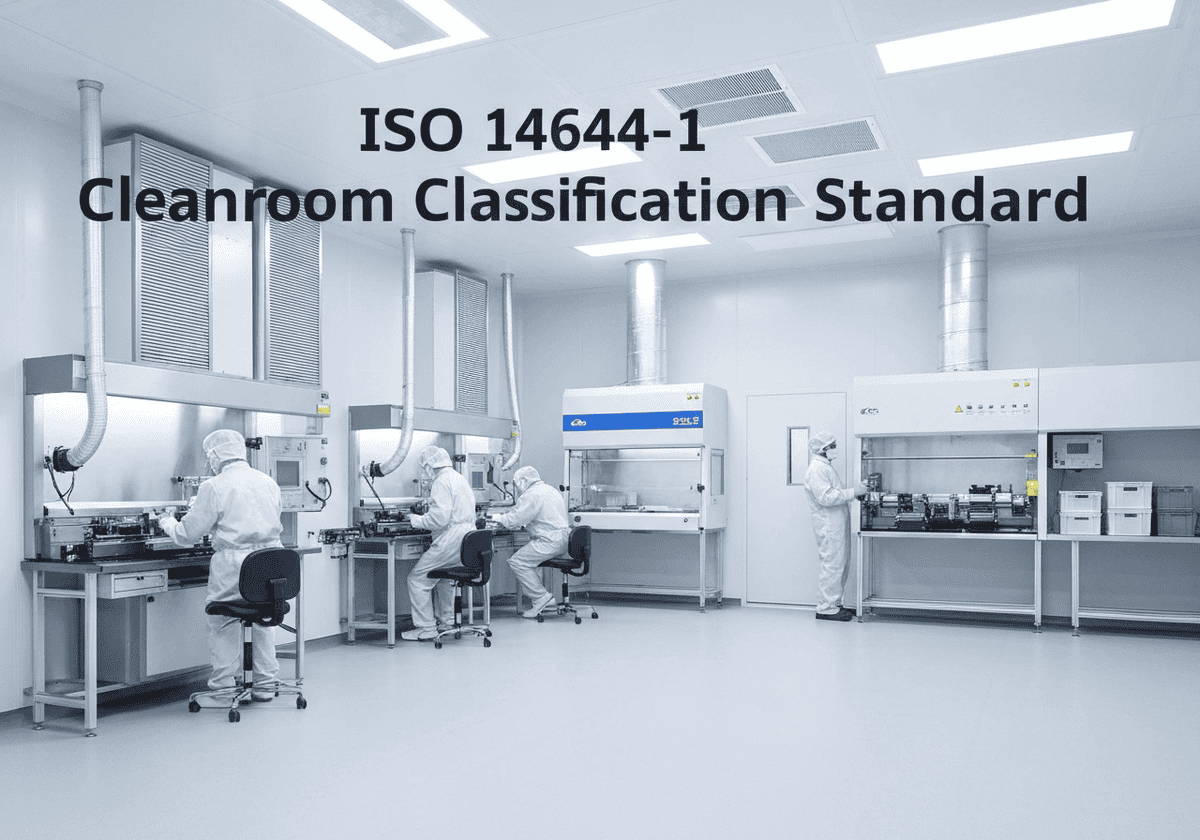
Cleanroom environment with air filtration for semiconductor fabrication in environmental engineering.

(generated image for illustration only)

ISO 14644-1 classifies cleanroom air cleanliness by the maximum allowable concentration of airborne particles. The classification, from ISO 1 to ISO 9, is determined by the formula \(C_N = 10^N \times (\frac{0.1}{D})^{2.08}\), where \(C_N\) is the max concentration of particles/m³, N is the ISO class number, and D is the particle size in µm.


The ISO 14644-1 standard provides a globally recognized framework for specifying the cleanliness of air in cleanrooms and controlled environments. It replaced the widely used US Federal Standard 209E, which classified rooms as Class 100, Class 10,000, etc., based on particle counts per cubic foot. The ISO formula, \(C_N = 10^N \times (\frac{0.1}{D})^{2.08}\), establishes a logarithmic relationship between the ISO class number (N) and the maximum permitted particle concentration (\(C_N\)) for a given particle size (D). For example, an ISO Class 5 cleanroom must not exceed 3,520 particles/m³ at a size of 0.5 µm and 293 particles/m³ at 1.0 µm. This is roughly equivalent to the old FED STD 209E Class 100.

Certification to an ISO class requires rigorous testing procedures. Particle counters are used at multiple, statistically determined locations within the room to measure airborne particulate levels. The room must meet the concentration limits for all specified particle sizes to achieve its classification. The standard also outlines requirements for monitoring to maintain performance over time. This systematic approach ensures that a cleanroom in one part of the world is directly comparable to another, which is critical for global supply chains in high-tech industries like microelectronics and pharmaceuticals where microscopic contaminants can cause catastrophic product failure.

UNESCO Nomenclature: 3307
– Environmental engineering

Type

Abstract System

Disruption

Substantial

Usage

Widespread Use

Precursors

  • US Federal Standard 209E
  • advances in laser particle counting technology
  • growing need for contamination control in microelectronics and pharmaceuticals
  • development of statistical process control methods

Applications

  • semiconductor fabrication
  • pharmaceutical manufacturing
  • biotechnology research
  • aerospace assembly
  • medical device production

Patents:

NA

Potential Innovations Ideas

Due to scrapping bot traffic, currently more than 40k per day, this content is reserved to community members.
> Login < or > Register < (100% free) to access this, so as all other restricted content and tools.

Related to: ISO 14644-1, cleanroom classification, particle concentration, contamination control, air cleanliness, ISO class, environmental engineering, particulate matter.

Historical Context

ISO 14644-1 Cleanroom Classification Standard

1994
1997
1998
1999-05-01
2000
2000
2000
1993-07-22
1996
1998
1999
2000
2000
2000
2002

(if date is unknown or not relevant, e.g. "fluid mechanics", a rounded estimation of its notable emergence is provided)

Related Invention, Innovation & Technical Principles

Full size images and downloads are only available, 100% free, for registered members.

> Login <