Product Design, Manufacturing & Innovation Resources
Home » Internal vs. External Setup in SMED

Internal vs. External Setup in SMED

1960
  • Shigeo Shingo
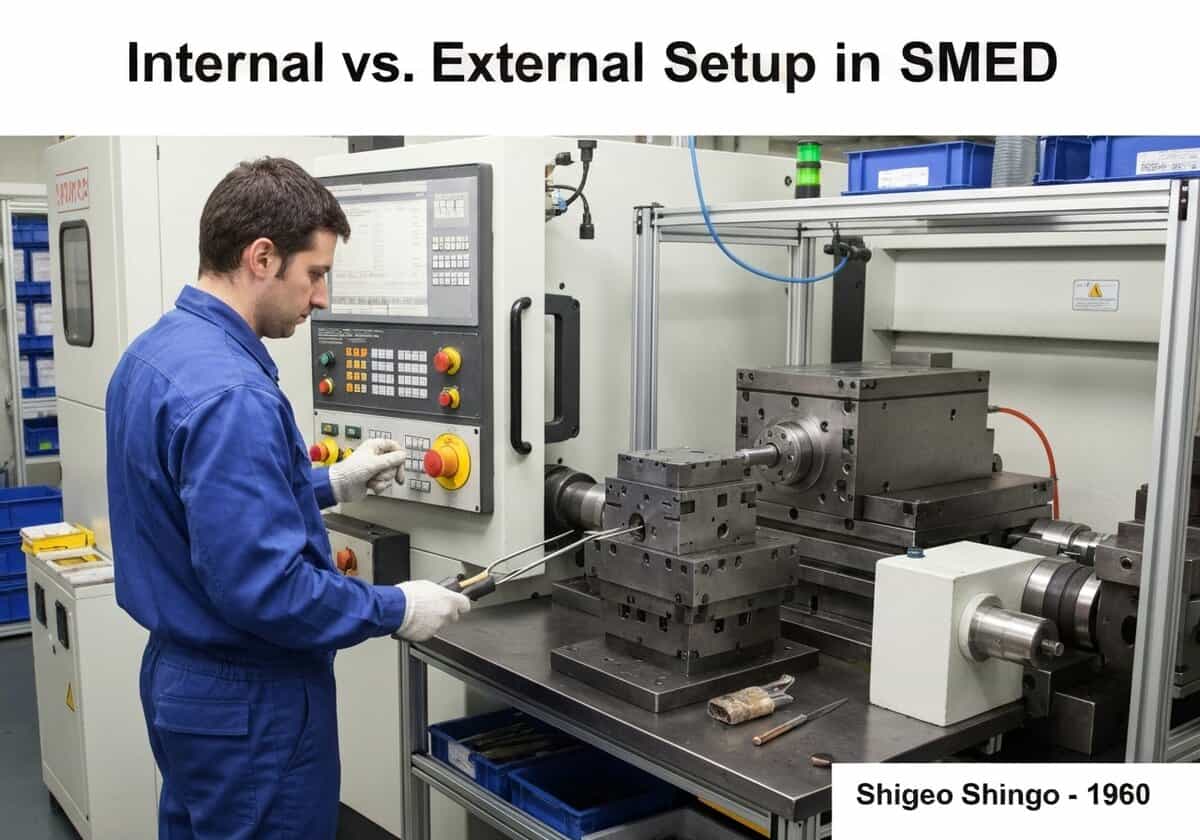
External setup operation in SMED methodology within industrial engineering.

(generated image for illustration only)

The SMED methodology fundamentally distinguishes between internal and external setup operations. Internal setup activities can only be performed when a machine is stopped, such as the usual example of mounting a new die. External setup activities can be completed while the machine is still running, like pre-heating tools or fetching the next die. The primary goal is to convert internal setup time to external.


The distinction between internal and external setup is the cornerstone of the SMED system. Before its formalization, changeover processes were often treated as a monolithic block of time where the machine was unproductive. Shigeo Shingo’s critical insight was to analyze every single action taken during a changeover and categorize it. Internal setup (Internal Exchange of Die or IED) includes any task that absolutely requires the machine to be shut down. Examples include unbolting the old tool, cleaning the machine bed, and securing the new tool. External setup (External Exchange of Die or OED) encompasses all preparatory and post-processing tasks that can be performed while the machine is still producing the last batch. This includes transporting the next die to the machine, pre-heating molds, preparing clamps and bolts, and moving the finished parts away. The initial stages of a SMED implementation focus heavily on identifying and separating these activities. A simple checklist is often the first tool used. By meticulously preparing all necessary tools, parts, and conditions beforehand (externalizing the setup), the time the machine is actually stopped (internal setup) can be dramatically reduced. This conceptual separation is what enables the subsequent, more technical steps of converting and streamlining.

UNESCO Nomenclature: 3307
– Industrial technology

Type

Abstract System

Disruption

Substantial

Usage

Widespread Use

Precursors

  • time and motion studies by Frederick Winslow Taylor
  • frank and Lillian Gilbreth’s motion analysis (Therbligs)
  • Henry Ford’s assembly line principles
  • Toyota production system (TPS) development

Applications

  • just-in-time (jit) manufacturing
  • lean production systems
  • agile manufacturing
  • flexible manufacturing systems
  • one-piece flow production

Patents:

NA

Potential Innovations Ideas

Due to scrapping bot traffic, currently more than 40k per day, this content is reserved to community members.
> Login < or > Register < (100% free) to access this, so as all other restricted content and tools.

Related to: SMED, internal setup, external setup, changeover, lean manufacturing, Shigeo Shingo, IED, OED, process improvement, industrial engineering.

Historical Context

Internal vs. External Setup in SMED

1960
1960
1960
1960
1963
1965-12-21
1970
1960
1960
1960
1960
1962
1964
1970
1970

(if date is unknown or not relevant, e.g. "fluid mechanics", a rounded estimation of its notable emergence is provided)

Related Invention, Innovation & Technical Principles

Full size images and downloads are only available, 100% free, for registered members.

> Login <