Product Design, Manufacturing & Innovation Resources
Home » Henderson-Hasselbalch Equation

Henderson-Hasselbalch Equation

1917
  • Lawrence Joseph Henderson
  • Karl Albert Hasselbalch
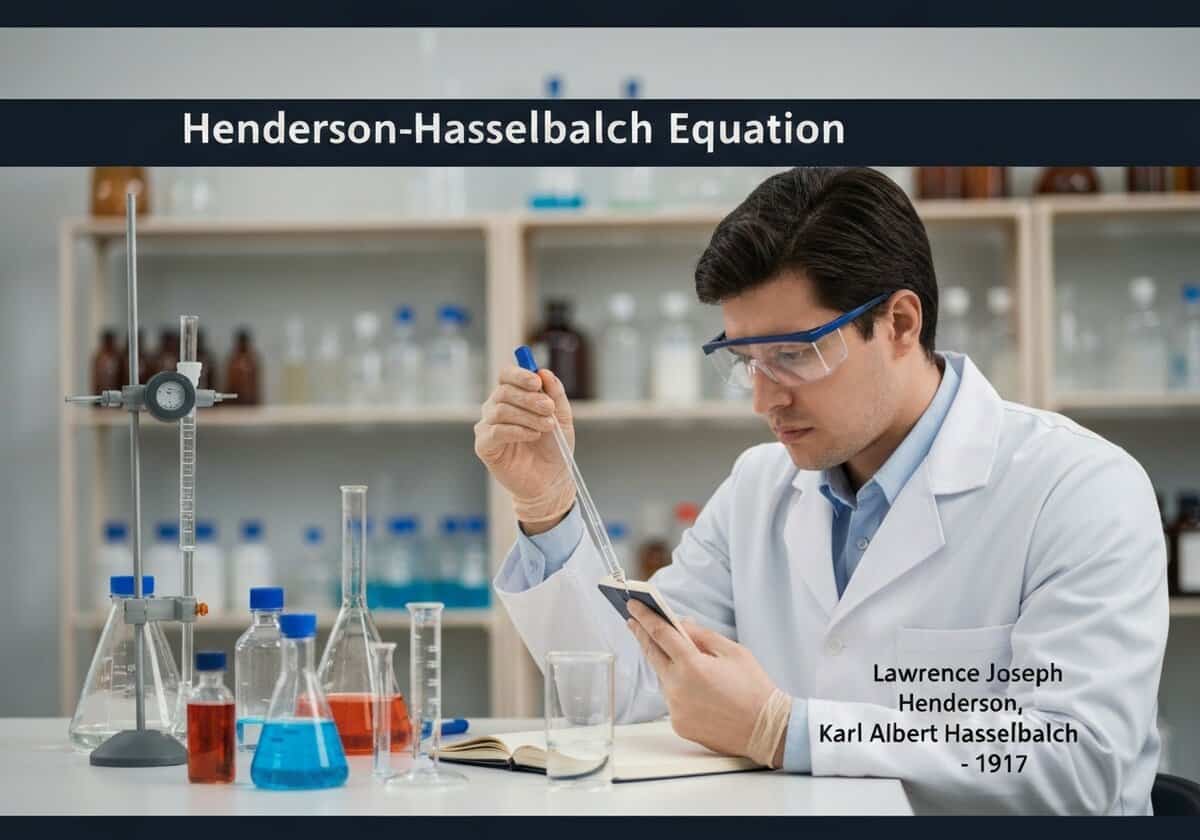
Laboratory scene demonstrating preparation of buffer solutions using the Henderson-Hasselbalch equation.

(generated image for illustration only)

The Henderson-Hasselbalch equation relates the pH of a solution of a weak acid to its acid dissociation constant (\(pK_a\)) and the ratio of the concentrations of the deprotonated species (conjugate base, \([A^-]\)) to the protonated species (acid, \([HA]\)). The equation is \(pH = pK_a + \log_{10}\left(\frac{[A^-]}{[HA]}}\right)\). It is fundamental for understanding and preparing buffer solutions.

The equation is derived from the acid dissociation constant expression, \(K_a = \frac{[H^+][A^-]}{[HA]}\). By taking the negative logarithm of both sides and rearranging, the final form is obtained. The equation’s primary utility is in preparing buffer solutions of a desired pH and in calculating the equilibrium pH in acid-base reactions. A key insight from the equation is that when the concentrations of the acid and its conjugate base are equal (\([HA] = [A^-]\)), the logarithmic term becomes zero, and the pH of the solution is exactly equal to the \(pK_a\) of the acid. This point represents the maximum buffering capacity of the system, where it most effectively resists pH changes.

The equation relies on several assumptions, primarily that the acid is weak and that the autoionization of water is negligible. It uses concentrations instead of activities, making it an approximation that works best for dilute solutions. Despite these limitations, it provides an excellent framework for understanding how buffers function and is widely used in biological and chemical sciences.

UNESCO Nomenclature: 2209
– Physical chemistry

Type

Abstract System

Disruption

Foundational

Usage

Widespread Use

Precursors

  • law of mass action
  • Arrhenius theory of acids and bases
  • Brønsted–Lowry acid–base theory
  • concept of the acid dissociation constant (Ka)
  • Sørensen’s pH scale

Applications

  • biochemistry for calculating the pH of buffer systems
  • pharmacology for determining drug absorption
  • clinical medicine for understanding acid-base balance
  • protein chemistry for calculating isoelectric points
  • environmental science for modeling water chemistry

Patents:

NA

Potential Innovations Ideas

Due to scrapping bot traffic, currently more than 40k per day, this content is reserved to community members.
> Login < or > Register < (100% free) to access this, so as all other restricted content and tools.

Related to: Henderson-Hasselbalch, buffer solution, pKa, weak acid, conjugate base, acid-base equilibrium, biochemistry, logarithm, pH calculation, titration.

Historical Context

Henderson-Hasselbalch Equation

1913
1915
1916
1917
1918
1920
1920
1912
1915
1915-11
1916
1918
1919-05-29
1920
1920

(if date is unknown or not relevant, e.g. "fluid mechanics", a rounded estimation of its notable emergence is provided)

Related Invention, Innovation & Technical Principles

Full size images and downloads are only available, 100% free, for registered members.

> Login <