Product Design, Manufacturing & Innovation Resources
Home » Gravitational Time Dilation

Gravitational Time Dilation

1915
  • Albert Einstein
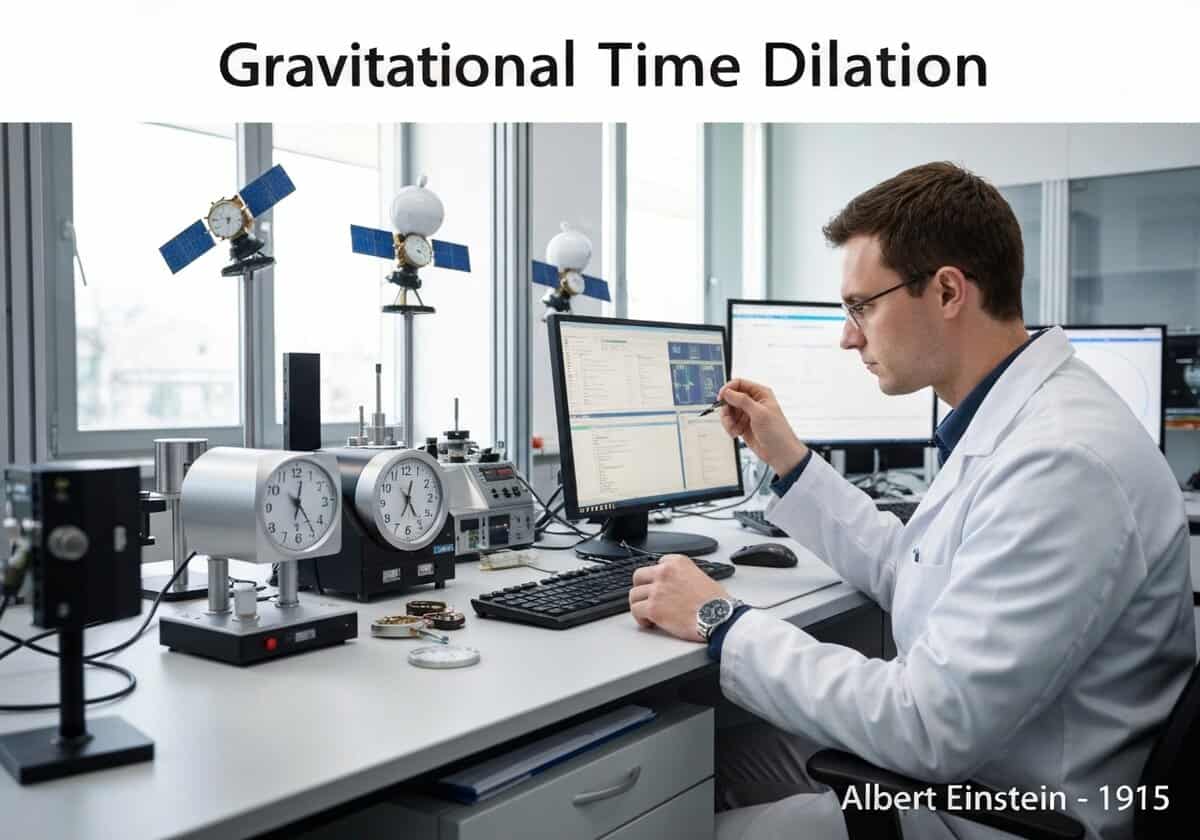
Atomic clock calibration in a lab demonstrating gravitational time dilation principles.

(generated image for illustration only)

A key prediction of general relativity is that time passes at different rates in different gravitational potentials. A clock in a stronger gravitational field (closer to a massive object) will tick slower than a clock in a weaker field. This effect, known as gravitational time dilation, has been experimentally verified and is a crucial factor in modern technology like GPS.


Gravitational time dilation arises from the principle that the rate at which time passes is influenced by the curvature of spacetime. In a region of stronger gravity, the ‘flow’ of time itself is slower relative to a region of weaker gravity. This is not a mechanical effect on clocks but an actual difference in the passage of time. For example, a clock at sea level runs slightly slower than an identical clock on a mountain. The formula for this effect for a non-rotating, spherically symmetric mass is \(t_f = t_0 \sqrt{1 – \frac{2GM}{rc^2}}\), where \(t_f\) is the time for the distant observer and \(t_0\) is the time in the gravitational field.

This effect was first confirmed experimentally by the Pound-Rebka experiment in 1959, which measured the gravitational redshift of photons (a related phenomenon). The most significant real-world application is the Global Positioning System (GPS). The atomic clocks on GPS satellites are in a weaker gravitational field than clocks on Earth’s surface, so they run faster by about 45 microseconds per day. They also experience special relativistic time dilation due to their high velocity, making them run slower by about 7 microseconds per day. The net effect is that GPS satellite clocks run faster by about 38 microseconds daily. Without correcting for this, GPS navigation errors would accumulate at about 10 kilometers per day, rendering the system useless.

UNESCO Nomenclature: 2211
– Relativity

Type

Abstract System

Disruption

Substantial

Usage

Widespread Use

Precursors

  • Special relativity and its concept of time dilation due to velocity
  • Equivalence principle
  • Minkowski spacetime

Applications

  • global positioning system (GPS) satellites require corrections for both special and general relativistic time dilation to function accurately
  • precise timekeeping with atomic clocks
  • understanding the physics of black holes and neutron stars
  • astronomical observation of gravitational redshift

Patents:

NA

Potential Innovations Ideas

Due to scrapping bot traffic, currently more than 40k per day, this content is reserved to community members.
> Login < or > Register < (100% free) to access this, so as all other restricted content and tools.

Related to: time dilation, general relativity, gravity, spacetime, GPS, atomic clock, gravitational potential, redshift.

Historical Context

Gravitational Time Dilation

1909
1910
1912
1915
1915-11
1916
1918
1909
1910
1911-04-08
1913
1915
1916
1917
1918

(if date is unknown or not relevant, e.g. "fluid mechanics", a rounded estimation of its notable emergence is provided)

Related Invention, Innovation & Technical Principles

Full size images and downloads are only available, 100% free, for registered members.

> Login <