Product Design, Manufacturing & Innovation Resources
Home » Genetic Toolkit Concept

Genetic Toolkit Concept

1990
  • Sean B. Carroll
  • Eric H. Davidson
  • Walter Gehring
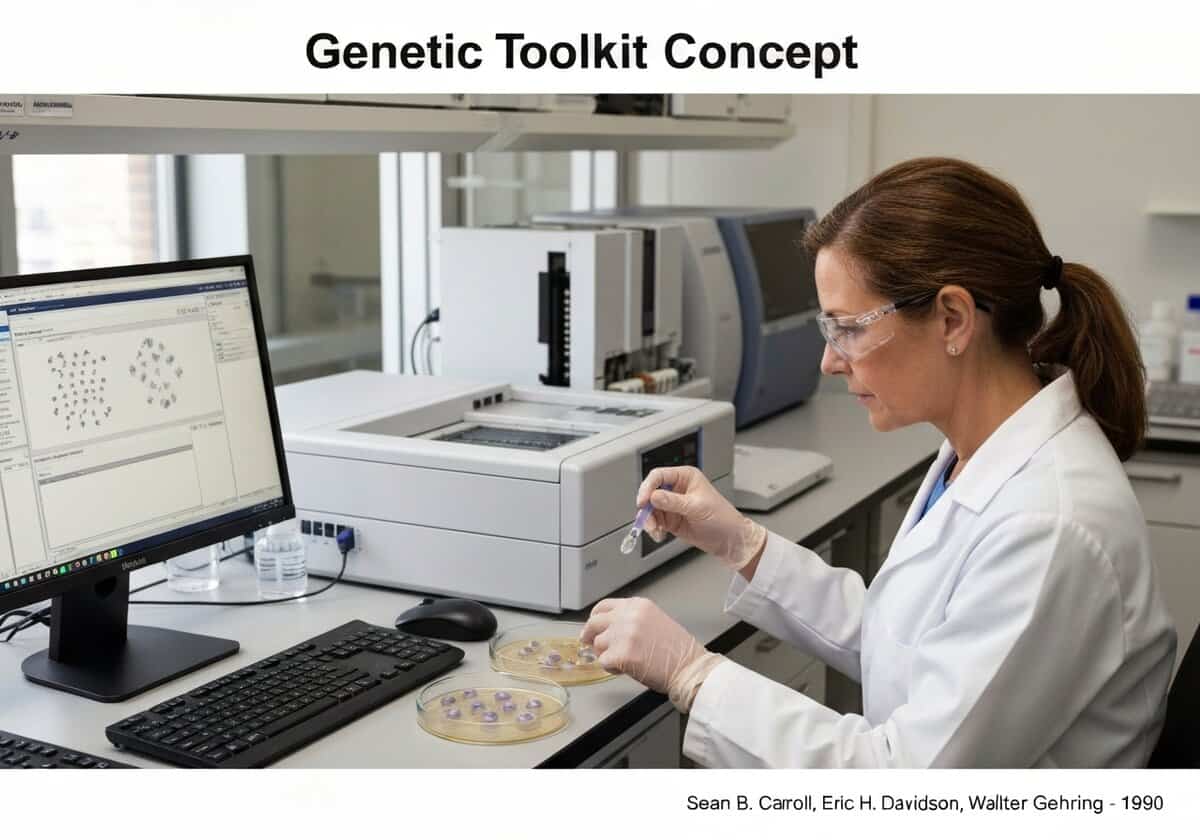
Researcher studying embryos in a lab, focusing on genetic toolkit applications in developmental genetics.

(generated image for illustration only)

Evolutionary developmental biology revealed that a conserved set of genes, the “genetic toolkit,” controls embryonic development across a vast range of animal phyla. These genes, such as Hox genes, are highly conserved and regulate body plan formation, limb development, and eye formation. Their differential deployment and regulation, rather than the evolution of new genes, drives much of morphological diversity.

The genetic toolkit concept revolutionized evolutionary biology by shifting the focus from the evolution of new genes to the evolution of gene regulation. Before the 1990s, it was widely assumed that the vast morphological differences between animal groups, like insects and vertebrates, must have arisen from fundamentally different sets of genes. However, comparative genomics and developmental genetics revealed this to be incorrect. The discovery that genes like Hox, which pattern the anterior-posterior body axis, are present and function similarly in nearly all bilaterally symmetric animals was a landmark finding. This toolkit primarily consists of genes encoding transcription factors and components of cell signaling pathways (like Wnt, Hedgehog, and TGF-beta).

These toolkit genes are organized into complex gene regulatory networks (GRNs). Evolution largely acts by modifying these networks—specifically, by altering the cis-regulatory elements (enhancers and silencers) that control when and where toolkit genes are expressed. A small change in an enhancer can lead to a significant change in morphology, such as the number of legs on an insect or the shape of a bird’s beak, without altering the protein product of the gene itself. This explains how vast diversity can arise from a relatively small, shared set of genes. The concept provides a mechanistic basis for macroevolutionary changes and connects the genotype directly to the phenotype through the process of development.

UNESCO Nomenclature: 2411
– Evolution

Type

Abstract System

Disruption

Substancial

Usage

Widespread Use

Precursors

  • discovery of homeotic genes in Drosophila melanogaster
  • the modern synthesis of evolutionary biology
  • advances in DNA sequencing and molecular cloning
  • classical embryology and fate mapping
  • mendelian genetics

Applications

  • understanding the genetic basis of congenital birth defects
  • cancer biology, where developmental pathways are often reactivated
  • regenerative medicine research
  • targeted gene editing using CRISPR to study developmental processes
  • agricultural science for modifying crop and livestock development

Patents:

NA

Potential Innovations Ideas

Due to scrapping bot traffic, currently more than 40k per day, this content is reserved to community members.
> Login < or > Register < (100% free) to access this, so as all other restricted content and tools.

Related to: genetic toolkit, Hox genes, evo-devo, gene regulatory networks, deep homology, transcription factors, developmental biology, macroevolution, conserved genes, CIS-regulation.

Historical Context

Genetic Toolkit Concept

1979
1983
1988
1990
1990
1997
2000
1977
1983
1987
1990
1990
1990
1997
2000

(if date is unknown or not relevant, e.g. "fluid mechanics", a rounded estimation of its notable emergence is provided)

Related Invention, Innovation & Technical Principles

Full size images and downloads are only available, 100% free, for registered members.

> Login <