Product Design, Manufacturing & Innovation Resources
Home » Fundamental Theorem of Algebra

Fundamental Theorem of Algebra

1799
  • Carl Friedrich Gauss
  • Jean le Rond d’Alembert
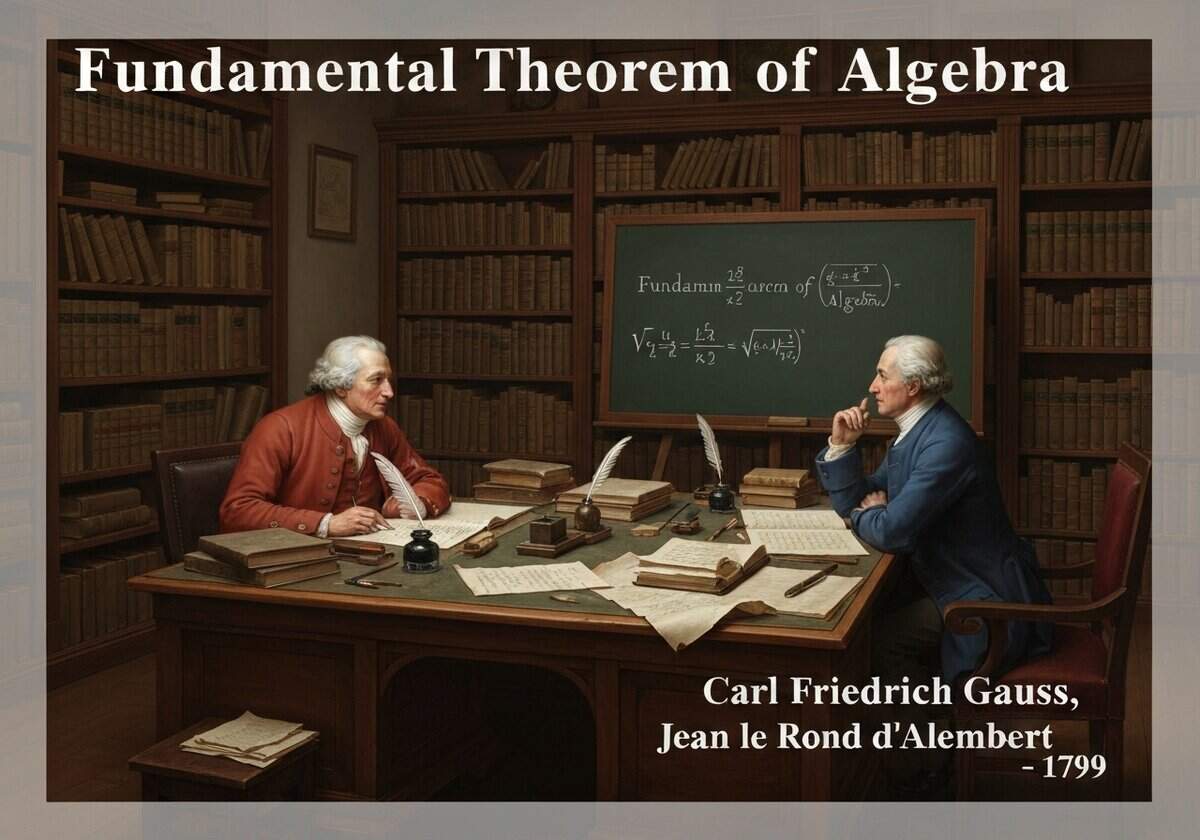
Historical study room with mathematicians discussing the Fundamental Theorem of Algebra.

(generated image for illustration only)

The fundamental theorem of algebra states that every non-constant single-variable polynomial with complex coefficients has at least one complex root. This guarantees that the field of complex numbers is algebraically closed, meaning polynomial equations that cannot be solved in real numbers can be solved in complex numbers. For a polynomial \(p(z) = a_n z^n + \dots + a_1 z + a_0\), there exists a \(z_0 in \mathbb{C}\) such that \(p(z_0) = 0\).
The theorem is a cornerstone of algebra, asserting the completeness of the complex number system for polynomial equations. While its statement is straightforward, its proof is not purely algebraic and typically requires concepts from analysis or topology. The theorem implies that any polynomial of degree \(n\) can be factored into \(n\) linear factors over the complex numbers: \(p(z) = a_n(z-z_1)(z-z_2)\cdots(z-z_n)\), where \(z_1, \dots, z_n\) are the complex roots. This factorization is unique up to the ordering of the roots.

Historically, the need for such a theorem arose from the study of polynomial equations. Italian mathematicians like Cardano and Tartaglia found solutions to cubic and quartic equations in the 16th century, which sometimes involved square roots of negative numbers, hinting at the necessity of complex numbers. However, the formal statement and attempts at proof came later. D’Alembert made a significant attempt in 1746, but his proof had a gap. Carl Friedrich Gauss is credited with the first substantially rigorous proof in his 1799 doctoral thesis, although it also had some topological gaps by modern standards. He later produced several other distinct proofs.

UNESCO Nomenclature: 1101
– Algebra

Type

Abstract System

Disruption

Foundational

Usage

Widespread Use

Precursors

  • discovery of solutions to cubic and quartic equations (Cardano, Tartaglia)
  • introduction and formalization of complex numbers (Bombelli, Euler)
  • Descartes’ rule of signs for bounding the number of real roots
  • early work on the relationship between coefficients and roots (Viète’s formulas)

Applications

  • control theory (stability analysis of linear systems)
  • signal processing (z-transform analysis)
  • quantum mechanics (solving characteristic equations for energy eigenvalues)
  • electrical engineering (circuit analysis using phasors)

Patents:

NA

Potential Innovations Ideas

Due to scrapping bot traffic, currently more than 40k per day, this content is reserved to community members.
> Login < or > Register < (100% free) to access this, so as all other restricted content and tools.

Related to: fundamental theorem of algebra, complex numbers, polynomial roots, algebraically closed field, Gauss, d’Alembert, complex analysis, polynomial factorization, roots of unity, single-variable polynomial.

Historical Context

Fundamental Theorem of Algebra

-450
1585
1779
1799
1801
1850
1875
-300
-550
1750
1790
1800
1844
1874
1893

(if date is unknown or not relevant, e.g. "fluid mechanics", a rounded estimation of its notable emergence is provided)

Related Invention, Innovation & Technical Principles

Full size images and downloads are only available, 100% free, for registered members.

> Login <