Product Design, Manufacturing & Innovation Resources
بيت » سحب الإطار (تأثير تحريك العدسة)

سحب الإطار (تأثير تحريك العدسة)

1918
  • Josef Lense
  • Hans Thirring
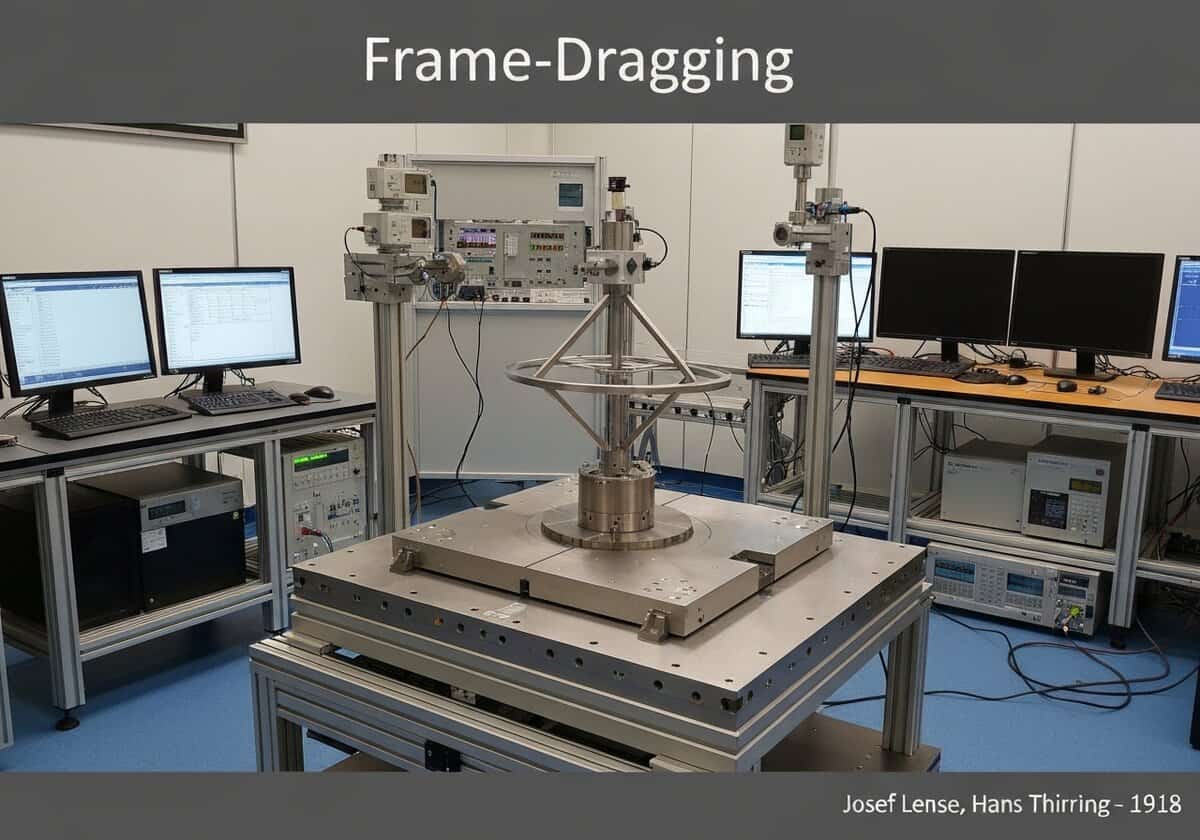
تجربة جيروسكوب معملية توضح ظاهرة سحب الإطار في النسبية.

(صورة توضيحية فقط)

General relativity predicts that a massive, rotating object should ‘drag’ the fabric of spacetime around with it, a phenomenon known as frame-dragging or the Lense-Thirring effect. This means a gyroscope orbiting the rotating body will precess, not because of any applied torque, but because spacetime itself is being twisted by the body’s rotation.
The Lense-Thirring effect is a subtle consequence of the Einstein Field Equations when applied to a rotating mass. While a non-rotating mass curves spacetime statically (described by the Schwarzschild metric), a rotating mass introduces a ‘twist’ to spacetime. This is analogous to a spinning ball in a viscous fluid like honey; the fluid near the ball is dragged by its rotation. In frame-dragging, spacetime itself is dragged. The effect is extremely weak. For Earth, the predicted precession of a gyroscope in a polar orbit is only about 42 milliarcseconds per year.

The most definitive confirmation came from the Gravity Probe B (GP-B) satellite mission, launched in 2004. GP-B used four ultra-precise gyroscopes in a polar orbit. After years of data analysis, the science team announced in 2011 that they had measured the frame-dragging effect to within 19% of the value predicted by general relativity. The effect is much more pronounced near rapidly rotating, extremely massive objects like black holes and neutron stars. Frame-dragging plays a crucial role in the astrophysics of these objects, influencing the behavior of accretion disks and potentially providing a mechanism for launching powerful relativistic jets from the poles of active galactic nuclei.

UNESCO Nomenclature: 2211
– Relativity

يكتب

نظام مجرد

خلل

Substantial

الاستخدام

استخدام واسع النطاق

مقدمات

  • معادلات أينشتاين للمجال
  • Mach’s principle (as a conceptual influence)
  • مفهوم الزخم الزاوي والدوران في الميكانيكا الكلاسيكية

التطبيقات

  • اختبار التنبؤ الأساسي للنسبية العامة باستخدام أقمار صناعية مثل مسبار الجاذبية ب
  • قياس دوران الثقوب السوداء
  • فهم ديناميكيات أقراص التراكم حول الأجسام الضخمة
  • providing high-precision measurements of earth’s gravitational field

براءات الاختراع:

NA

أفكار ابتكارية محتملة

  • a propulsion system for spacecraft that ‘surfs’ on the dragged spacetime of a rotating body
  • استخراج الطاقة من الثقوب السوداء الدوارة من خلال استغلال الغلاف الجوي الناتج عن سحب الإطار
  • نظام ملاحة للفضاء العميق يعتمد على رسم خرائط لحقول سحب الإطارات للأجرام السماوية
  • استخدام سحب الإطار لتثبيت مدارات الأقمار الصناعية دون الحاجة إلى الوقود
  • طريقة لقياس الدوران الداخلي للنجوم والكواكب
  • إنشاء حقول سحب الإطارات الاصطناعية في المختبر لدراسة ديناميكيات الزمكان
  • جهاز اتصال يستخدم التواءات الزمكان المعدلة
  • طريقة لتغيير الزخم الزاوي للكويكبات للدفاع الكوكبي
Related to: frame-dragging, lense-thirring effect, general relativity, spacetime, gravity probe b, gyroscope, ثقب أسود spin, rotation.

السياق التاريخي

سحب الإطار (تأثير تحريك العدسة)

1915
1915-11
1916
1918
1919-05-29
1920
1920
1913
1915
1916
1917
1918
1920
1920
1921

(إذا كان التاريخ غير معروف أو غير ذي صلة، على سبيل المثال "ميكانيكا الموائع"، يتم توفير تقدير تقريبي لظهوره الملحوظ)

أحدث الإضافات

أهم المنشورات والمقالات

أفضل الأدوات الأصلية

السنة العاشرة عيد

الصور والتنزيلات بالحجم الكامل متاحة فقط، ومجانية تمامًا، للأعضاء المسجلين.