Product Design, Manufacturing & Innovation Resources
Home » Fluid Mechanics

Fluid Mechanics

1750
  • Archimedes
  • Daniel Bernoulli
  • Leonhard Euler
  • Claude-Louis Navier
  • George Gabriel Stokes
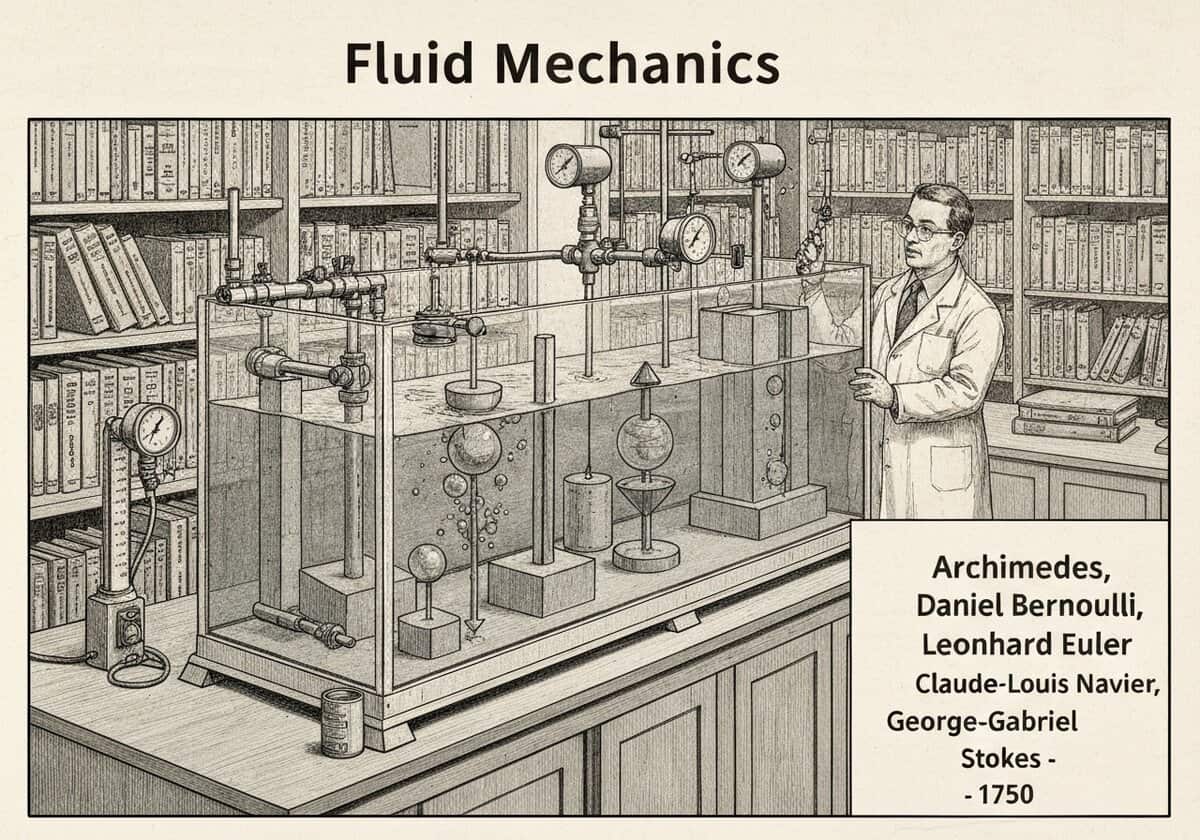
Fluid mechanics laboratory experiment demonstrating buoyancy and fluid dynamics principles.

(generated image for illustration only)

Fluid mechanics is the branch of applied mechanics concerned with the statics (fluids at rest) and dynamics (fluids in motion) of liquids and gases. It applies fundamental principles of mass, momentum, and energy conservation to analyze and predict fluid behavior. Its applications are vast, ranging from aerodynamics and hydraulics to meteorology and oceanography.

The governing equations of motion for a viscous fluid are the Navier-Stokes equations. These are a set of nonlinear partial differential equations that arise from applying Newton’s second law to fluid motion, combined with the assumption that fluid stress is the sum of a diffusing viscous term and a pressure term. For a compressible Newtonian fluid, the vector equation is: \(\rho(\frac{\partial \mathbf{v}}{\partial t} + \mathbf{v} \cdot \nabla \mathbf{v}) = -\nabla p + \nabla \cdot \mathbf{T} + \mathbf{f}\), where \(\rho\) is density, \(\mathbf{v}\) is velocity, \(p\) is pressure, \(\mathbf{T}\) is the stress tensor, and \(\mathbf{f}\) represents body forces. Solving these equations is a central challenge in the field.

Fluid behavior is often characterized by dimensionless numbers. The most famous is the Reynolds number (Re), which describes the ratio of inertial forces to viscous forces and is used to predict the transition from smooth, orderly laminar flow to chaotic turbulent flow. Other important numbers include the Mach number for compressible flows and the Froude number for flows with a free surface. Due to the complexity of the governing equations, especially for turbulent flows, computational fluid dynamics (CFD) has become an essential tool, using numerical methods to solve and analyze problems involving fluid flows.

UNESCO Nomenclature: 2210
– Mechanics

Type

Abstract System

Disruption

Foundational

Usage

Widespread Use

Precursors

  • Continuum mechanics assumption
  • Newton’s laws of motion
  • Principles of thermodynamics
  • Development of calculus
  • Archimedes’ principle on buoyancy

Applications

  • aerodynamics (design of aircraft wings, cars, and wind turbines)
  • hydraulics (design of dams, pipelines, and pumps)
  • meteorology (weather forecasting and climate modeling)
  • biomedical engineering (analysis of blood flow in arteries)
  • environmental engineering (modeling of pollutant dispersal in air and water)

Patents:

NA

Potential Innovations Ideas

Due to scrapping bot traffic, currently more than 40k per day, this content is reserved to community members.
> Login < or > Register < (100% free) to access this, so as all other restricted content and tools.

Related to: fluid mechanics, fluid dynamics, navier-stokes equations, viscosity, turbulent flow, laminar flow, aerodynamics, cfd.

Historical Context

Fluid Mechanics

1687
1687
1738
1750
1757
1788
1800
1678
1687
1687
1738
1750
1785
1788
1800

(if date is unknown or not relevant, e.g. "fluid mechanics", a rounded estimation of its notable emergence is provided)

Related Invention, Innovation & Technical Principles

Full size images and downloads are only available, 100% free, for registered members.

> Login <