Product Design, Manufacturing & Innovation Resources
Home » Aqueous Film-Forming Foam (AFFF)

Aqueous Film-Forming Foam (AFFF)

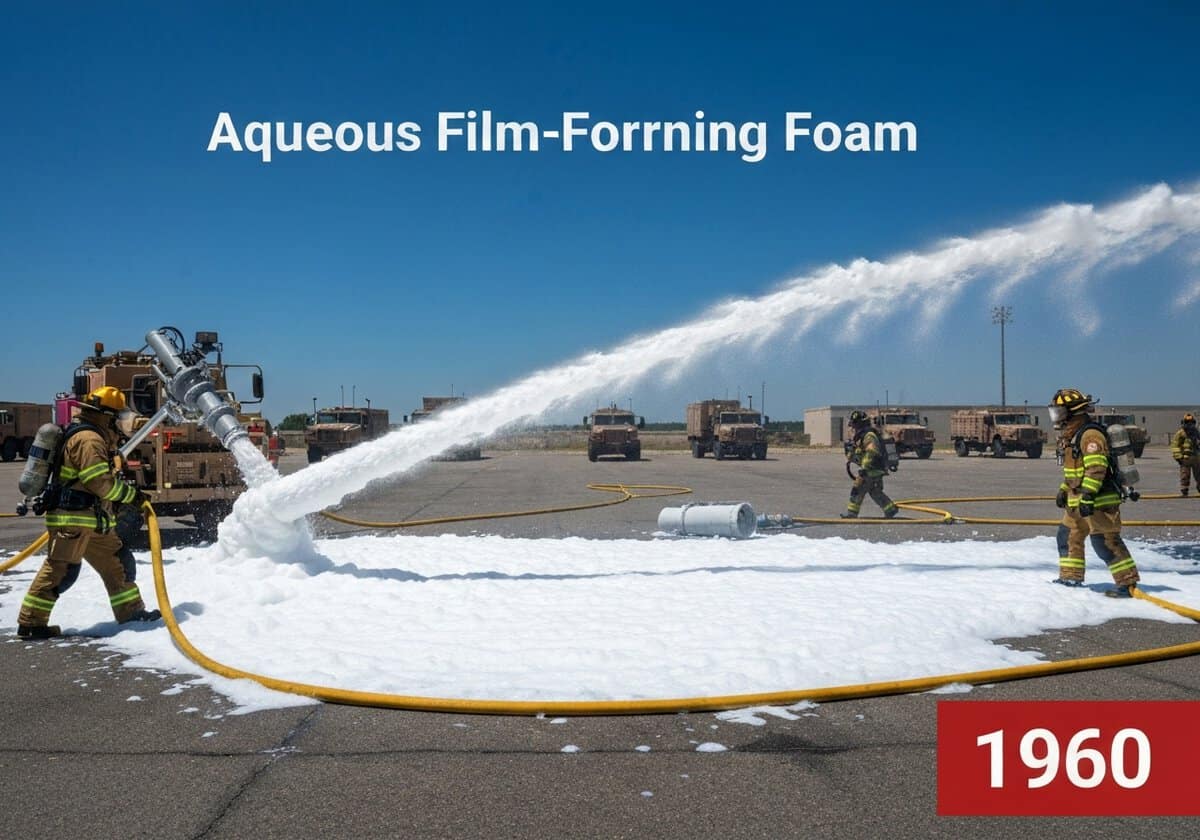
1960
Firefighters applying aqueous film-forming foam during training for Class B fire suppression.

(generated image for illustration only)

Aqueous film-forming foam (AFFF) is a highly effective fire suppressant for Class B fires (flammable liquids). Its effectiveness comes from PFAS-based fluorosurfactants, which dramatically lower the surface tension of water. This allows the foam to spread rapidly across the surface of a burning liquid, forming a vapor barrier that suffocates the fire and cools the fuel.


AFFF was a revolutionary development in firefighting technology. Before AFFF, protein-based foams were used, but they were less effective and slower to control large liquid fuel fires. The key innovation in AFFF is the use of fluorosurfactants. These molecules have a water-soluble (hydrophilic) head and a water-insoluble (hydrophobic) fluorocarbon tail. When mixed with water and aerated, they create a foam blanket. Crucially, as the foam drains, the fluorosurfactants create a thin aqueous film that floats on the surface of the hydrocarbon fuel. This film has a surface tension lower than that of the fuel, allowing it to spread rapidly and reseal if disturbed. The film serves multiple purposes: it suppresses the release of flammable vapors, separates the fuel from oxygen, and the water content provides a cooling effect. This combination makes AFFF exceptionally fast and effective at extinguishing difficult-to-control liquid fires, which is why it became the standard for high-risk environments like airports and military installations. However, the environmental persistence and toxicity of the PFAS used in AFFF have led to it becoming a major source of groundwater contamination at training sites.

UNESCO Nomenclature: 3309
– Environmental engineering

Type

Chemical Product

Disruption

Revolutionary

Usage

Widespread Use

Precursors

  • invention of protein-based firefighting foams in the early 20th century
  • synthesis of fluorosurfactants by 3m in the 1950s
  • understanding of surface tension and film-forming phenomena
  • the need for improved fire suppression for jet fuel fires in the military

Applications

  • military bases and airfields
  • civilian airports
  • oil refineries and petrochemical plants
  • fire departments for responding to fuel spills and fires

Patents:

NA

Potential Innovations Ideas

Due to scrapping bot traffic, currently more than 40k per day, this content is reserved to community members.
> Login < or > Register < (100% free) to access this, so as all other restricted content and tools.

Related to: afff, firefighting foam, fluorosurfactant, pfas, class b fire, flammable liquid, surface tension, vapor barrier, environmental contamination, fire suppression.

Historical Context

Aqueous Film-Forming Foam (AFFF)

1960
1960
1960
1960
1960
1960
1963
1960
1960
1960
1960
1960
1960
1962
1964

(if date is unknown or not relevant, e.g. "fluid mechanics", a rounded estimation of its notable emergence is provided)

Related Invention, Innovation & Technical Principles

Full size images and downloads are only available, 100% free, for registered members.

> Login <