Product Design, Manufacturing & Innovation Resources
Home » Ductility and Brittleness

Ductility and Brittleness

1850
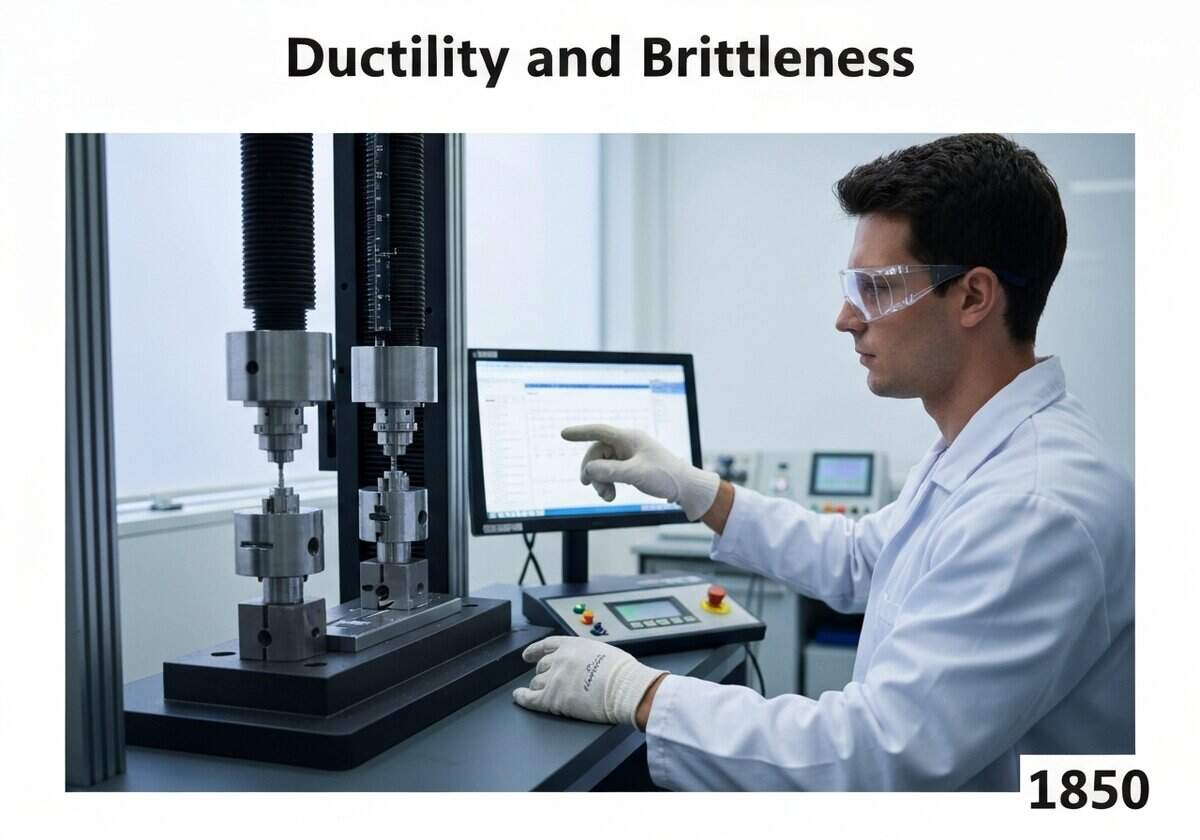
Tensile testing of metal samples in materials science laboratory for ductility and brittleness evaluation.

(generated image for illustration only)

Ductility is a measure of a material’s ability to undergo significant plastic deformation before rupture, often quantified by percent elongation or percent reduction in area. Ductile materials, like steel, show a long plastic region on their stress-strain curve. Brittleness is the opposite; brittle materials, like ceramics or cast iron, fracture with little to no plastic deformation.

The distinction between ductile and brittle behavior is clearly visible on the stress-strain curve. A ductile material exhibits a significant strain after the yield point and before the fracture point. This large area under the curve after yielding indicates that the material can absorb a great deal of energy before it breaks. This property is crucial for safety in many engineering applications, as a ductile failure provides a visible warning (e.g., bending or stretching) before a complete collapse. Key measures of ductility are percent elongation, \((\frac{L_f – L_0}{L_0}) \times 100\), and percent reduction in area, \((\frac{A_0 – A_f}{A_0}) \times 100\), where the ‘f’ subscript denotes the final dimension at fracture.

Conversely, a brittle material shows very little strain after its elastic limit. The fracture stress is often close to the ultimate tensile strength, and failure occurs suddenly and without warning. Ceramics, glasses, and some polymers are classic examples. The behavior of a material can also depend on external conditions. For instance, many steels that are ductile at room temperature undergo a ductile-to-brittle transition at low temperatures, a phenomenon that has led to catastrophic failures, such as in the Liberty ships during World War II.

UNESCO Nomenclature: 3322
– Materials science

Type

Material Property

Disruption

Foundational

Usage

Widespread Use

Precursors

  • metallurgical practices of annealing and tempering to control material properties
  • observations of material failure modes in early engineering structures
  • development of the tensile test as a standard characterization method

Applications

  • selection of materials for applications requiring forming (e.g., car bodies)
  • design of structures to ensure failure is gradual (ductile) rather than catastrophic (brittle)
  • wire drawing and metal extrusion processes
  • assessing material performance at low temperatures, where many materials become brittle

Patents:

NA

Potential Innovations Ideas

Due to scrapping bot traffic, currently more than 40k per day, this content is reserved to community members.
> Login < or > Register < (100% free) to access this, so as all other restricted content and tools.

Related to: ductility, brittleness, plastic deformation, fracture, elongation, reduction in area, ductile failure, brittle fracture, material behavior, stress-strain curve.

Historical Context

Ductility and Brittleness

1788
1834
1850
1850
1850
1850
1867
1761
1807-01-01
1850
1850
1850
1850
1860
1870

(if date is unknown or not relevant, e.g. "fluid mechanics", a rounded estimation of its notable emergence is provided)

Related Invention, Innovation & Technical Principles

Full size images and downloads are only available, 100% free, for registered members.

> Login <