Product Design, Manufacturing & Innovation Resources
Maison » Théorème de Cauchy-Kowalevski

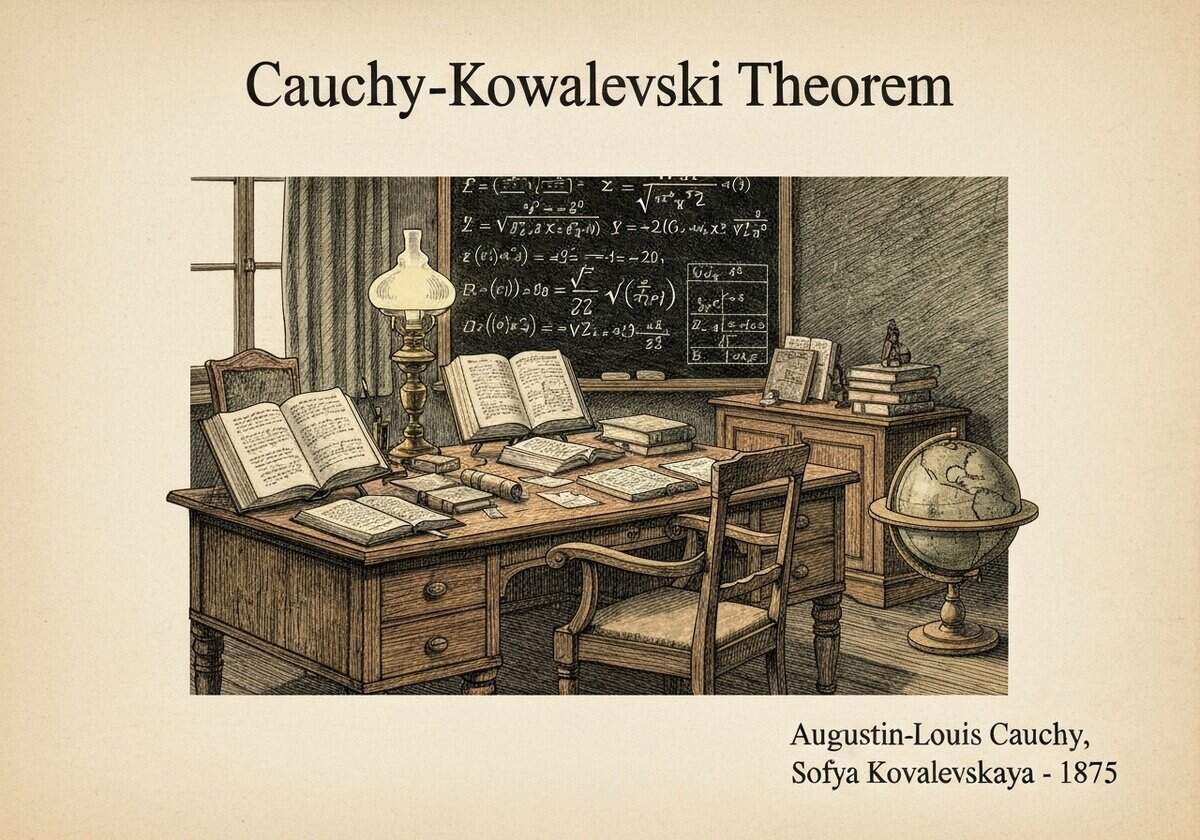
Théorème de Cauchy-Kowalevski

1875
  • Augustin-Louis Cauchy
  • Sofya Kovalevskaya
Study room of mathematicians Cauchy and Kovalevski with analysis books and equations.

(Image générée à titre d'illustration uniquement)

A fundamental existence and uniqueness theorem for partial differential equations associated with Cauchy initial value problems. It states that if the PDE and the initial conditions are ‘analytic’ (can be represented by convergent power series), then a unique analytic solution exists in a neighborhood of the initial surface. It provides a local existence guarantee but does not address global behavior or well-posedness.

Le théorème de Cauchy-Kowalevski est un outil théorique puissant, bien que son applicabilité pratique soit limitée par la stricte exigence d'analyticité. Une fonction analytique est infiniment différentiable et peut être localement représentée par sa série de Taylor. De nombreux problèmes physiques impliquent des fonctions ou des frontières non analytiques ; le théorème ne s'applique donc pas.

The theorem considers a system of PDEs where the highest-order time derivative of each unknown function is expressed in terms of lower-order time derivatives and spatial derivatives. The initial data is specified on a non-characteristic surface (a surface where the initial value problem can be uniquely solved for the highest derivatives). For a PDE of order [latex]k[/latex], this typically involves specifying the function and its first [latex]k-1[/latex] time derivatives at [latex]t=0[/latex].

The proof of the theorem is constructive, based on finding the coefficients of the power series expansion of the solution. It demonstrates that under the analytic assumption, these coefficients can be uniquely determined from the PDE and the initial data, and that the resulting series converges in some small neighborhood. However, the theorem gives no information about the size of this neighborhood of existence, nor does it guarantee that the solution depends continuously on the initial data (a key component of well-posedness). Hans Lewy’s famous 1957 example showed a simple linear PDE with smooth (but non-analytic) coefficients that has no solutions at all, highlighting the theorem’s limitations.

UNESCO Nomenclature: 1102
– Analysis

Taper

Abstract System

Perturbation

Substantiel

Usage

Niche/Specialized

Précurseurs

  • cauchy’s work on complex analysis and power series
  • théorie des fonctions analytiques de Weierstrass
  • formulation de problèmes de valeur initiale pour les odes et les edp
  • méthode des majorants (une technique clé dans la preuve)

Applications

  • fournir une base théorique à l'existence de solutions en physique mathématique
  • guider le développement de méthodes numériques basées sur des développements en séries
  • analyse théorique en relativité générale
  • prouver l'existence de solutions locales à certaines équations aux dérivées partielles non linéaires

Brevets:

NA

Idées d'innovations potentielles

  • démonstrateurs de théorèmes automatisés qui vérifient les conditions d'analyticité pour les systèmes EDP complexes
  • logiciel de calcul symbolique qui génère des solutions locales en séries entières pour les EDP
  • development of ‘weak solution’ theories (e.g., sobolev spaces) to handle non-analytic cases
  • méthodes numériques qui utilisent des approximations analytiques locales pour améliorer la précision
  • Découverte de lois physiques pilotée par l'IA en recherchant des EDP avec des solutions analytiques locales correspondant aux données
  • théorie du contrôle pour les systèmes où la prévisibilité locale est garantie par le théorème
  • travaux fondateurs pour les théories des champs quantiques où l'analyticité locale est une hypothèse clé
  • algorithmes de détection de la formation de singularités par l'observation de la décomposition des solutions analytiques locales
Related to: cauchy-kowalevski theorem, existence theorem, uniqueness theorem, analytic function, cauchy problem, initial value problem, power series, pde theory.

Contexte historique

Théorème de Cauchy-Kowalevski

1799
1801
1850
1875
1897
1950
1790
1800
1844
1874
1893
1900

(si la date est inconnue ou non pertinente, par exemple « mécanique des fluides », une estimation arrondie de son émergence notable est fournie)

10e année anniversaire

Les images en pleine résolution et les téléchargements sont uniquement disponibles, et 100% gratuits, pour les membres inscrits.