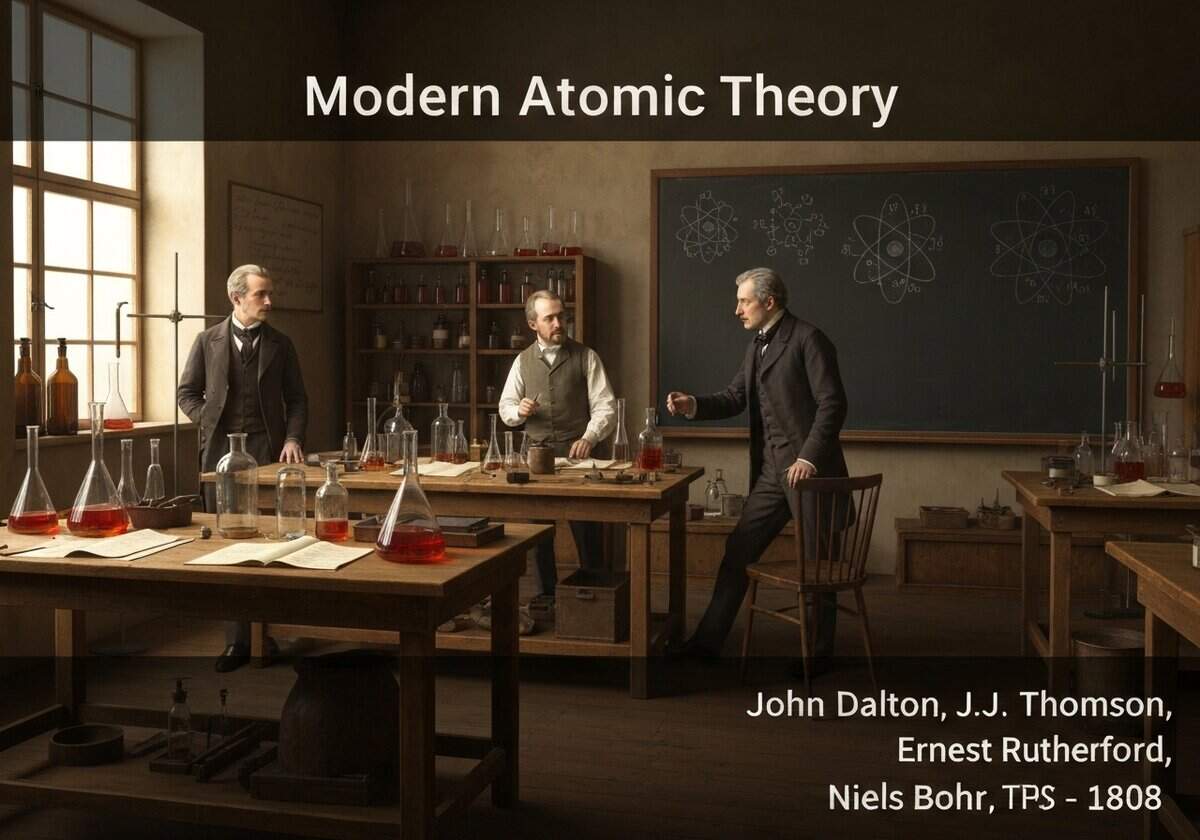
Modern Atomic Theory
1808
- John Dalton
- J.J. Thomson
- Ernest Rutherford
- Niels Bohr
Atomic theory posits that all matter is composed of discrete units called atoms. An element consists of atoms with a specific number of protons in their nucleus. While once considered indivisible, atoms are now known to comprise subatomic particles: protons, neutrons, and electrons. Chemical reactions involve the rearrangement of these atoms, which are conserved during the process.
The modern understanding of the atom is the result of a series of revolutionary discoveries that refined initial concepts. John Dalton’s early 19th-century theory provided the first scientific framework, postulating that elements were made of identical, indivisible atoms and that compounds were combinations of these atoms in fixed ratios. This explained the laws of mass conservation and definite proportions. However, the discovery of the electron by J.J. Thomson in 1897 proved that atoms were divisible. He proposed the ‘plum pudding’ model, with electrons embedded in a sphere of positive charge.
This model was overturned by Ernest Rutherford’s gold foil experiment in 1909. By firing alpha particles at a thin gold foil, he observed that while most passed through, a few were deflected at large angles. This implied a small, dense, positively charged nucleus, leading to his planetary model of the atom with electrons orbiting the nucleus. Niels Bohr refined this in 1913 by incorporating quantum ideas, proposing that electrons exist in specific, quantized energy levels or orbits. This model successfully explained the emission spectra of hydrogen. The final major evolution was the development of quantum mechanics in the 1920s by Schrödinger, Heisenberg, and others. In the current quantum mechanical model, electrons do not have fixed orbits but exist in probability distributions called orbitals, described by wavefunctions. This sophisticated model is the foundation for understanding chemical bonding, reactivity, and the properties of all matter.
UNESCO Nomenclature: 2201
– Atomic and molecular physics
Precursors
- ancient greek concept of ‘atomos’ (Democritus, Leucippus)
- law of conservation of mass (Lavoisier)
- law of definite proportions (Joseph Proust)
- law of multiple proportions (John Dalton)
Applications
- development of the periodic table
- understanding chemical bonding and molecular structure
- nuclear energy and weapons
- nanotechnology
- semiconductor technology and electronics
- spectroscopy for material analysis
Potential Innovations Ideas
Due to scrapping bot traffic, currently more than 40k per day, this content is reserved to community members.
> Login < or > Register < (100% free) to access this, so as all other restricted content and tools.
Related to: atom, atomic theory, John Dalton, nucleus, proton, neutron, electron, quantum mechanics, subatomic particles, chemical element.