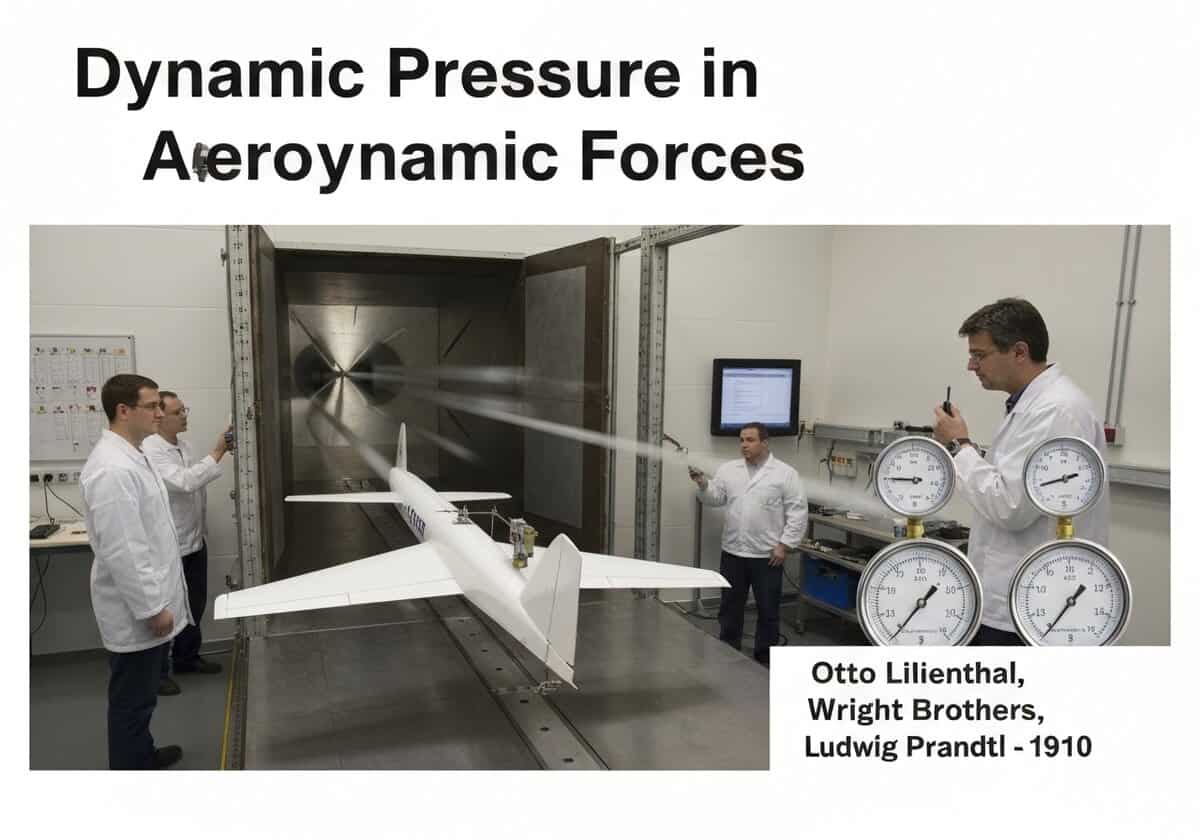
Dynamic Pressure in Aerodynamic Forces
1910
- Otto Lilienthal
- Wright brothers
- Ludwig Prandtl
Aerodynamic forces, such as lift and drag, on an object are directly proportional to the dynamic pressure of the surrounding fluid. The formulas are \(L = C_L \cdot q \cdot A\) and \(D = C_D \cdot q \cdot A\), where \(C_L\) and \(C_D\) are the dimensionless lift and drag coefficients, \(q\) is the dynamic pressure, and \(A\) is a reference area.
The use of dynamic pressure to define aerodynamic forces is a cornerstone of aeronautical engineering, enabling a powerful method of analysis called dimensional analysis. By expressing lift and drag in terms of dynamic pressure (\(q\)), a reference area (\(A\)), and a dimensionless coefficient (\(C_L\) or \(C_D\)), engineers can separate the effects of fluid properties and speed from the effects of the object’s shape. The coefficients \(C_L\) and \(C_D\) depend primarily on the shape of the body, its orientation to the flow (angle of attack), and the Reynolds number and Mach number. This separation is incredibly useful. For example, a scale model of an aircraft can be tested in a wind tunnel, and the measured lift and drag coefficients can be used to accurately predict the forces on the full-scale aircraft under different flight conditions (different altitudes, hence different densities, and different speeds).
A critical application of this concept in aerospace is the notion of “Max Q,” which refers to the point during a spacecraft’s atmospheric ascent where it experiences the maximum dynamic pressure. As a rocket accelerates, its speed (\(u\)) increases, causing \(q\) to rise. Simultaneously, as it gains altitude, the atmospheric density (\(\rho\)) decreases, causing \(q\) to fall. The combination of these two opposing effects results in a peak value for dynamic pressure. This is a moment of maximum mechanical stress on the vehicle, and its structure must be designed to withstand these loads. Throttling down the engines around Max Q is a common strategy to reduce these stresses and ensure the vehicle’s structural integrity.
UNESCO Nomenclature: 3301
– Aeronautical engineering and technology
Precursors
- Bernoulli’s principle
- Definition of dynamic pressure
- Newton’s laws of motion and fluid resistance concepts
- Early experimental work on airfoils by pioneers like George Cayley
Applications
- aircraft wing and fuselage design
- automobile and race car body shaping for downforce and efficiency
- turbine blade design for power generation
- design of sails for boats and yachts
- analysis of projectile trajectories (ballistics)
- wind engineering for building stability
Potential Innovations Ideas
Due to scrapping bot traffic, currently more than 40k per day, this content is reserved to community members.
> Login < or > Register < (100% free) to access this, so as all other restricted content and tools.
Related to: aerodynamics, lift, drag, dynamic pressure, lift coefficient, drag coefficient, airfoil, fluid dynamics, aeronautical engineering, max q.