Product Design, Manufacturing & Innovation Resources
Home » Delta-v (astrodynamics)

Delta-v (astrodynamics)

1900
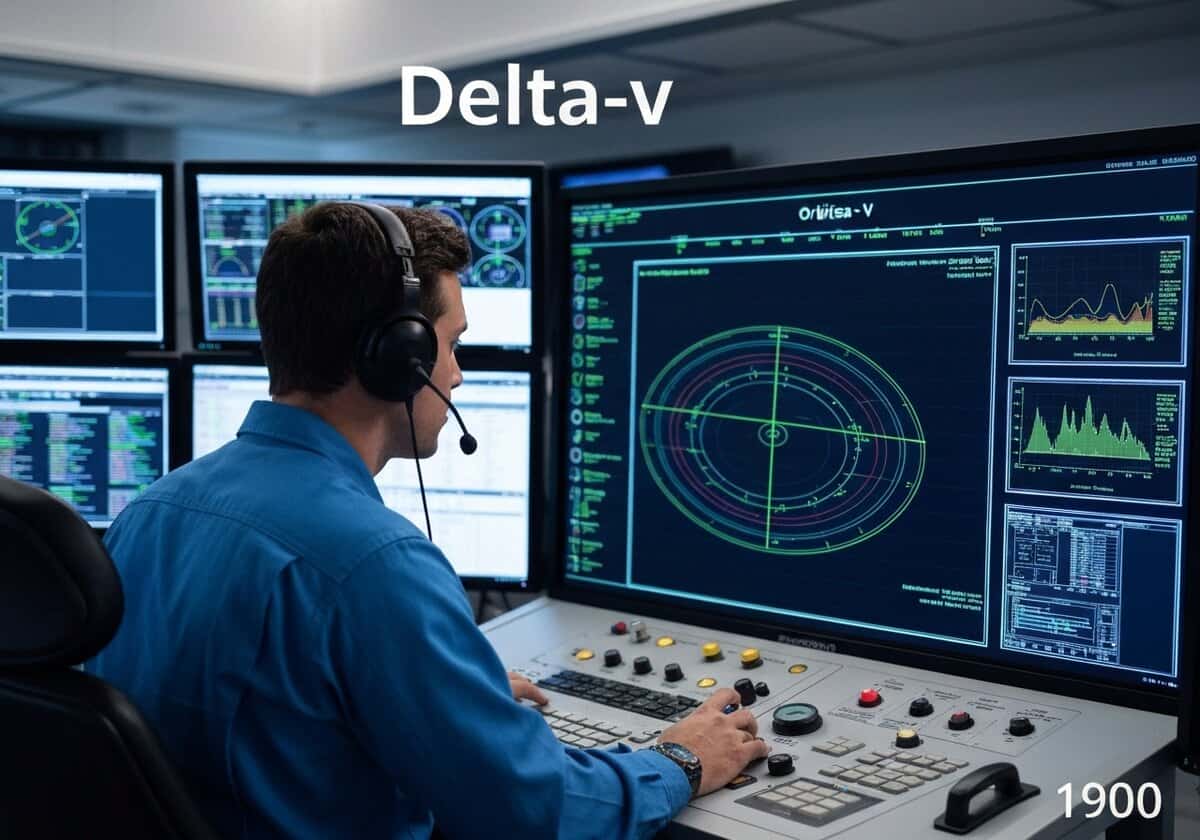
Aerospace engineer analyzing delta-v calculations in a control room.

(generated image for illustration only)

Delta-v, literally “change in velocity,” is a scalar measure of the impulse required to perform an orbital maneuver. It quantifies the total propulsive effort needed for a mission, independent of the spacecraft’s mass. This value is crucial for mission planning as it determines the necessary propellant load. Delta-v is cumulative; the total for a mission is the sum of all required maneuvers.

Delta-v (Δv) is one of the most fundamental concepts in astrodynamics, representing the change in velocity that a spacecraft’s propulsion system must provide. Unlike terrestrial travel where one might measure fuel in liters or gallons, in space, the ‘cost’ of a journey is measured in delta-v. This is because the amount of fuel required is directly proportional to the delta-v and depends on the spacecraft’s mass and engine efficiency, as described by the Tsiolkovsky rocket equation.

A key feature of delta-v is that it is additive. A mission is broken down into a series of maneuvers (e.g., launch to low Earth orbit, transfer to the Moon, lunar orbit insertion, landing). Each segment has an associated delta-v cost. These costs are summed to create a ‘delta-v budget’ for the entire mission. Mission planners must ensure the chosen spacecraft design can provide this total delta-v, with some margin for contingencies. For example, the delta-v to reach Low Earth Orbit (LEO) is approximately 9.4 km/s, while traveling from LEO to Mars orbit requires an additional 3.6 km/s. These values are calculated based on orbital mechanics and are independent of the specific spacecraft, making delta-v a universal metric for comparing mission requirements and vehicle capabilities.

UNESCO Nomenclature: 3301
– Aerospace engineering

Type

Abstract System

Disruption

Foundational

Usage

Widespread Use

Precursors

  • Isaac Newton’s laws of motion
  • principles of conservation of momentum
  • early work on ballistics and projectile motion by pioneers like Galileo Galilei

Applications

  • mission planning for interplanetary probes
  • calculating fuel requirements for satellites
  • designing launch vehicle ascent trajectories
  • planning orbital rendezvous and docking maneuvers

Patents:

NA

Potential Innovations Ideas

Due to scrapping bot traffic, currently more than 40k per day, this content is reserved to community members.
> Login < or > Register < (100% free) to access this, so as all other restricted content and tools.

Related to: delta-v, astrodynamics, orbital mechanics, spacecraft, impulse, velocity change, mission planning, specific impulse, propellant, rocket.

Historical Context

Delta-v (astrodynamics)

1890
1897
1900
1900
1903-05-10
1910
1910
1890
1890
1899-01-01
1900
1903
1906
1910
1910

(if date is unknown or not relevant, e.g. "fluid mechanics", a rounded estimation of its notable emergence is provided)

Full size images and downloads are only available, 100% free, for registered members.

> Login <