Product Design, Manufacturing & Innovation Resources
Home » AC Circuit Generalization of Ohm’s Law

AC Circuit Generalization of Ohm’s Law

1890
  • Oliver Heaviside
  • Charles Proteus Steinmetz
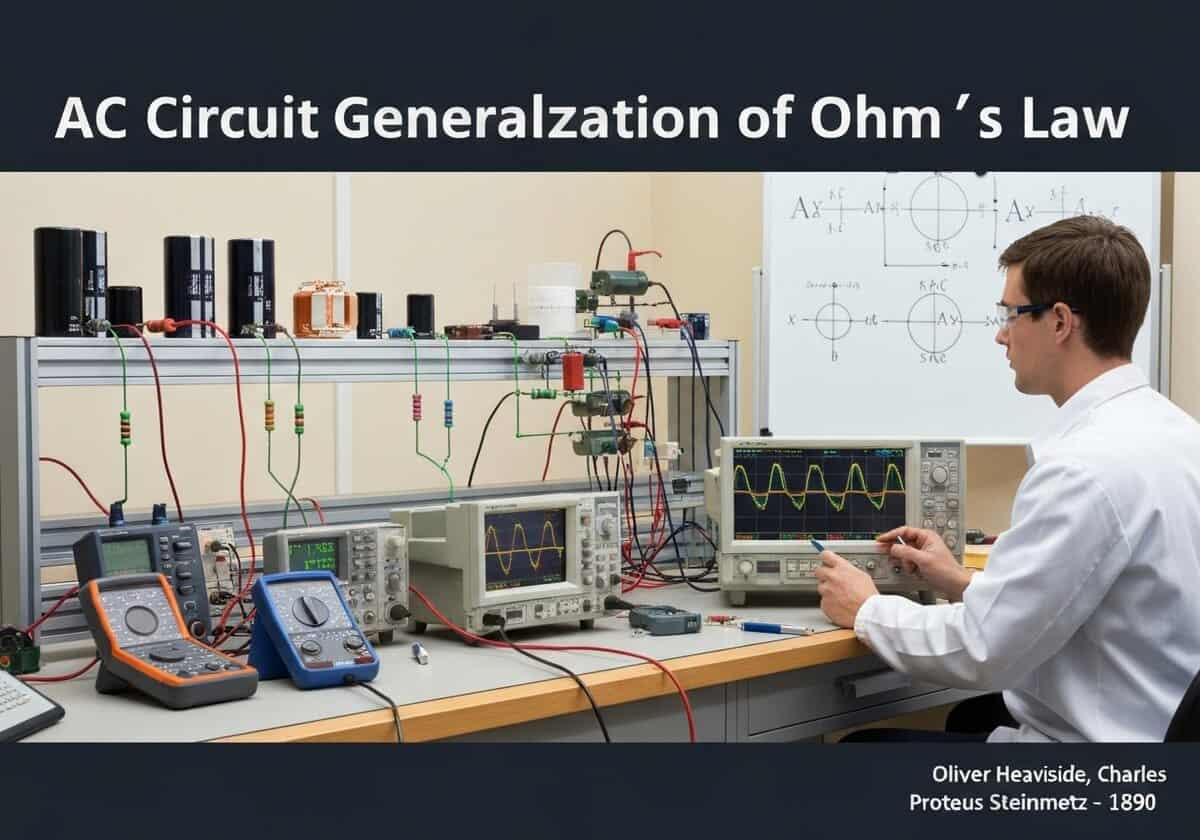
AC circuit setup with complex phasors in electrical engineering laboratory.

(generated image for illustration only)

For alternating current (AC) circuits, Ohm’s law is generalized using complex numbers to \(\mathbf{V} = \mathbf{I} \mathbf{Z}\). Here, \(\mathbf{V}\) and \(\mathbf{I}\) are complex phasors representing the sinusoidally varying voltage and current, capturing both magnitude and phase. \(\mathbf{Z}\) is the complex impedance, which extends the concept of resistance to include the effects of capacitors and inductors.


In AC circuits, capacitors and inductors introduce a phase shift between the voltage and current. Simple resistance is insufficient to describe this behavior. Impedance, \(\mathbf{Z}\), is a complex quantity defined as \(\mathbf{Z} = R + jX\), where \(R\) is the resistance (the real part) and \(X\) is the reactance (the imaginary part). Reactance is the opposition to current flow from capacitors (\(X_C\)) and inductors (\(X_L\)), and it is frequency-dependent.

This phasor form of Ohm’s law allows engineers to use algebraic methods, similar to those for DC circuits, to solve for magnitudes and phase angles in complex AC systems. The magnitude of the impedance, \(|\mathbf{Z}| = \sqrt{R^2 + X^2}\), determines the ratio of voltage amplitude to current amplitude. The phase angle of the impedance, \(\phi = \arctan(X/R)\), represents the phase difference between the voltage and current. This generalization is indispensable for modern electrical engineering, underpinning the design of everything from power supplies to wireless communication devices.

UNESCO Nomenclature: 3308
– Electrical engineering

Type

Abstract System

Disruption

Substantial

Usage

Widespread Use

Precursors

  • Ohm’s law for dc circuits
  • Michael Faraday’s law of induction, describing how changing magnetic fields create voltage
  • Joseph Henry’s work on self-inductance
  • James Clerk Maxwell’s unified theory of electromagnetism
  • The mathematical framework of complex numbers and phasor analysis

Applications

  • design of audio filters (high-pass, low-pass, band-pass)
  • analysis of power transmission and distribution grids
  • radio frequency (rf) circuit design for communication systems
  • impedance matching in antennas to maximize power transfer
  • modeling and analysis of rlc circuits in electronics

Patents:

NA

Potential Innovations Ideas

  • adaptive impedance matching networks for 5G/6G antennas that adjust in real-time to environmental changes
  • biomedical sensors that use impedance spectroscopy to differentiate between healthy and cancerous tissues
  • smart grid technologies that dynamically manage reactive power to improve efficiency
  • non-destructive testing equipment that identifies material defects by mapping impedance variations
  • active noise cancellation headphones with digital filters that are precisely tuned using impedance models
  • wireless charging systems that optimize power transfer by actively matching coil impedances
  • geophysical survey tools that use multi-frequency impedance measurements to characterize mineral deposits
  • haptic feedback systems that modulate impedance to create different tactile sensations
  • lab-on-a-chip devices that sort cells based on their unique electrical impedance profiles
  • software-defined radio (sdr) systems with reconfigurable impedance characteristics
Related to: AC circuits, impedance, reactance, phasor, complex numbers, alternating current, circuit theory, RLC circuit, phase shift, electrical engineering.

Historical Context

AC Circuit Generalization of Ohm’s Law

1876
1882-01-01
1886-04-23
1890
1897
1900
1900
1875-01-01
1881
1884
1890
1890
1899-01-01
1900
1903

(if date is unknown or not relevant, e.g. "fluid mechanics", a rounded estimation of its notable emergence is provided)

10th year anniversary

Full size images and downloads are only available, 100% free, for registered members.

> Login <