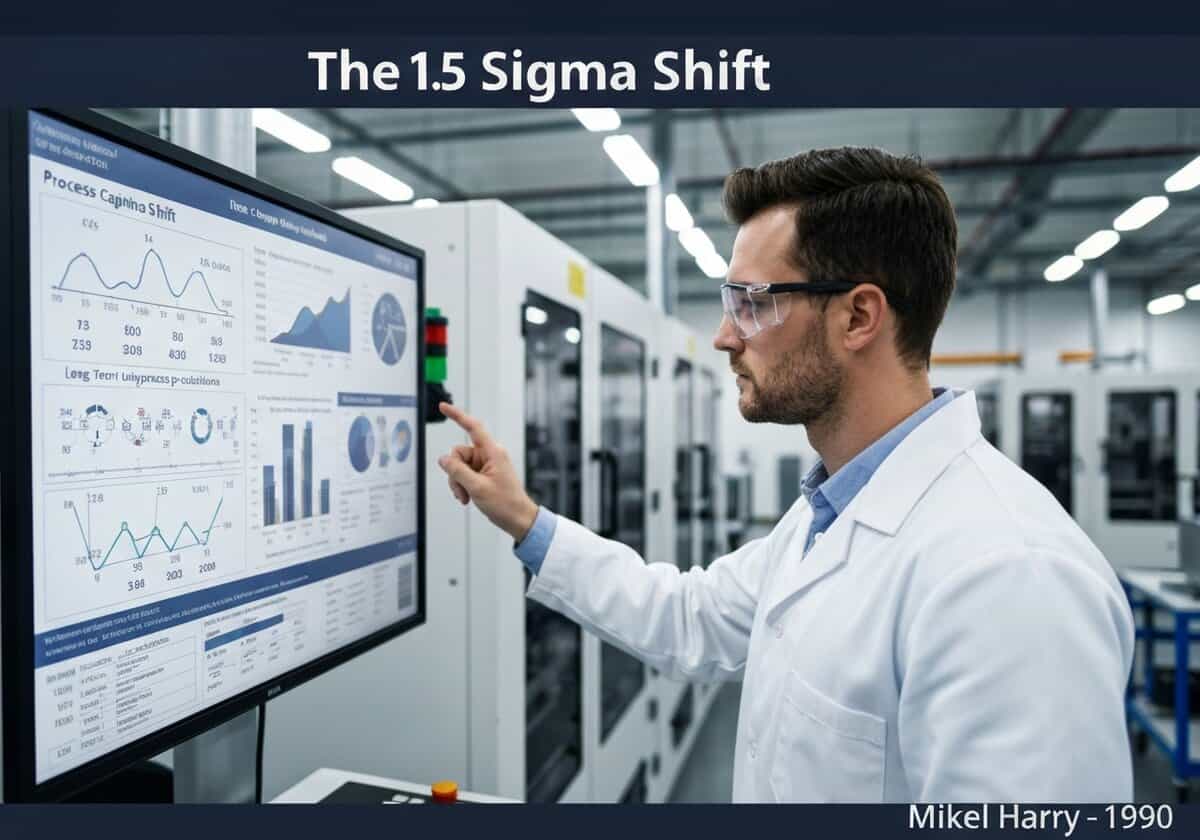
免责声明:1.5 西格玛转变是六西格玛中最具争议的方面之一。 它起源于 观察 that short-term data, collected over a brief period, typically shows less variation than long-term data from the same process. This is because over longer periods, factors like tool wear, material variations, operator differences, and environmental changes cause the process mean to drift. The 1.5 sigma value was determined empirically by Motorola engineers as a reasonable general estimate for this drift. By incorporating this shift, Six Sigma provides a more realistic, long-term view of process performance. The calculation for DPMO is thus based on the probability of an outcome falling outside a specification limit that is [latex]4.5\sigma[/latex] from the drifted mean ([latex]6\sigma – 1.5\sigma[/latex]). Critics argue that the 1.5 value is arbitrary and that a well-controlled process should not drift this much. Proponents argue it’s a pragmatic adjustment that makes the Six Sigma standard more applicable to real-world industrial processes.
Related to: 1.5 sigma shift, process drift, six sigma, dpmo, statistical process control, process capability, long-term variation, motorola, quality control, standard deviation.