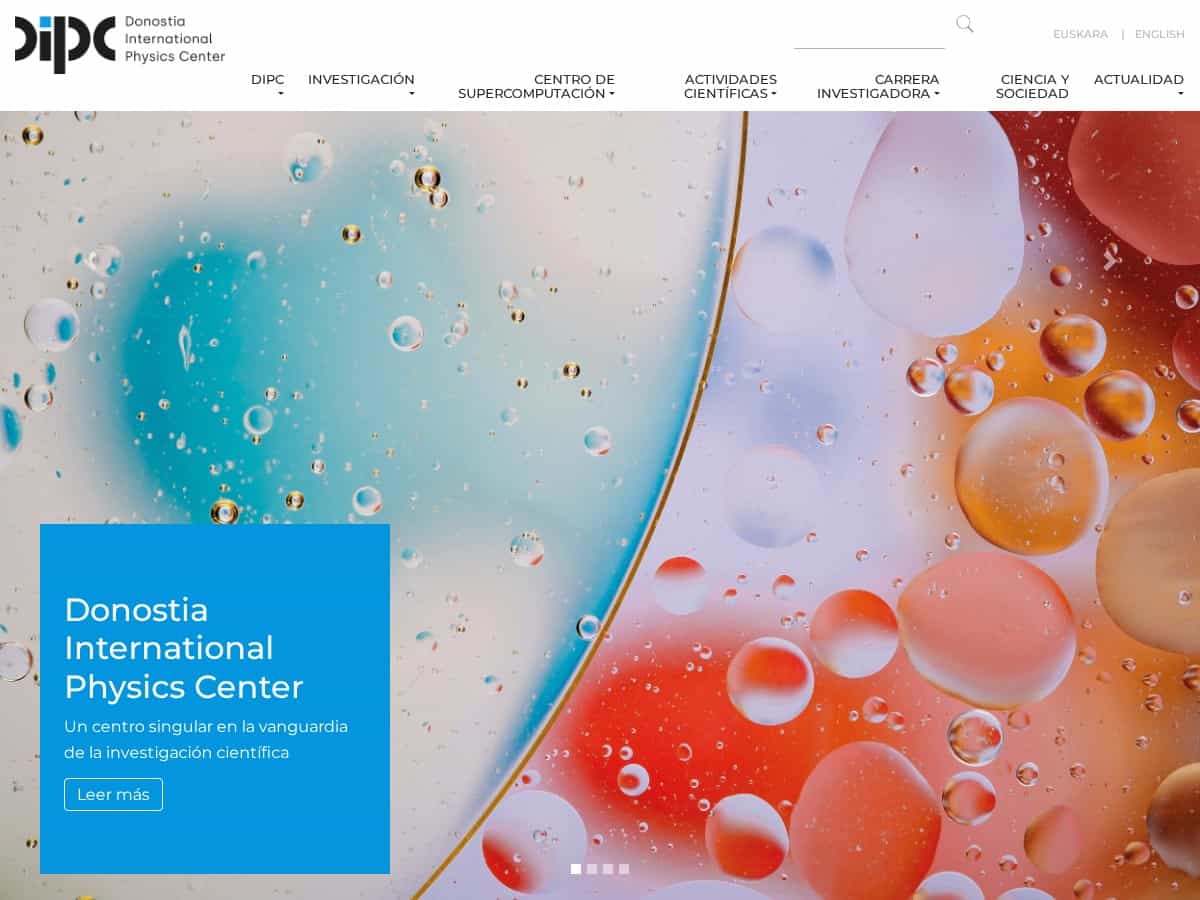
Donostia-San Sebastián, in Gipuzkoa, is the base of the Donostia International Physics Center, known as DIPC, a foundation that carries out basic research in physics and related fields and shares scientific culture with society. It began its activities in 2000.
DIPC is backed by the Basque Government, the Gipuzkoa Provincial Council, the San Sebastián City Council and the University of the Basque Country, together with companies such as Kutxa, EDP, Telefónica and CAF. Its work is organised in four thematic areas, called Quantum, Nano, Cosmos and Life, and covers condensed matter physics, materials science, nanoscience and physical chemistry.
Researchers, visiting scientists, PhD students and postdoctoral staff form the scientific community. Prospective applicants can find vacancies and visitor programmes on the DIPC website.
Foundation with public and private support. Strong international collaborations and a vibrant program of visiting researchers. Close ties with UPV/EHU.
Research:
Theoretical and computational research in electronic properties of materials, nanoscience, surface physics, polymer physics, and quantum phenomena in condensed matter.
Famous Alumnis:
Pedro Miguel Etxenike
International recognition**:
Number of staff***:
150
Current students***:
80
Foreign students***:
60%
Cumulative former students***:
200
Pros
Leading international research center in its specialized fields, fostering a dynamic scientific community. Excellent for doctoral and postdoctoral research.
Cons
Primarily a research institute; degrees awarded via collaborating universities. Very specialized.
Best For
PhD students and researchers specializing in condensed matter physics, materials science, or nanoscience, seeking a high-level international research environment.
Instituto de Ciencias Fotónicas studies photonics, quantum optics and nanophotonics near Barcelona.
Instituto de Física de Altas Energías is another public physics centre, devoted to particle physics, astrophysics and cosmology.
Instituto de Física Corpuscular, public, joins particle, astroparticle and nuclear physics in Valencia.
Centro de Investigaciones Energéticas, Medioambientales y Tecnológicas is a public centre working on energy technologies, environmental science and advanced materials.
Instituto de Ciencias Matemáticas offers pure and applied mathematics and mathematical physics in Madrid.
Okinawa Institute of Science and Technology Graduate University, in Japan, works in neuroscience, physics and chemistry.
Empa - Eidgenössische Materialprüfungs- und Forschungsanstalt (Switzerland) is a public research institute for materials science and nanotechnology.
Universiteit Twente, a Dutch public university, covers nanotechnology, biomedical engineering and robotics.
IHES in France is a private institute for mathematics and theoretical physics.
*our own picks (our criteria: a mix between domains, diploma delivered, reputation and size), but obviously too many criteria for an apple-to-apple ranking.
FAQ
What kind of organisation is DIPC?
It is a foundation devoted to basic research in physics and related disciplines. It also aims to share science with the wider public.
Which areas does it research?
Work is grouped into Quantum, Nano, Cosmos and Life. Topics include condensed matter, materials science, nanoscience and physical chemistry.
Who supports it?
Public backers include the Basque Government, the Gipuzkoa Provincial Council, the San Sebastián City Council and the University of the Basque Country. Companies including Kutxa, EDP, Telefónica and CAF are also listed.
Where is it?
DIPC is in Donostia-San Sebastián in Gipuzkoa, in the Spanish Basque Country. The address is on its website.
Who works there?
The community includes DIPC researchers, visiting researchers, PhD students and postdocs, plus technical and administrative staff.
Can students train there?
PhD students and postdoctoral researchers are part of the DIPC community. It is a research centre, not a degree-awarding university.
How do I join as a visitor or fellow?
The DIPC website announces calls for positions and visits. Conditions differ by programme.
*: without any judgment of the quality, readers are strongly encouraged to check the official status of the exact diploma envisioned as many universities have a mix of recognized diplomas, not recognized, “co-delivered,” “equivalent to”, “some pathways” (…), can change over time, and can be named differently from one country to another.
**: international reputation: is based on some criteria that do not mean much in some domains or specialties (number of researchers, of scientific publications, on budget ….). Our approximate 1-4 scale:
known locally
known locally and internationally
is listed in some of the world university’s classifications
is listed among the 20 firsts in some of world university’s classifications
***: estimated numbers, based on online sources and/or feedbacks. The numbers can vary greatly depending on school organisation (ex.: school is part of a group, it employs internal staff or external consultants or has public staff without employing them …). Refer to all the links provided to have accurate and updated numbers.
Innovation.world is not affiliated with this school/university. We recommend to contact them directly on their website for any special request.
To complete or correct any information here or share your opinion, please comment below or > send us a direct message <.