Product Design, Manufacturing & Innovation Resources
घर » क्यूरी तापमान

क्यूरी तापमान

1895
  • Pierre Curie
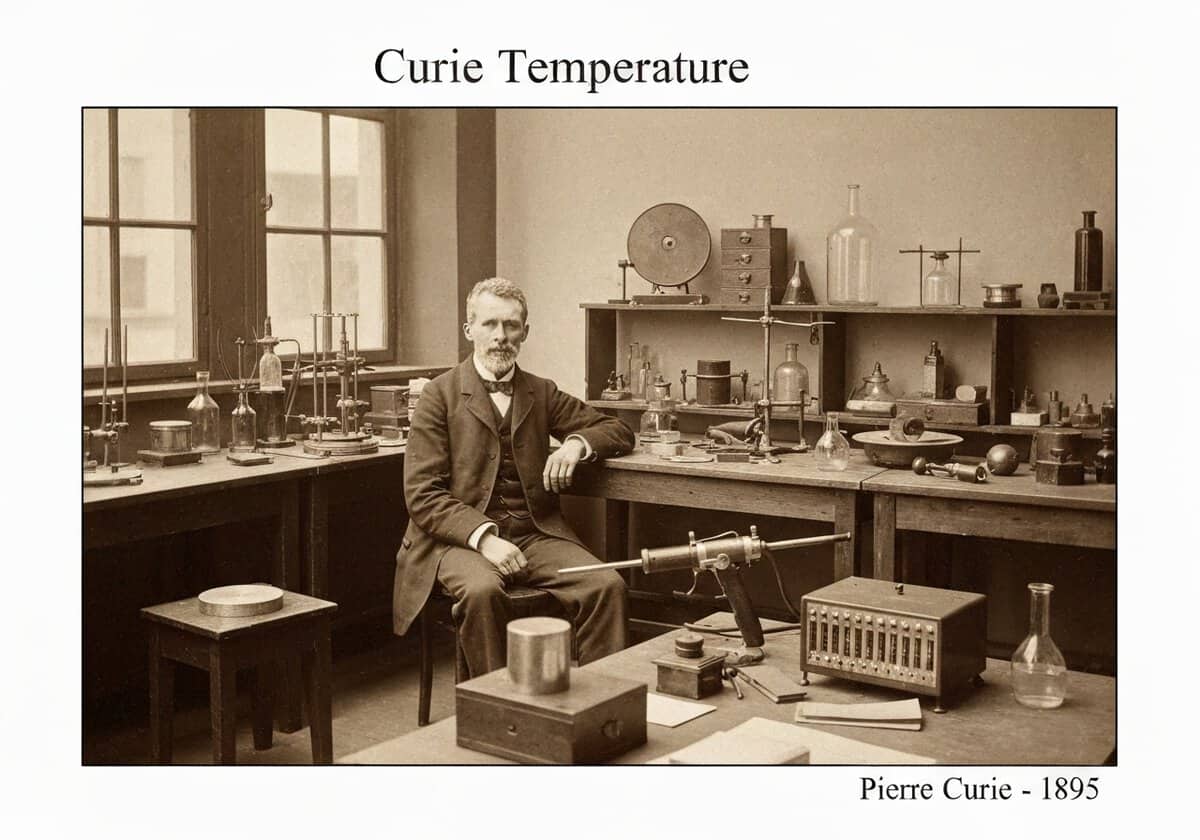
1895 में पियरे क्यूरी द्वारा चुंबकीय गुणों का अध्ययन करते हुए प्रयोगशाला का दृश्य।

(यह छवि केवल उदाहरण के लिए बनाई गई है)

क्यूरी तापमान (T_c), या क्यूरी बिंदु, वह क्रांतिक तापमान है जिसके ऊपर कुछ पदार्थ अपने स्थायी चुंबकीय गुण खो देते हैं। लौहचुंबकीय पदार्थ T_c से ऊपर पराचुंबकीय हो जाते हैं। यह एक अवस्था परिवर्तन है जहाँ ऊष्मीय ऊर्जा इतनी प्रबल हो जाती है कि वह परमाणु क्षणों के स्वतः चुंबकीय क्रम का कारण बनने वाली क्वांटम यांत्रिक विनिमय अंतःक्रियाओं पर विजय प्राप्त कर लेती है।

Pierre Curie discovered that a material’s magnetism changed at a specific temperature, a finding that was crucial for understanding the nature of magnetism. Below the Curie temperature ([latex]T_c[/latex]), the exchange interaction dominates, forcing adjacent atomic magnetic moments to align, creating the spontaneous magnetization characteristic of लोहित चुंबकत्व. As the temperature increases, thermal agitation causes the moments to fluctuate more randomly. At the Curie temperature, the thermal energy is sufficient to completely disrupt this long-range ordering. The material undergoes a second-order phase transition, and its spontaneous magnetization drops to zero. Above [latex]T_c[/latex], the material is paramagnetic; an external magnetic field can still induce a weak alignment of the atomic moments, but this alignment disappears once the field is removed.

प्रत्येक ferromagnetic material has a unique Curie temperature. For example, iron’s [latex]T_c[/latex] is 770 °C (1043 K), cobalt’s is 1130 °C (1403 K), and nickel’s is 358 °C (631 K). This property is exploited in various प्रौद्योगिकियों. For instance, magneto-optical discs use a laser to heat a small spot of magnetic material above its Curie point, allowing a weak magnetic field to change its magnetic orientation to write data. In paleomagnetism, the Curie temperature is fundamental for studying the Earth’s past magnetic field, as magnetic minerals in cooling volcanic rocks align with the Earth’s field and lock in that orientation as they cool below their [latex]T_c[/latex].

UNESCO Nomenclature: 2211
ठोस अवस्था भौतिकी

Type

स्थूल संपत्ति

व्यवधान

संतोषजनक

उपयोग

व्यापक उपयोग

शगुन

  • ऊष्मा और तापमान की समझ
  • गर्म करने पर चुम्बकों की शक्ति कम होने के प्रारंभिक अवलोकन
  • ऊष्मागतिकी का विकास
  • पदार्थ का परमाणु सिद्धांत

आवेदन

  • सामग्रियों का ऊष्मीय विचुम्बकीकरण
  • ऊष्माचुंबकीय डेटा भंडारण (चुंबकीय-प्रकाशिक डिस्क)
  • तापमान सेंसर
  • तापमान नियंत्रण वाली सोल्डरिंग गन
  • पृथ्वी के इतिहास के पुराचुंबकत्व अध्ययन

पेटेंट:

NA

संभावित नवाचार विचार

  • कैंसर के इलाज के लिए स्व-विनियमित चुंबकीय हाइपरथर्मिया
  • curie point engines for low-grade heat ऊर्जा संकलन
  • तापमान के साथ गुणधर्म बदलने वाले पुन: विन्यास योग्य चुंबकीय परिपथ
  • विशिष्ट तापमान पर खुलने वाले त्रुटि-मुक्त चुंबकीय कुंडी
  • एयरोस्पेस अनुप्रयोगों के लिए उच्च संवेदनशीलता वाले थर्मल स्विच
  • नियंत्रित थर्मल साइक्लिंग का उपयोग करने वाले डेटा मिटाने वाले उपकरण
  • phase-change materials for ऊष्मीय ऊर्जा भंडारण coupled with magnetic sensors
  • advanced उत्प्रेरक where magnetic state influences reactivity
  • तापमान पर निर्भर चुंबकीय परिरक्षण वाले स्मार्ट पदार्थ
  • अपशिष्ट ऊष्मा को बिजली में परिवर्तित करने के लिए पायरोमैग्नेटिक जनरेटर
संबंधित विषय: क्यूरी तापमान, क्यूरी बिंदु, लौहचुंबकत्व, पराचुंबकत्व, अवस्था संक्रमण, ऊष्मीय ऊर्जा, विनिमय अंतःक्रिया, पियरे क्यूरी, चुंबकत्व, ठोस-अवस्था भौतिकी।

ऐतिहासिक संदर्भ

क्यूरी तापमान

1890
1890
1895
1895
1896
1900
1900
1889
1890
1890
1895
1895
1899
1900
1900

(यदि तिथि अज्ञात है या प्रासंगिक नहीं है, उदाहरण के लिए "द्रव यांत्रिकी", तो इसके उल्लेखनीय उद्भव का एक अनुमानित आंकड़ा प्रदान किया गया है)

नवीनतम परिवर्धन

शीर्ष पोस्ट और लेख

शीर्ष मूल उपकरण

10वां वर्ष सालगिरह

पंजीकृत सदस्यों के लिए पूर्ण आकार की छवियाँ और डाउनलोड 100% निःशुल्क उपलब्ध हैं।