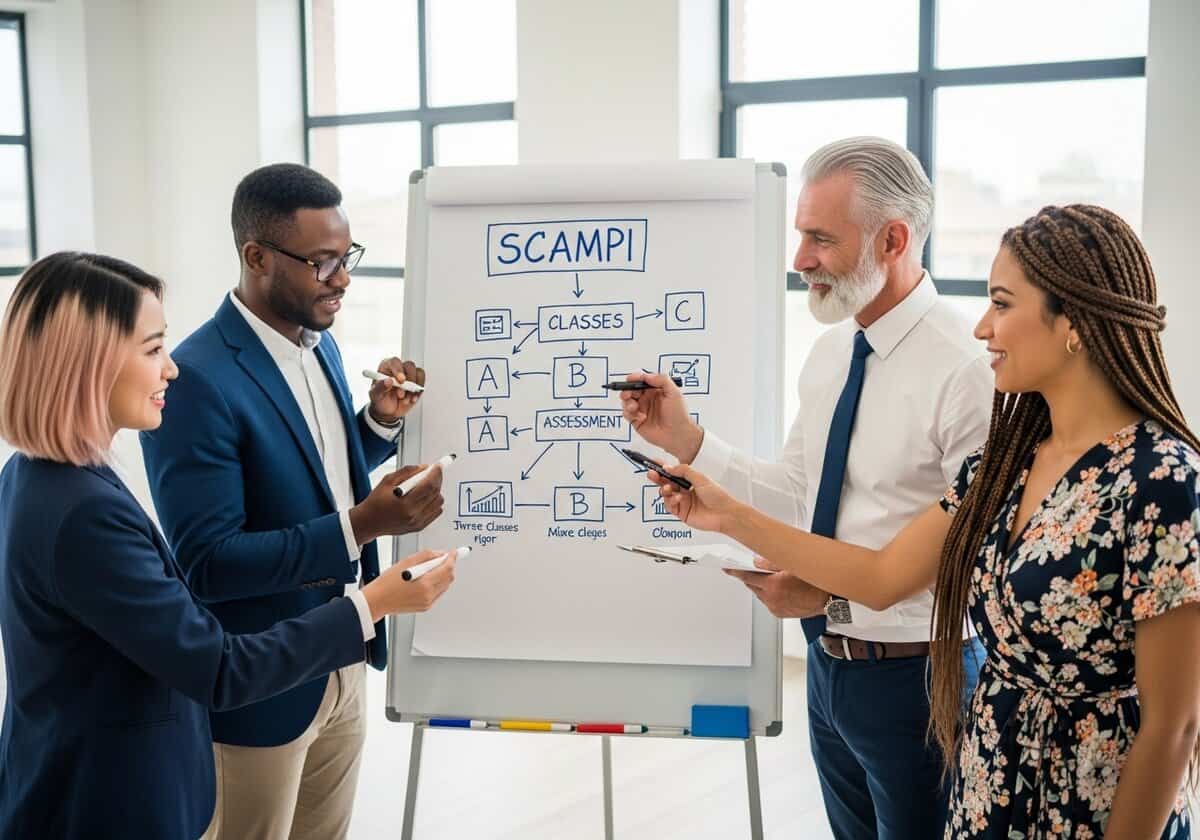
La méthodologie SCAMPI, ou Standard CMMI La méthode CMMI (Appraisal Method for Process Improvement) est une méthode d'amélioration des capacités organisationnelles par le biais d'une évaluation rigoureuse et d'une amélioration continue. Selon le Carnegie Mellon Software Engineering Institute, les organisations qui mettent en œuvre les cadres CMMI enregistrent une amélioration de 35% dans les domaines suivants performance des processus au fil du temps, ce qui démontre les avantages tangibles des processus d'évaluation structurés. Cet article explore en profondeur le cadre SCAMPI, en détaillant ses objectifs, la classification des types d'évaluation (classes A, B et C), les phases clés impliquées dans le processus d'évaluation SCAMPI et les rôles essentiels requis pour des évaluations efficaces.
A Retenir

- SCAMPI provides a structured approach for process improvement.
- Evaluation identifies strengths and weaknesses of processes.
- Three classes (A, B, C) define assessment rigor.
- Key phases include preparation, execution, and reporting.
- Les évaluateurs principaux guident l'évaluation équipes efficacement.
- Promotes organizational maturity across various sectors.
Definition of SCAMPI and its Framework
SCAMPI, qui signifie Standard CMMI Appraisal Method for Process Improvement, est une approche d'évaluation structurée conçue pour évaluer et améliorer les processus d'amélioration de la qualité. capacité du processus au sein des organisations. Il est ancré dans la Intégration du modèle de maturité des capacités (CMMI), un cadre éprouvé utilisé pour l'amélioration des processus dans le domaine de l'ingénierie logicielle et de l'ingénierie des systèmes.
The SCAMPI methodology facilitates organizations in identifying strengths and areas needing enhancement by conducting thorough evaluations that align with predefined maturity levels, which range from Level 1 (Initial) to Level 5 (Optimizing).
The detailed CMMI Framework can be found here (recommended before this detailed SCAMPI):

The SCAMPI framework comprises various components, including appraisal protocols, guidelines, and a set of objectives that drive the evaluation process. Within this framework, three classes of appraisals are distinctly identified, an organization being able to choose a specific class based on its goals, size, and specific industry requirements:
- Class A provides the most rigorous assessment, involving comprehensive data collection and analysis
- Classes B and C offer varying degrees of depth and focus.
Additionally, the methodology serves as a mechanism for ensuring compliance with industry standards and government regulations. Organizations involved in defense contracting or quality assurance must adhere to strict guidelines, making SCAMPI crucial in demonstrating accountability and reliability. Appraisals can uncover areas needing corrective actions, enabling organizations to maintain compliance while improving their operational readiness.
Conseil: organizations should integrate SCAMPI objectives into their strategic planning to ensure alignment between resource allocation and process improvement initiatives. This alignment can lead to optimized investments in training and technology, further amplifying the impact of the SCAMPI methodology in details across all levels of the organization.
SCAMPI Classes and Their Specific Applications
SCAMPI (Standard CMMI Appraisal Method for Process Improvement) exists in three distinct classes, each designed to serve different appraisal needs and contexts.
- Class A appraisals: sont les plus complètes, exigeant une évaluation complète des processus d'une organisation par rapport au modèle CMMI. Cette classe est utilisée pour évaluer la capacité d'une organisation à atteindre les niveaux de maturité et est essentielle pour les projets de grande envergure où la conformité et la gestion des risques sont primordiales. Par exemple, une entreprise de défense peut subir une évaluation de classe A pour s'assurer que ses processus répondent aux normes strictes du ministère de la défense en matière de gestion de programme, ce qui permet d'améliorer le taux de réussite des projets et de réduire les coûts de mise en œuvre. cycle de vie coûts. Durée totale typique : 6-8 semaines.
- Class B appraisals: offer an intermediate approach, typically conducted with less rigor than Class A. This class is suitable for organizations looking to gain insight into their process strengths and weaknesses without committing to a full assessment. The findings can guide targeted improvements, which can lead to an increase in both efficiency and customer satisfaction. Typical total duration: 4-6 weeks.
- Class C appraisals: are the least formal and are commonly used for internal assessments or benchmarking against industry standards. They help organizations identify process areas needing improvement without the associated costs of higher classes. Frequently, small businesses adopt this class to establish foundational practices that support future growth. A notable benefit is that Class C appraisals can reveal quick wins in process improvement, enabling rapid feedback loops for ongoing enhancement. Typical total duration: 2-4 weeks.
Le choix entre ces classes dépend de plusieurs facteurs, notamment les objectifs organisationnels et la situation actuelle. niveau de maturitéet les exigences réglementaires. Les organisations pourraient envisager d'utiliser une certification de classe A pour une reconnaissance officielle par les parties prenantes externes, tout en optant pour une certification de classe B ou C pour les audits internes ou les projets pilotes.
The SCAMPI Appraisal Process
Essential Roles in the SCAMPI Evaluation
| Le processus d'évaluation du SCAMPI s'appuie sur différents rôles qui s'alignent pour garantir une évaluation efficace de la maturité des processus d'une organisation : |  |
| The Appraisal Team Leader (ATL): directs the overall evaluation, functioning as a mediator between the organization and the SCAMPI team. The ATL must possess extensive experience in appraisal methodologies and should ideally have completed related training. A successful ATL streamlines communication, coordinates schedules, and ensures that all team members possess the necessary skills to perform their roles efficiently. | The Appraisal Team Members (ATMs): who perform several tasks, including data collection, document review, and observation during interviews. ATMs bring subject matter expertise in specific domains, which is crucial for making informed judgments about the organization’s practices. These members are also responsible for verifying that evidence aligns with appraisal criteria laid out in the SCAMPI methodology in details. |
| Subject Matter Experts (PME): also play a significant part in the SCAMPI evaluation, providing targeted insights into areas such as technical practices, risk management, and quality assurance. SMEs enhance the appraisal accuracy, ensuring that findings are well-founded. | The Organization representative: this individual assists the appraisal team in understanding the organizational context, policies, and existing practices. He is responsible for facilitating meetings, actively engaging in discussions and offering organizational insights, he bridges the gap between the SCAMPI evaluation team and the internal processes. |
The SCAMPI Steps
The SCAMPI appraisal process consists of distinct phases designed to assess and improve organizational processes systematically:
| SCAMPI Class A Appraisals | SCAMPI Class B Appraisals | SCAMPI Class C Appraisals | |
|---|---|---|---|
| 1. Initiation & Purpose | Specific: sponsor authorizes for official maturity/capability level rating, benchmarking, or supplier qualification. SEI-Authorized Lead Appraiser is mandatory. Objectives and scope are formally defined and documented. | Specific: sponsor defines purpose, typically for internal process improvement, initial gap analysis, risk identification, or progress tracking between Class A appraisals. Lead Appraiser is CMMI knowledgeable but not necessarily SEI-authorized. Objectives and scope are more flexible. | Specific: sponsor defines a very specific, narrow focus (e.g., health check of a single process area, readiness for a minor change, or verifying a specific practice). Often conducted by internal personnel with CMMI knowledge. Emphasis on quick turnaround and targeted insight. |
| 2. Planning the Appraisal | Specific: requires a detailed, formal appraisal plan (schedule, resources, logistics, data needs, team roles). Rigorous team selection and formal training. Organizational Unit (OU) preparation is extensive, often including a readiness review. Formal identification of required objective evidence. | Specific: involves a less formal appraisal plan. Team selection is more flexible, based on knowledge and availability. OU preparation is less intensive. Focus on identifying key areas for data collection efficiently. | Specific: minimal formal planning. Quick identification of scope, participants, and data sources. Often utilizes opportunistic scheduling and existing resources. |
| 3. Preparing for Data Collection | Specific: involves development/tailoring of comprehensive data collection instruments (interview scripts, document review checklists based on all CMMI PIs). Appraisal team is formally trained on the CMMI model and the SCAMPI A method.Extensive review of preliminary objective evidence is mandatory. | Specific: involves development or adaptation of data collection instruments, which can be less structured or use standard templates. Team familiarization with relevant CMMI areas. Review of readily available documentation. Less emphasis on exhaustive preliminary evidence. | Specific: utilizes informal checklists or highly focused questions.Minimal specific preparation, relying on existing knowledge of the process area and the specific objective. |
| 4. Conducting Data Collection (On-site/Remote) | Specific: starts with a formal opening meeting. Involves extensive and rigorous data collection through interviews (practitioners, managers, process owners), thorough document reviews (direct and indirect evidence for all PIs in scope), and observation of demonstrations. Daily data consolidation and validation by the entire team. A rigorous evidence trail is maintained. | Specific: data collection through interviews (individual or group), document reviews, and potentially workshops. Focus is on identifying strengths and weaknesses broadly across selected areas. Data consolidation is less formal and iterative. Evidence trail is less rigorous. | Specific: highly targeted and rapid data collection (e.g., short, focused interviews with key personnel, review of specific artifacts or records). Can be very short in duration (hours to a few days). Focus is solely on the predefined specific objective. |
| 5. Consolidating & Validating Data / Analysis | Specific: involves rigorous corroboration of evidence from multiple sources (triangulation) for all PIs. Formal characterization of practice implementation (strengths, weaknesses, alternative practices) against CMMI goals and practices. Draft preliminary findings are documented and reviewed by the team for consensus against strict criteria. | Specific: consolidation of observations and collected data. Identification of key process strengths, weaknesses, and improvement opportunities/themes. Analysis is more qualitative and focused on identifying patterns and areas for improvement rather than formal characterization. | Specific: rapid analysis of collected information directly against the specific focus of the appraisal. Identification of key observations and immediately actionable items. |
| 6. Generating Ratings/Findings | Specific: formal determination of satisfaction for CMMI Specific Goals and Generic Goals based on collected, validated objective evidence. Leads to the generation of official Maturity Level rating (Staged representation) or Capability Level ratings (Continuous representation) by the SEI-Authorized Lead Appraiser. | Specific to Class B & C: No official ratings are produced. Class B Specific: findings focus on gaps against the CMMI model, areas of concern, potential risks, and detailed recommendations for improvement. Observations are often mapped to CMMI practices if applicable. Class C Specific: findings are typically direct observations related to the narrow scope and are presented as actionable feedback or quick wins. | |
| 7. Reporting Results | Specific: results in a formal, comprehensive appraisal report including scope, method, team, detailed findings (strengths, weaknesses per Process Area), supporting objective evidence, and the official ratings. Formal presentation to sponsor and OU. If rated, an Appraisal Disclosure Statement and data package are submitted to the CMMI Institute. Formal closing meeting. | Specific: report focuses on findings, observations, identified risks, and detailed recommendations for process improvement. Format can be less formal than Class A. Presentation to sponsor and relevant stakeholders. Primarily for internal distribution and use. | Specific: often an informal report, email summary, or brief presentation summarizing key observations and suggested immediate actions. Emphasis is on quick, practical feedback to the target audience. |
| Resource Intensity & Duration | High resource intensity (larger team size, significant effort from OU personnel, cost). Typically 1-3 weeks for the on-site/data collection phase, plus significant preparation (weeks/months) and reporting time (weeks). | Medium resource intensity. Duration varies, often 3-10 days for data collection and analysis, with less preparation and reporting overhead than Class A. | Low resource intensity. Typically 1-3 days, including preparation and reporting. Very focused effort on a small scale. |
| Typical examples |  A large defense contractor requires an official CMMI Maturity Level 3 rating to bid on a government contract. |  A software development department wants to assess its current process maturity against CMMI Level 2 practices to identify key areas for improvement before considering a formal Class A appraisal. |  A project team manager wants a quick check on whether the team is consistently following the newly implemented peer review process for critical software modules. |
| Tips |
|
|
|
Bonus: SCAMPI parameters vs CMMI Maturity Levels
Our industry-unique technical, quality, legal, quality, control parameters suggested per each CMMI Maturity Level and SCAMPI Class Appraisals (big screen strongly recommended).
| CMMI Maturity Level | SCAMPI Class A Appraisals | SCAMPI Class B Appraisals | SCAMPI Class C Appraisals |
|---|---|---|---|
| ML1: Initial | Specific: Bien que le point ML1 ne soit pas un objectif à atteindre (c'est le point de départ), une évaluation de classe A l'évalue indirectement. Si une organisation ne parvient pas à atteindre les objectifs des domaines de processus (DP) du niveau ML2, elle est, par défaut, évaluée au niveau ML1.
| Specific to Class B & C: n'est généralement pas l'objet direct d'une "inspection ML1", car l'objectif est généralement l'amélioration vers des niveaux plus élevés. Si l'on évalue une organisation soupçonnée d'être au niveau ML1 :
| |
| ML2: Managed | Specific: rigorous inspection of all ML2 Process Areas (REQM, PP, PMC, SAM, MA, PPQA, CM). Requires objective evidence for institutionalization via Generic Practices (GP 2.1 to GP 2.10) at the project level.
Evidence of project-level process discipline is mandatory for an ML2 rating. | Specific: reviews practices related to ML2 PAs to identify strengths, weaknesses, and improvement opportunities. Less formal evidence collection and validation than Class A.
Aims to provide a gap analysis against ML2 PAs for internal improvement or Class A readiness. | Specific: highly focused deep dive into one or two specific ML2 practices, a single PA, or an aspect of a PA on a specific project (par exemple, "Efficacité de la traçabilité des exigences pour le projet X" ou "Le processus de contrôle des changements pour le projet Y est-il respecté ?)
Provides quick, targeted feedback on a limited aspect of ML2. |
| ML3: Defined | Specific: rigorous inspection of all ML3 Process Areas (e.g., RD, TS, PI, VER, VAL, OPF, OPD, OT, IPM, RSKM, DAR) in addition to ML2 PAs. Requires evidence of an organizational standard set of processes and supporting assets, and that projects tailor from these. Institutionalization via GPs up to GP 3.2.
Evidence of organizational standardization, tailoring, and process asset deployment is mandatory for an ML3 rating. | Specific: explores the existence, adequacy, deployment, and use of organizational standard processes and assets.
Assesses the maturity of organizational process infrastructure and consistency of its use. | Specific: could investigate a specific organizational process, asset, or ML3 practice (par exemple, "Dans quelle mesure le processus standard de gestion des risques de l'organisation est-il adapté et utilisé par le projet Z ?" ou "Utilité du nouveau modèle de spécification des exigences de la PAL").
Checks health, adoption, or effectiveness of a very specific part of the ML3 infrastructure. |
| ML4: Quantitatively Managed | Specific: rigorous inspection of ML4 PAs (OPP, QPM) in addition to ML2 & ML3 PAs. Requires objective evidence of statistical and quantitative management of selected subprocesses.
Deep dive into data validity, statistical methods, criteria for subprocess selection, and how quantitative insights drive project and process management is mandatory for an ML4 rating. | Specific: explores initial efforts towards or readiness for quantitative management. Does not verify statistical validity deeply.
Identifies opportunities for, and readiness towards, implementing quantitative management. | Specific: could look at a specific subprocess to assess its stability or data richness for potential quantitative management. Or, review the application of a pilot quantitative technique on a project.
Assesses feasibility or early results of a very limited quantitative effort for a narrow scope. |
| ML5: Optimizing | Specific: rigorous inspection of ML5 PAs (OPM, CAR) in addition to ML2, ML3 & ML4 PAs. Requires objective evidence of continuous, data-driven process improvement and innovation.
Evidence of a sustained, data-driven continuous improvement culture and tangible performance benefits is mandatory for an ML5 rating. | Specific: identifies opportunities for innovation or more systematic causal analysis and problem prevention. Does not verify deep statistical impact or institutionalization of improvements.
Assesses potential for or early stages of establishing an optimizing culture and systematic improvement mechanisms. | Specific: could assess the effectiveness of a specific pilot improvement initiative or the application of a specific causal analysis technique for a recurring problem.
Evaluates a single instance of an improvement, problem-solving activity, or innovation effort. |
Conseil: regularly revisiting SCAMPI appraisal results can cultivate an environment of sustained improvement, helping organizations stay ahead of regulatory changes and competitive pressures.
Conclusion
The SCAMPI methodology serves as a cornerstone for organizations aiming to enhance their process maturity through systematic evaluation and targeted improvement strategies. By adhering to structured phases and clearly defined roles, organizations can effectively implement the CMMI framework and witness substantial performance enhancements. The significant statistic from the Carnegie Mellon Software Engineering Institute—that organizations leveraging CMMI frameworks achieve a 35% improvement in process performance—speaks volumes about the tangible benefits derived from rigorous appraisal practices such as those found within the SCAMPI methodology in details.

FAQ
What is the SCAMPI methodology?
SCAMPI stands for Standard CMMI Appraisal Method for Process Improvement. It is a structured approach designed to evaluate and enhance organizational processes using the CMMI framework.
What are the different classes of SCAMPI and their specific applications?
SCAMPI has three classes: A, B, and C. Class A is formal and comprehensive, used for official CMMI ratings, while Classes B and C are less formal and focus on readiness assessments or internal evaluations.
How does SCAMPI impact organizational process maturity?
SCAMPI provides organizations with a detailed understanding of their process maturity levels. This insight enables targeted improvements, ultimately leading to higher efficiency and effectiveness.
How does SCAMPI relate to CMMI models?
SCAMPI is directly based on CMMI models, using their framework to assess and enhance processes. It aligns organizational practices with the best practices outlined in the CMMI framework.
Sujets connexes
- Benchmarking practices: une méthode permettant de comparer les processus de l'organisation avec ceux des leaders de l'industrie afin d'identifier les lacunes.
- Analyse des causes profondes (RCA) : a technique for finding the underlying reasons for process deficiencies or failures.
- Process Mapping: visual representation of workflows to analyze and improve organizational processes.
- Continuous improvement models: des cadres comme PDCA ou Six Sigma qui facilitent l'amélioration continue des processus.
- Capability Maturity Model Integration (CMMI) Frameworks: detailed guides designed to improve process efficiencies across organizations.
- Change management strategies: structured approaches to managing change in processes and organizational culture.
- Quality Management Systems (QMS): a set of coordinated activities to direct and control an organization to consistently improve quality.
- Stakeholder engagement techniques: strategies for involving all relevant parties in the improvement process to ensure success.
- Risk management frameworks: structured methodologies for identifying and managing potential risks in projects and processes.
- Performance measurement systems: frameworks for assessing the efficiency and effectiveness of processes and practices.
Glossaire des termes utilisés
Asynchronous Transfer Mode (ATM): Technologie de réseau haut débit utilisant des cellules de taille fixe pour la transmission de données, permettant une communication efficace et flexible sur différents supports. Elle prend en charge plusieurs types de services, notamment la voix, la vidéo et les données, facilitant ainsi la gestion de la qualité de service (QoS).
Capability Maturity Model Integration (CMMI): Un cadre d'amélioration des processus qui fournit aux organisations les éléments essentiels pour une amélioration efficace de leurs processus, en mettant l'accent sur la performance, la qualité et l'efficacité dans divers domaines, notamment le développement logiciel et la prestation de services. Il comprend cinq niveaux de maturité pour guider la croissance organisationnelle.
Computer Aided Manufacturing (CAM): une technologie qui utilise des logiciels et des machines contrôlées par ordinateur pour automatiser les processus de fabrication, permettant une production précise, des modifications de conception et une gestion efficace des ressources dans diverses industries.
Computer-Aided Manufacturing (CAM): L'utilisation de logiciels et de machines à commande numérique permet d'automatiser les processus de fabrication, améliorant ainsi la précision, l'efficacité et la cadence de production. Elle intègre les flux de travail de conception et de fabrication, permettant la conversion directe des modèles numériques en produits physiques.
Contract Manufacturer (CM): Une entreprise qui produit des biens pour le compte d'une autre entreprise, généralement selon des spécifications de conception et de qualité spécifiques. Ce dispositif permet à l'entreprise qui recrute de se concentrer sur ses compétences clés, comme le marketing et le développement produit, tout en externalisant les processus de fabrication.
Performance Qualification (PQ): un processus qui vérifie qu'un système ou un équipement fonctionne conformément aux exigences spécifiées dans des conditions réelles, garantissant qu'il remplit systématiquement sa fonction prévue dans des limites prédéterminées.
Personnel Airlock (PAL): Une entrée étanche conçue pour permettre au personnel de passer d'un environnement de pression à un autre tout en minimisant la contamination et en garantissant la sécurité. Elle est généralement utilisée dans les stations spatiales, les laboratoires ou les salles blanches. Elle est dotée de portes verrouillables qui empêchent toute ouverture simultanée.
Plan Do Check Act (PDCA): un modèle d’amélioration continue composé de quatre étapes itératives : planifier un objectif, exécuter le plan, évaluer les résultats par rapport aux attentes et prendre des mesures correctives pour améliorer les performances et les processus.
Qualified Person (QP): une personne possédant la formation, l’expérience et l’autorité nécessaires pour superviser et assurer le respect des exigences réglementaires dans la préparation et la soumission de documents techniques, en particulier dans les secteurs des mines et des ressources, tels que définis par les normes industrielles pertinentes.
Quality Management System (QMS): un système structuré de processus, de procédures et de responsabilités visant à garantir une qualité constante des produits et des services, à faciliter l’amélioration continue et à répondre aux exigences des clients et des réglementations.
Root Cause Analysis (RCA): Un processus systématique permettant d'identifier les facteurs fondamentaux à l'origine d'un problème ou d'un échec, visant à traiter et à éliminer les causes sous-jacentes plutôt que de simplement soigner les symptômes.
Statistical Process Control (SPC): une méthode de contrôle de la qualité qui utilise des techniques statistiques pour surveiller et contrôler un processus, garantissant qu'il fonctionne à son plein potentiel en identifiant les variations et en maintenant une production cohérente dans des limites spécifiées.
Value Engineering (VE): Méthode systématique visant à optimiser la valeur d'un projet en analysant ses fonctions, en réduisant les coûts et en améliorant les performances sans compromettre la qualité ni la fiabilité. Elle implique un travail d'équipe interdisciplinaire pour identifier et mettre en œuvre des alternatives rentables.
Verification and Validation (V&V): un processus visant à garantir qu'un système répond aux spécifications et remplit son objectif, impliquant deux activités distinctes : la vérification vérifie si le produit répond aux spécifications de conception, tandis que la validation évalue s'il satisfait aux besoins et aux exigences des utilisateurs.

















