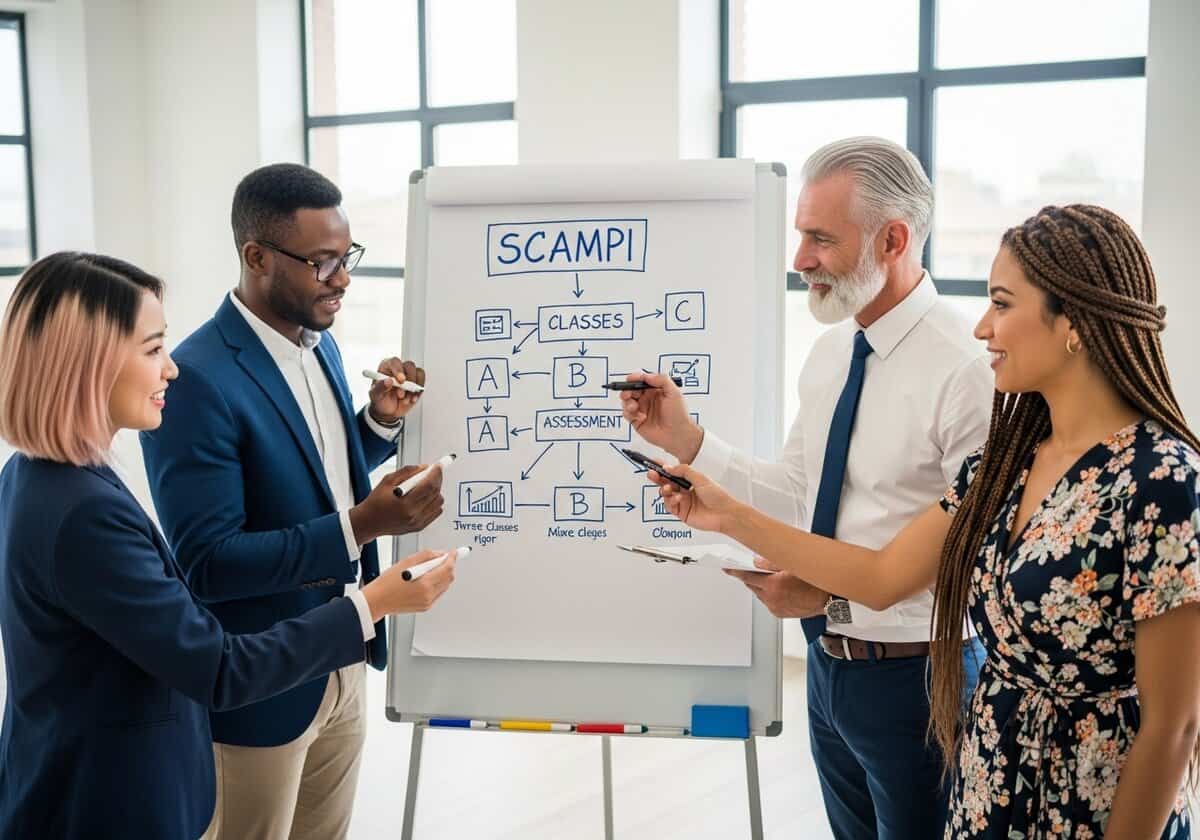
A metodologia SCAMPI, ou Padrão CMMI O Método de Avaliação para Melhoria de Processos (CMMI) é um método para aprimorar as capacidades organizacionais por meio de avaliação rigorosa e melhoria contínua. De acordo com o Instituto de Engenharia de Software da Carnegie Mellon, as organizações que implementam as estruturas do CMMI experimentam uma melhoria de 35% em desempenho do processo over time, demonstrating the tangible benefits of structured appraisal processes. This article thoroughly explores the SCAMPI framework, detailing its objectives, classification of appraisal types (Classes A, B, and C), the key phases involved in the SCAMPI appraisal process, and the essential roles required for effective evaluations.
Principais conclusões
- O SCAMPI oferece uma abordagem estruturada para a melhoria de processos.
- A avaliação identifica os pontos fortes e as fragilidades dos processos.
- Três classes (A, B, C) definem o rigor da avaliação.
- As fases principais incluem preparação, execução e elaboração de relatórios.
- Os avaliadores principais orientam a avaliação. equipes eficientemente.
- Promove a maturidade organizacional em diversos setores.
Definição do SCAMPI e sua estrutura
SCAMPI, sigla para Método Padrão de Avaliação CMMI para Melhoria de Processos, é uma abordagem de avaliação estruturada projetada para avaliar e aprimorar processos. capacidade do processo dentro das organizações. Está enraizado no Integração do Modelo de Maturidade de Capacidade (CMMI), uma estrutura comprovada usada para aprimoramento de processos em engenharia de software e engenharia de sistemas.
A metodologia SCAMPI facilita às organizações a identificação de pontos fortes e áreas que necessitam de melhorias, através da realização de avaliações minuciosas que se alinham com níveis de maturidade predefinidos, que variam do Nível 1 (Inicial) ao Nível 5 (Otimização).
A estrutura CMMI detalhada pode ser encontrada aqui (recomendada antes desta estrutura SCAMPI detalhada):

A estrutura SCAMPI compreende vários componentes, incluindo protocolos de avaliação, diretrizes e um conjunto de objetivos que orientam o processo de avaliação. Dentro dessa estrutura, três classes de avaliações são claramente identificadas, podendo uma organização escolher uma classe específica com base em seus objetivos, porte e requisitos específicos do setor:
- A Classe A oferece a avaliação mais rigorosa, envolvendo coleta e análise de dados abrangentes.
- As turmas B e C oferecem diferentes níveis de profundidade e foco.
Além disso, a metodologia serve como um mecanismo para garantir a conformidade com os padrões da indústria e as regulamentações governamentais. Organizações envolvidas em contratos de defesa ou garantia de qualidade devem seguir diretrizes rigorosas, tornando o SCAMPI crucial para demonstrar responsabilidade e confiabilidade. As avaliações podem revelar áreas que necessitam de ações corretivas, permitindo que as organizações mantenham a conformidade e, ao mesmo tempo, melhorem sua prontidão operacional.
Dica: As organizações devem integrar os objetivos do SCAMPI em seu planejamento estratégico para garantir o alinhamento entre a alocação de recursos e as iniciativas de melhoria de processos. Esse alinhamento pode levar a investimentos otimizados em treinamento e tecnologia, ampliando ainda mais o impacto da metodologia SCAMPI em detalhes em todos os níveis da organização.
Classes SCAMPI e suas aplicações específicas
O SCAMPI (Método Padrão de Avaliação CMMI para Melhoria de Processos) existe em três classes distintas, cada uma projetada para atender a diferentes necessidades e contextos de avaliação.
- Avaliações de Classe A: As avaliações de Classe A são as mais abrangentes, exigindo uma avaliação completa dos processos de uma organização em relação ao modelo CMMI. Essa classe é utilizada para avaliar a capacidade de uma organização em atingir os níveis de maturidade e é fundamental para projetos de grande escala, onde a conformidade e a gestão de riscos são primordiais. Por exemplo, uma empresa contratada pela área de defesa pode passar por uma avaliação de Classe A para garantir que seus processos atendam aos rigorosos padrões do Departamento de Defesa dos EUA para gestão de programas, resultando em maiores taxas de sucesso do projeto e redução de riscos. life-cycle Custos. Duração total típica: 6 a 8 semanas.
- Avaliações de Classe B: Oferecemos uma abordagem intermediária, geralmente conduzida com menos rigor do que a Classe A. Esta classe é adequada para organizações que buscam obter insights sobre os pontos fortes e fracos de seus processos sem se comprometer com uma avaliação completa. Os resultados podem orientar melhorias direcionadas, o que pode levar a um aumento tanto na eficiência quanto na satisfação do cliente. Duração total típica: 4 a 6 semanas.
- Avaliações de Classe C: As avaliações de Classe C são as menos formais e geralmente são usadas para avaliações internas ou para comparação com padrões do setor. Elas ajudam as organizações a identificar áreas de processo que precisam de melhorias sem os custos associados às classes mais avançadas. Frequentemente, pequenas empresas adotam essa classe para estabelecer práticas fundamentais que sustentem o crescimento futuro. Um benefício notável é que as avaliações de Classe C podem revelar ganhos rápidos na melhoria de processos, permitindo ciclos de feedback ágeis para aprimoramento contínuo. Duração total típica: 2 a 4 semanas.
A escolha entre essas classes depende de vários fatores, incluindo os objetivos organizacionais e a situação atual. nível de maturidadee requisitos regulamentares. As organizações podem considerar a utilização de uma certificação Classe A para reconhecimento formal por partes interessadas externas, enquanto optam pelas certificações Classe B ou C para auditorias internas ou projetos-piloto.
The SCAMPI Appraisal Process
Essential Roles in the SCAMPI Evaluation
| The SCAMPI evaluation process relies on various roles that align to ensure an effective appraisal of an organization’s process maturity: |  |
| The Appraisal Team Leader (ATL): directs the overall evaluation, functioning as a mediator between the organization and the SCAMPI team. The ATL must possess extensive experience in appraisal methodologies and should ideally have completed related training. A successful ATL streamlines communication, coordinates schedules, and ensures that all team members possess the necessary skills to perform their roles efficiently. | The Appraisal Team Members (ATMs): who perform several tasks, including data collection, document review, and observation during interviews. ATMs bring subject matter expertise in specific domains, which is crucial for making informed judgments about the organization’s practices. These members are also responsible for verifying that evidence aligns with appraisal criteria laid out in the SCAMPI methodology in details. |
| Subject Matter Experts (PMEs): also play a significant part in the SCAMPI evaluation, providing targeted insights into areas such as technical practices, risk management, and quality assurance. SMEs enhance the appraisal accuracy, ensuring that findings are well-founded. | The Organization representative: this individual assists the appraisal team in understanding the organizational context, policies, and existing practices. He is responsible for facilitating meetings, actively engaging in discussions and offering organizational insights, he bridges the gap between the SCAMPI evaluation team and the internal processes. |
The SCAMPI Steps
The SCAMPI appraisal process consists of distinct phases designed to assess and improve organizational processes systematically:
| SCAMPI Class A Appraisals | SCAMPI Class B Appraisals | SCAMPI Class C Appraisals | |
|---|---|---|---|
| 1. Initiation & Purpose | Specific: sponsor authorizes for official maturity/capability level rating, benchmarking, or supplier qualification. SEI-Authorized Lead Appraiser is mandatory. Objectives and scope are formally defined and documented. | Specific: sponsor defines purpose, typically for internal process improvement, initial gap analysis, risk identification, or progress tracking between Class A appraisals. Lead Appraiser is CMMI knowledgeable but not necessarily SEI-authorized. Objectives and scope are more flexible. | Specific: sponsor defines a very specific, narrow focus (e.g., health check of a single process area, readiness for a minor change, or verifying a specific practice). Often conducted by internal personnel with CMMI knowledge. Emphasis on quick turnaround and targeted insight. |
| 2. Planning the Appraisal | Specific: requires a detailed, formal appraisal plan (schedule, resources, logistics, data needs, team roles). Rigorous team selection and formal training. Organizational Unit (OU) preparation is extensive, often including a readiness review. Formal identification of required objective evidence. | Specific: involves a less formal appraisal plan. Team selection is more flexible, based on knowledge and availability. OU preparation is less intensive. Focus on identifying key areas for data collection efficiently. | Specific: minimal formal planning. Quick identification of scope, participants, and data sources. Often utilizes opportunistic scheduling and existing resources. |
| 3. Preparing for Data Collection | Specific: involves development/tailoring of comprehensive data collection instruments (interview scripts, document review checklists based on all CMMI PIs). Appraisal team is formally trained on the CMMI model and the SCAMPI A method.Extensive review of preliminary objective evidence is mandatory. | Specific: involves development or adaptation of data collection instruments, which can be less structured or use standard templates. Team familiarization with relevant CMMI areas. Review of readily available documentation. Less emphasis on exhaustive preliminary evidence. | Specific: utilizes informal checklists or highly focused questions.Minimal specific preparation, relying on existing knowledge of the process area and the specific objective. |
| 4. Conducting Data Collection (On-site/Remote) | Specific: starts with a formal opening meeting. Involves extensive and rigorous data collection through interviews (practitioners, managers, process owners), thorough document reviews (direct and indirect evidence for all PIs in scope), and observation of demonstrations. Daily data consolidation and validation by the entire team. A rigorous evidence trail is maintained. | Specific: data collection through interviews (individual or group), document reviews, and potentially workshops. Focus is on identifying strengths and weaknesses broadly across selected areas. Data consolidation is less formal and iterative. Evidence trail is less rigorous. | Specific: highly targeted and rapid data collection (e.g., short, focused interviews with key personnel, review of specific artifacts or records). Can be very short in duration (hours to a few days). Focus is solely on the predefined specific objective. |
| 5. Consolidating & Validating Data / Analysis | Specific: involves rigorous corroboration of evidence from multiple sources (triangulation) for all PIs. Formal characterization of practice implementation (strengths, weaknesses, alternative practices) against CMMI goals and practices. Draft preliminary findings are documented and reviewed by the team for consensus against strict criteria. | Specific: consolidation of observations and collected data. Identification of key process strengths, weaknesses, and improvement opportunities/themes. Analysis is more qualitative and focused on identifying patterns and areas for improvement rather than formal characterization. | Specific: rapid analysis of collected information directly against the specific focus of the appraisal. Identification of key observations and immediately actionable items. |
| 6. Generating Ratings/Findings | Specific: formal determination of satisfaction for CMMI Specific Goals and Generic Goals based on collected, validated objective evidence. Leads to the generation of official Maturity Level rating (Staged representation) or Capability Level ratings (Continuous representation) by the SEI-Authorized Lead Appraiser. | Specific to Class B & C: No official ratings are produced. Class B Specific: findings focus on gaps against the CMMI model, areas of concern, potential risks, and detailed recommendations for improvement. Observations are often mapped to CMMI practices if applicable. Class C Specific: findings are typically direct observations related to the narrow scope and are presented as actionable feedback or quick wins. | |
| 7. Reporting Results | Specific: results in a formal, comprehensive appraisal report including scope, method, team, detailed findings (strengths, weaknesses per Process Area), supporting objective evidence, and the official ratings. Formal presentation to sponsor and OU. If rated, an Appraisal Disclosure Statement and data package are submitted to the CMMI Institute. Formal closing meeting. | Specific: report focuses on findings, observations, identified risks, and detailed recommendations for process improvement. Format can be less formal than Class A. Presentation to sponsor and relevant stakeholders. Primarily for internal distribution and use. | Specific: often an informal report, email summary, or brief presentation summarizing key observations and suggested immediate actions. Emphasis is on quick, practical feedback to the target audience. |
| Resource Intensity & Duration | High resource intensity (larger team size, significant effort from OU personnel, cost). Typically 1-3 weeks for the on-site/data collection phase, plus significant preparation (weeks/months) and reporting time (weeks). | Medium resource intensity. Duration varies, often 3-10 days for data collection and analysis, with less preparation and reporting overhead than Class A. | Low resource intensity. Typically 1-3 days, including preparation and reporting. Very focused effort on a small scale. |
| Typical examples |  A large defense contractor requires an official CMMI Maturity Level 3 rating to bid on a government contract. |  A software development department wants to assess its current process maturity against CMMI Level 2 practices to identify key areas for improvement before considering a formal Class A appraisal. |  A project team manager wants a quick check on whether the team is consistently following the newly implemented peer review process for critical software modules. |
| Pontas |
|
|
|
Bonus: SCAMPI parameters vs CMMI Maturity Levels
Our industry-unique technical, quality, legal, quality, control parameters suggested per each CMMI Maturity Level and SCAMPI Class Appraisals (big screen strongly recommended).
| CMMI Maturity Level | SCAMPI Class A Appraisals | SCAMPI Class B Appraisals | SCAMPI Class C Appraisals |
|---|---|---|---|
| ML1: Initial | Specific: while ML1 is not a target to achieve (it’s the starting point), a Class A appraisal indirectly assesses it. If an organization fails to meet the goals of ML2 Process Areas (PAs), it is, by default, appraised at ML1.
| Specific to Class B & C: generally not a direct focus for a “ML1 inspection” itself, as the goal is usually improvement towards higher levels. If assessing an organization suspected to be at ML1:
| |
| ML2: Managed | Specific: rigorous inspection of all ML2 Process Areas (REQM, PP, PMC, SAM, MA, PPQA, CM). Requires objective evidence for institutionalization via Generic Practices (GP 2.1 to GP 2.10) at the project level.
Evidence of project-level process discipline is mandatory for an ML2 rating. | Specific: reviews practices related to ML2 PAs to identify strengths, weaknesses, and improvement opportunities. Less formal evidence collection and validation than Class A.
Aims to provide a gap analysis against ML2 PAs for internal improvement or Class A readiness. | Specific: highly focused deep dive into one or two specific ML2 practices, a single PA, or an aspect of a PA on a specific project (e.g., “Effectiveness of requirements traceability on Project X” or “Is the change control process for Project Y being followed?”).
Provides quick, targeted feedback on a limited aspect of ML2. |
| ML3: Defined | Specific: rigorous inspection of all ML3 Process Areas (e.g., RD, TS, PI, VER, VAL, OPF, OPD, OT, IPM, RSKM, DAR) in addition to ML2 PAs. Requires evidence of an organizational standard set of processes and supporting assets, and that projects tailor from these. Institutionalization via GPs up to GP 3.2.
Evidence of organizational standardization, tailoring, and process asset deployment is mandatory for an ML3 rating. | Specific: explores the existence, adequacy, deployment, and use of organizational standard processes and assets.
Assesses the maturity of organizational process infrastructure and consistency of its use. | Specific: could investigate a specific organizational process, asset, or ML3 practice (e.g., “How effectively is the organizational standard risk management process being tailored and used by Project Z?” or “Usability of the new requirements specification template from the PAL”).
Checks health, adoption, or effectiveness of a very specific part of the ML3 infrastructure. |
| ML4: Quantitatively Managed | Specific: rigorous inspection of ML4 PAs (OPP, QPM) in addition to ML2 & ML3 PAs. Requires objective evidence of statistical and quantitative management of selected subprocesses.
Deep dive into data validity, statistical methods, criteria for subprocess selection, and how quantitative insights drive project and process management is mandatory for an ML4 rating. | Specific: explores initial efforts towards or readiness for quantitative management. Does not verify statistical validity deeply.
Identifies opportunities for, and readiness towards, implementing quantitative management. | Specific: could look at a specific subprocess to assess its stability or data richness for potential quantitative management. Or, review the application of a pilot quantitative technique on a project.
Assesses feasibility or early results of a very limited quantitative effort for a narrow scope. |
| ML5: Optimizing | Specific: rigorous inspection of ML5 PAs (OPM, CAR) in addition to ML2, ML3 & ML4 PAs. Requires objective evidence of continuous, data-driven process improvement and innovation.
Evidence of a sustained, data-driven continuous improvement culture and tangible performance benefits is mandatory for an ML5 rating. | Specific: identifies opportunities for innovation or more systematic causal analysis and problem prevention. Does not verify deep statistical impact or institutionalization of improvements.
Assesses potential for or early stages of establishing an optimizing culture and systematic improvement mechanisms. | Specific: could assess the effectiveness of a specific pilot improvement initiative or the application of a specific causal analysis technique for a recurring problem.
Evaluates a single instance of an improvement, problem-solving activity, or innovation effort. |
Dica: regularly revisiting SCAMPI appraisal results can cultivate an environment of sustained improvement, helping organizations stay ahead of regulatory changes and competitive pressures.
Conclusão
The SCAMPI methodology serves as a cornerstone for organizations aiming to enhance their process maturity through systematic evaluation and targeted improvement strategies. By adhering to structured phases and clearly defined roles, organizations can effectively implement the CMMI framework and witness substantial performance enhancements. The significant statistic from the Carnegie Mellon Software Engineering Institute—that organizations leveraging CMMI frameworks achieve a 35% improvement in process performance—speaks volumes about the tangible benefits derived from rigorous appraisal practices such as those found within the SCAMPI methodology in details.

Perguntas frequentes
O que é a metodologia SCAMPI?
SCAMPI significa Método Padrão de Avaliação CMMI para Melhoria de Processos. É uma abordagem estruturada, concebida para avaliar e aprimorar processos organizacionais utilizando a estrutura CMMI.
Quais são as diferentes classes de SCAMPI e suas aplicações específicas?
O SCAMPI possui três classes: A, B e C. A classe A é formal e abrangente, utilizada para avaliações oficiais do CMMI, enquanto as classes B e C são menos formais e focam em avaliações de prontidão ou avaliações internas.
Como o SCAMPI impacta a maturidade dos processos organizacionais?
O SCAMPI proporciona às organizações uma compreensão detalhada dos seus níveis de maturidade de processos. Essa visão permite melhorias direcionadas, resultando, em última análise, em maior eficiência e eficácia.
Qual a relação entre o SCAMPI e os modelos CMMI?
O SCAMPI é baseado diretamente nos modelos CMMI, utilizando sua estrutura para avaliar e aprimorar processos. Ele alinha as práticas organizacionais com as melhores práticas descritas na estrutura CMMI.
Tópicos relacionados
- Práticas de benchmarking: Um método para comparar os processos da organização com os dos líderes do setor, a fim de identificar lacunas.
- Root Cause Analysis (RCA): Uma técnica para encontrar as causas subjacentes de deficiências ou falhas em processos.
- Mapeamento de Processos: Representação visual de fluxos de trabalho para analisar e melhorar processos organizacionais.
- Modelos de melhoria contínua: estruturas como PDCA ou Seis Sigma que facilitem melhorias contínuas nos processos.
- Capability Maturity Model Integration (CMMI) Frameworks: Guias detalhados elaborados para melhorar a eficiência dos processos em todas as organizações.
- Change management strategies: Abordagens estruturadas para gerenciar mudanças em processos e cultura organizacional.
- Sistemas de Gestão da Qualidade (SGQ): Um conjunto de atividades coordenadas para orientar e controlar uma organização, visando a melhoria contínua da qualidade.
- Técnicas de engajamento das partes interessadas: Estratégias para envolver todas as partes relevantes no processo de melhoria, visando o sucesso.
- Estruturas de gestão de riscos: Metodologias estruturadas para identificar e gerenciar riscos potenciais em projetos e processos.
- Sistemas de medição de desempenho: Estruturas para avaliar a eficiência e a eficácia de processos e práticas.
Glossário de termos utilizados
Asynchronous Transfer Mode (ATM): Uma tecnologia de rede de alta velocidade que utiliza células de tamanho fixo para transmissão de dados, permitindo uma comunicação eficiente e flexível em diversos tipos de mídia. Ela suporta múltiplos tipos de serviço, incluindo voz, vídeo e dados, facilitando o gerenciamento da Qualidade de Serviço (QoS).
Capability Maturity Model Integration (CMMI): Uma estrutura de melhoria de processos que fornece às organizações elementos essenciais para uma melhoria eficaz dos processos, com foco em desempenho, qualidade e eficiência em vários domínios, incluindo desenvolvimento de software e prestação de serviços. Consiste em cinco níveis de maturidade para orientar o crescimento organizacional.
Computer Aided Manufacturing (CAM): Uma tecnologia que utiliza software e máquinas controladas por computador para automatizar processos de fabricação, permitindo produção precisa, modificações de projeto e gerenciamento eficiente de recursos em diversos setores.
Computer-Aided Manufacturing (CAM): Utilização de software e máquinas controladas por computador para automatizar processos de fabricação, aumentando a precisão, a eficiência e a velocidade de produção. Integra fluxos de trabalho de projeto e fabricação, permitindo a tradução direta de modelos digitais em produtos físicos.
Contract Manufacturer (CM): Uma empresa que produz bens para outra, geralmente seguindo especificações de design e qualidade específicas. Esse tipo de acordo permite que a empresa contratante se concentre em suas competências essenciais, como marketing e desenvolvimento de produtos, enquanto terceiriza os processos de fabricação.
Performance Qualification (PQ): a process that verifies a system or equipment operates according to specified requirements under real-world conditions, ensuring it consistently performs its intended function within predetermined limits.
Personnel Airlock (PAL): a sealed entryway designed to allow personnel to transition between different pressure environments while minimizing contamination and maintaining safety, typically used in space stations, laboratories, or cleanrooms. It features interlocking doors that prevent simultaneous opening.
Plan Do Check Act (PDCA): Um modelo de melhoria contínua que consiste em quatro etapas iterativas: planejar um objetivo, executar o plano, avaliar os resultados em relação às expectativas e tomar medidas corretivas para aprimorar o desempenho e os processos.
Qualified Person (QP): an individual with the necessary education, experience, and authority to oversee and ensure compliance with regulatory requirements in the preparation and submission of technical documents, particularly in the mining and resource sectors, as defined by relevant industry standards.
Quality Management System (QMS): Um sistema estruturado de processos, procedimentos e responsabilidades que visa garantir a qualidade consistente de produtos e serviços, facilitar a melhoria contínua e atender aos requisitos do cliente e às normas regulamentares.
Root Cause Analysis (RCA): Um processo sistemático para identificar os fatores fundamentais que levam a um problema ou fracasso, visando abordar e eliminar as causas subjacentes em vez de apenas tratar os sintomas.
Statistical Process Control (SPC): a method of quality control that employs statistical techniques to monitor and control a process, ensuring it operates at its full potential by identifying variations and maintaining consistent output within specified limits.
Value Engineering (VE): Um método sistemático para melhorar o valor de um projeto através da análise de suas funções, redução de custos e aprimoramento do desempenho, sem sacrificar a qualidade ou a confiabilidade. Envolve trabalho em equipe interdisciplinar para identificar e implementar alternativas economicamente viáveis.
Verification and Validation (V&V): Um processo para garantir que um sistema atenda às especificações e cumpra sua finalidade, envolvendo duas atividades distintas: a verificação, que checa se o produto atende às especificações de projeto, e a validação, que avalia se ele satisfaz as necessidades e os requisitos do usuário.

















