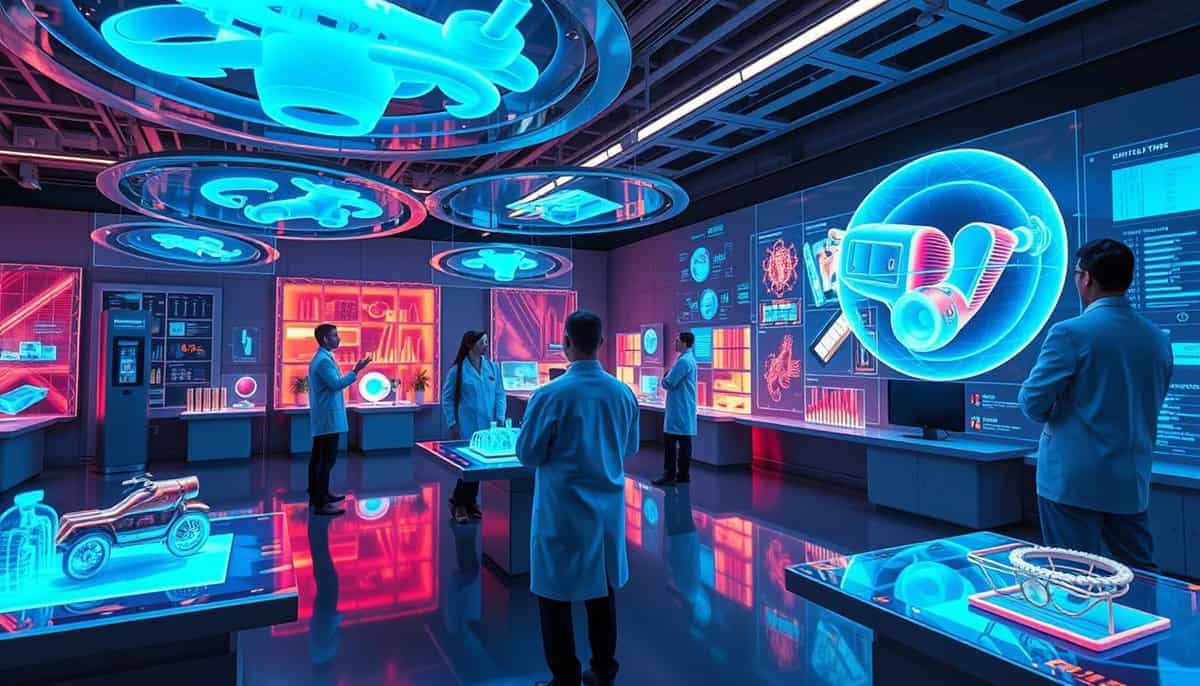
Nos próximos cinco anos, US$ 30 trilhões em receitas corporativas dependerão de novos produtos. Isso destaca o enorme potencial da tecnologia de gêmeos digitais em Pesquisa e Desenvolvimento (P&D). Com 75% dos executivos de desenvolvimento de produtos focados em digitalização, o mercado de tecnologia de gêmeos digitais deverá crescer cerca de 60% ao ano. Até 2027, espera-se que atinja US$ 73,5 bilhões.
Digital twins create virtual copies of physical systems. This allows for better simulation, prediction, and operation. They’re changing how we innovate and making development, cost optimization, and efficiency better. Thanks to this tech, we can get real-time data and predict product performance and market trends accurately.
Principais conclusões
- Os gêmeos digitais podem reduzir o tempo de desenvolvimento de produtos em 20 a 50%, diminuindo a necessidade de múltiplos protótipos.
- O uso de gêmeos digitais resulta em 25% menos problemas de qualidade e aumenta as vendas em 3 a 5%.
- Prevê-se que o mercado global de gêmeos digitais cresça 60% ao ano, atingindo US$ 73,5 bilhões até 2027.
- Muitos setores, como o de manufatura e o de biotecnologia, estão utilizando gêmeos digitais.
- Para empresas que enfrentam desafios na cadeia de suprimentos, investir em gêmeos digitais é crucial. Isso ajuda a reduzir custos e aumentar a receita.
Entendendo os Gêmeos Digitais: Uma Visão Geral Abrangente
Os gêmeos digitais representam uma grande mudança na forma como as indústrias usam e aprendem sobre objetos. São modelos virtuais que correspondem com muita precisão aos objetos reais. Isso permite insights profundos e melhor aproveitamento do espaço. Eles reúnem dados de diversas fontes, como IoT sensores, para simular bem o mundo real.
A utilização da IoT na pesquisa é fundamental para os gêmeos digitais. Os dispositivos de IoT coletam e analisam dados continuamente, tornando os modelos dinâmicos. Por exemplo, em automóveis, os gêmeos digitais verificam o desempenho do veículo em tempo real, o que ajuda a prever problemas e a identificar falhas antes que elas ocorram.
A adição de IA e análise preditiva aos gêmeos digitais é um grande passo em frente. Isso permite que os modelos se aprimorem e tomem decisões de forma autônoma. Isso é especialmente vantajoso em áreas como a aeroespacial, onde os detalhes são cruciais. O mercado de gêmeos digitais deve atingir US$ 73,5 bilhões até 2027. Isso demonstra a importância e a ampla disseminação dessa tecnologia.
| Indústria | Application | Benefits |
|---|---|---|
| Automotivo | Monitoramento do desempenho do veículo | Detecção precoce de desgaste |
| Aeroespacial | Otimização de sistemas | Segurança e eficiência aprimoradas |
| Fabricação | Otimização de Processos | Redução de custos |
| Assistência médica | Manutenção preditiva de Equipamentos | Melhoria da confiabilidade operacional |
| Planejamento Urbano | Teste de Cenários | Otimização de infraestrutura |
Os novos avanços em dados em tempo real conferem aos gêmeos digitais uma capacidade de reação rápida. Isso auxilia na tomada de decisões rápidas e inteligentes em diversas áreas. No planejamento urbano, por exemplo, os gêmeos digitais podem testar mudanças para contribuir com o crescimento sustentável.
Segurança cibernética É muito importante no caso dos gêmeos digitais, pois eles lidam com muitos dados privados. Uma segurança robusta, como encryptionIsso ajuda a proteger esses dados. Embora a criação de gêmeos digitais possa ser cara, o investimento vale a pena no final. Os benefícios que eles trazem compensam o custo e o esforço.
A evolução e a história da tecnologia de gêmeos digitais.
The development of digital twins started as simple models. They are now complex systems that work with AI and machine learning. The path of digital twin technology began in the 1960s. NASA used them first during the Apollo 13 mission. Since that time, the concept has grown and become very popular, especially in the early 2000s.
Em 2015, os gêmeos digitais tornaram-se essenciais para a revolução da "Indústria 4.0". Este foi um grande passo em sua história. O mercado atingiu o valor de US$ 6,5 bilhões em 2021 e pode chegar a US$ 125,7 bilhões até 2030. Esse crescimento se deve aos seus grandes benefícios: aumentam a eficiência, economizam tempo e dinheiro e aprimoram as avaliações de risco.
Recently, digital twins came back into the spotlight with the 2022 metaverse boom. They give businesses and users a clearer view of our physical world. Their benefits include cutting costs, fewer failures, and smoother operations. This applies in many fields, like aerospace and healthcare.
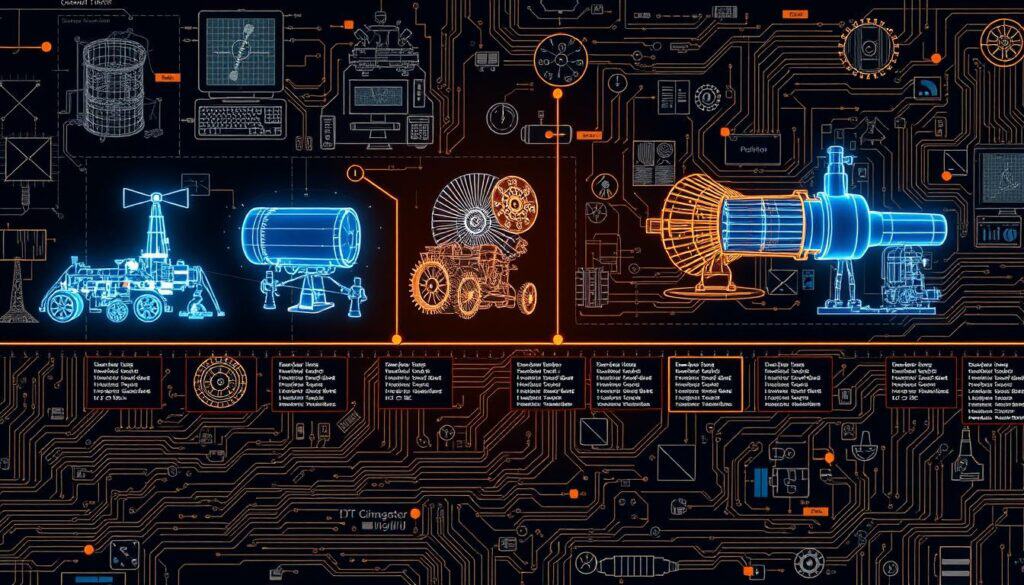
| Ano | Marco |
|---|---|
| década de 1960 | Uso da NASA durante a missão Apollo 13 |
| Início dos anos 2000 | Conceito ganha popularidade |
| 2015 | Integração com a “Indústria 4.0” |
| 2022 | Ressurgimento durante o boom do metaverso |
A utilização de gêmeos digitais em P&D muda muita coisa, mas também é difícil. Os altos custos iniciais e a necessidade de conhecimento especializado representam grandes desafios. No entanto, as empresas focam no valor. Os gêmeos digitais oferecem uma maneira inteligente de modelar ou testar elementos da vida real. Isso permite que as operações funcionem sem problemas e continuem sem interrupções.
Além disso, tecnologias como captura em tempo real e IA generativa ajudam a resolver esses pontos difíceis. Elas tornam a criação de produtos digitais mais rápida e fácil.
Em conclusão, a perspectiva histórica dos gêmeos digitais mostra sua evolução, de ideias a ferramentas essenciais na pesquisa e desenvolvimento modernos. Eles têm um futuro promissor, com grande potencial para dar vida a novas ideias.
Key Benefits of Digital Twins in Product Development
Digital twins are important in making products today. They help improve designs and make things cost-effective. With a digital twin, companies can test and change products in a virtual world. This means less money spent on making models and faster time getting products out there. This way, products become better and more reliable.
Enhancement of Product Design and Engineering
Companies get better at making products with digital twins. This technology lets them test changes in a virtual space. Engineers can fix problems before they appear in the real world. This leads to products that work better and have more features.
A report by McKinsey shows 75% of companies using digital twins achieved medium complexity. Some areas where it’s used include:
- Automotive: helps in working together on car designs worldwide.
- Industrial manufacturing: boosts product quality and reduces costs by finding issues early.
- Aeroespacial: makes plane performance better without as much testing, saving time and money.
Using digital twins to test and polish designs lessens the need for physical models. This leads to faster development times. Products can be released quicker and more efficiently.
Cost Reduction and Process Optimization
Digital twins play a big role in saving money in research and development. They make processes better and use resources wisely. By finding where waste happens, they help companies save a lot. For example, using digital twins has cut development time by 20-50% and lowered the costs of early models.
Also, digital twins offer valuable services after a sale, like predicting when maintenance is needed. This improves how long a product lasts, makes customers happier, and keeps them coming back.
| Indústria | Use Case |
|---|---|
| Eletrônicos de consumo | Optimizing supply chain quality and reducing waste |
| Automotivo | Facilitating global collaboration in 3D automotive design |
| Industrial Manufacturing | Improving product quality and cutting costs through early problem identification |
| Aeroespacial | Simulating and optimizing aircraft performance to reduce testing time and costs |
| Energia | Optimizing infrastructure performance and identifying cost-saving opportunities |
The benefits and process improvements from digital twins highlight their value in making products. The market for digital twins is expected to grow a lot, by 37.5% from 2023 to 2030. This technology will change how things are made and make R&D more efficient in many industries.
Implementing Digital Twins: Challenges and How to Overcome Them
The journey toward integrating digital twins within an organization’s framework is full of obstacles. These must be identified and addressed with careful planning and strong strategies.
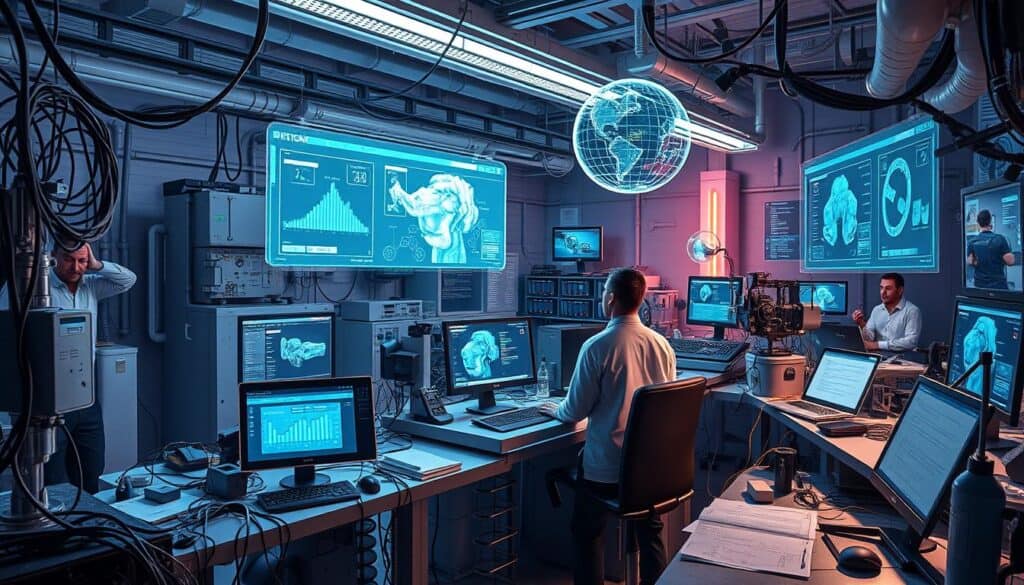
Data Complexity and Quality is a big barrier in the world of digital twins. When you mix data from different sources, it can cause accuracy problems and inefficiencies. This could lead to delays in the digital twin process. Making sure the data is reliable and high-quality is crucial for success.
System Integration is yet another hurdle. Old systems often can’t easily work with new digital twin technology. Overcoming this challenge requires making plans for effective integration. This allows for smooth data exchange and functionality across all systems.
Cost and ROI Concerns greatly impact digital twin implementation. It can be tough to get budget approval without clear return-on-investment figures. That’s why it’s key to create solid financial plans. Showing the long-term benefits is essential to get support.
Technical Expertise is vital for a successful strategy. There’s a lack of professionals who know how to use digital twin tech. We need more training programs and focused hiring to fill this skills gap.
Scalability is a big issue. Applying digital twin tech across different areas can spread resources thin. It demands careful resource management to keep things running smoothly and effectively.
Cybersecurity is crucial. Strong security steps must protect sensitive data from cyber threats. High security standards keep data safe and boost confidence in the organization.
Cultural Resistance can slow down digital twin adoption in a company. To overcome this, companies need to build a culture that welcomes digital advances. Effective gestão de mudanças helps support this shift.
Regulatory Compliance adds more complexity. Companies have to deal with specific industry rules and laws, especially about using and keeping data safe. This ensures a smooth implementation process.
Real-time Data Processing is essential. A strong IT setup is necessary to handle data quickly and reduce delays. This makes sure the operation is efficient and dependable.
Long-term Maintenance keeps digital twins relevant and accurate. Ongoing updates make the technology keep up with business changes. This ensures it stays useful over time.
This is summarized in the table below:
| Challenge | Descrição | Solutions |
|---|---|---|
| Data Complexity and Quality | Issues in merging data from multiple sources | Implementing rigorous data validation processes |
| System Integration | Compatibility problems with legacy systems | Developing custom integration solutions |
| Cost and ROI Concerns | Securing budget approval | Clear financial projections and ROI demonstrations |
| Conhecimento técnico | Shortage of skilled professionals | Targeted training and recruitment programs |
| Scalability | Resource management issues in expansion | Streamlined resource allocation strategies |
| Segurança cibernética | Protecting sensitive data | Implementing robust security measures |
| Cultural Resistance | Internal resistance to change | Effective change management practices |
| Regulatory Compliance | Navigating industry-specific regulations | Adhering to regulatory standards |
| Real-time Data Processing | Handling and minimizing data latency | Investing in strong IT infrastructure |
| Long-term Maintenance | Sustaining technology relevance | Ongoing upkeep and alignment with business needs |
Applicable Industries for Digital Twins
Digital twins are changing many industries by making operations better and sparking new ideas. They create virtual versions of physical things. This is how they’re changing specific sectors.
Automotive and Aerospace
In the automotive and aerospace fields, digital twins are very important. In aerospace, around 75% of leaders are exploring these technologies. Boeing, for example, safely increased its 737-800’s cargo capacity by 23% with digital twins.
These technologies are also crucial in the car industry. They’re predicted to make up at least 15% of the digital twin market. They help car makers improve design, testing, and more. This boosts vehicle safety and performance.
Healthcare and Life Sciences
Digital twins are making big changes in medicine and research. They simulate how human bodies react, improving drug tests and medical procedures. This tech helps create treatments that are just right for each patient. It lowers costs and improves care.
The market for digital twins in health is growing fast. It’s expected to jump from $9.5 billion in 2022 to over $72 billion by 2032. Its uses range from studying genes to planning complex surgeries.
Infrastructure and Energy Sectors
In infrastructure and energy, digital twins help make things work better and last longer. For cities, it’s about planning and sustainability. ABI Research thinks we’ll see 500 digital city twins by 2025. They help manage resources well and make cities greener.
In energy, they watch over and predict how well equipment will work. This cuts down on unexpected stops and makes things safer. Using digital twins saves money and helps keep our energy supply reliable and clean.
Here’s a look at how digital twins are used in different areas:
| Sector | Aplicações | Benefits |
|---|---|---|
| Automotivo | Design & R&D, Performance Testing | Enhanced Innovation, Safety Improvements |
| Aeroespacial | Weight Optimization, Manutenção preditiva | Operational Efficiency, Increased Cargo Capacity |
| Assistência médica | Drug Testing, Personalized Medicine | Better Treatment Plans, Reduced Costs |
| Infrastructure | Urban Planning, Resource Management | Sustainability, Efficient Operations |
| Energia | Performance Monitoring, Manutenção preditiva | Safety, Cost Savings |
Digital Twins in R&D: Revolutionizing Research and Development
Digital twins are changing how research gets done by allowing for virtual tests. This method cuts down on the time and resources needed for real-world trials. A 2023 McKinsey report found that digital twins help companies get their products out 30% faster.
Researchers can work faster, get immediate responses, and analyze their findings in depth with digital twins. This not only boosts innovation in research but also makes predictive models and experiments more precise. A 2022 study by Gartner showed using digital twins can cut costs by up to 50%.
Digital twins reduced our flight test time by 20% and brought substantial cost savings,” said Airbus when discussing the benefits of virtual testing.
In the drug-making world, digital twins could shorten the time to develop new medicines by up to 25%, says CSols Inc. This is key since about 80% of clinical trials don’t start on time, and 55% end early because they can’t get enough participants.
Ford uses digital twins to check how self-driving cars would do in different road situations. This helps them make safer cars faster, according to Ford Media Center. Digital twins are proving essential for new breakthroughs in various fields.
| Indústria | Beneficiar | Fonte |
|---|---|---|
| Aeroespacial | 20% reduction in flight test time, cost savings | Airbus |
| Produtos Farmacêuticos | 25% reduction in drug development timelines | CSols Inc. |
| Automotivo | Accelerated development of autonomous vehicles | Ford Media Center |
Key Tools and Technologies for Creating Digital Twins
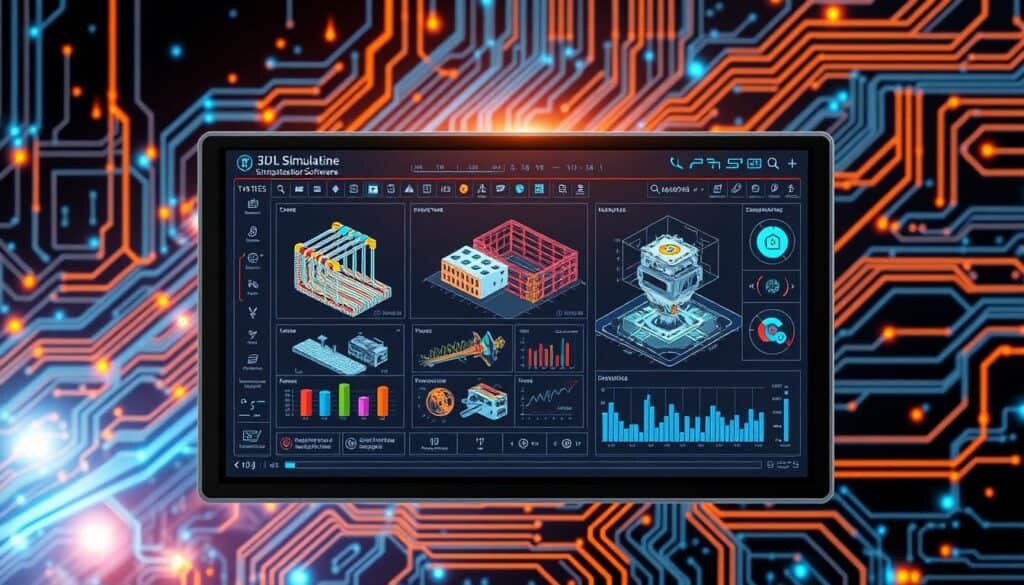
To build and manage digital twins effectively, you need the right tech. It starts with advanced simulation software, real-time data gathering through IoT devices and sensors, and powerful data analytics platforms. These elements ensure the digital twin mirrors the real object well. They provide insights that help improve performance and find areas for improvement.
Simulation Software
Simulation software is crucial for a good digital twin. Giants like Siemens and NVIDIA have worked together for years. They use tools like NVIDIA Omniverse and OpenUSD. These help in designing, simulating, and enhancing products and facilities. Thanks to these tools, we can deeply understand and operate digital twins. This drives better productivity and innovation in several fields.
IoT Devices and Sensors
Adding IoT devices and sensors is essential for collecting data in real time. This makes digital twins more lively and reactive. Famous names like BMW Group and Amazon Robotics connect these devices to their digital twins for 3D monitoring. This greatly aids in refining production and solving issues faster. With continuous IoT data, digital twins always match their physical versions.
Data Analytics Platforms
Forte data analytics platforms are key for handling the huge data from digital twins. These platforms enhance the twins’ functionality and accuracy. NVIDIA’s Omniverse Cloud offers an environment for creating and managing industrial digital applications. Using data analytics in research and development lets companies dig deeper. This way, they can optimize their work for better results.
Tips for Effective Digital Twin Implementation
Implementing digital twins successfully requires a well-thought strategy. This includes managing different data sources, taking care of security, and keeping an eye on costs. Here are some useful tips to help you tackle these issues effectively.
Ensuring Data Integration and Management
It’s vital to manage and blend large data amounts from various places. Good integration strategies are key. They help keep data consistent, allow easy data sharing, and keep data accurate. You can achieve great data management by:
- Establishing standardized data formats to ease integration between various systems.
- Using advanced data analytics platforms to process and analyze the data efficiently.
- Employing IoT devices and sensors to ensure real-time data acquisition and reliability.
This not only improves data integration but also aids in making smarter decisions and boosts operational performance.
Maintaining Data Security and Privacy
Keeping digital twin data secure is vital for protecting private information and following privacy laws. Implementing strong security measures is a must. This includes encryption and managing who can access the data. Important steps involve:
- Conducting regular security audits to identify and fix weaknesses.
- Encrypting data when stored and during transfer to stop unauthorized access and leaks.
- Implementing role-based access controls to keep data limited to approved staff only.
Strong security practices build trust and ensure sensitive data stays safe in digital twins.
Managing Implementation Costs
Handling cost management in R&D and the initial high costs of starting with digital twins is essential. With careful cost-value studies and looking for scalable options, controlling expenses becomes possible. Ways to do this include:
- Choosing digital twin platforms that are modular and scalable, allowing you to start small and grow as needed.
- Partnering with outside experts for insights and cost-saving methods.
- Training your own teams to better their tech skills which lowers the need for outside help.
Using these strategies helps keep costs in check while fully benefiting from digital twins in R&D.
| Challenge | Strategic Approach |
|---|---|
| Data Integration | Standardized data formats, advanced analytics, IoT devices |
| Security and Privacy | Regular audits, data encryption, role-based access |
| Cost Management | Scalable solutions, expert collaboration, internal training |
Using Digital Twins for Predictive Maintenance
Predictive maintenance is changing industries with digital twins. It helps predict equipment failure. This means less downtime and longer life for machinery. It improves efficiency and cuts maintenance costs.
It’s very useful for vehicles and factories. It stops small issues from becoming big problems. For example, in aviation, digital twins keep an eye on engine performance. They offer real-time info and predict risks. This makes sure planes are safe and reliable.
Digital twins use five kinds of data for maintenance. These are digital models, static data, IoT data, service data, and simulations. These data types help make better maintenance decisions. As digital tools get better, maintenance becomes more efficient. This leads to less downtime and better reliability in operations.
Leituras e métodos complementares
- Internet of Things (IoT) Integration: sensor data acquisition, IoT architecture design, edge computing.
- Machine Learning and AI: predictive analytics, anomaly detection, reinforcement learning.
- Data Analytics and Big Data: data fusion, real-time analytics, data visualization.
- Cloud Computing: cloud storage solutions, distributed computing, scalability management.
- Cybersecurity for Digital Twins: threat modeling, encryption techniques, access control systems.
- Augmented Reality (AR) and Virtual Reality (VR): immersive visualization, AR/VR interface design, experiência do usuário optimization.
- Systems Engineering: Systems architecture design, lifecycle management, requirements engineering.
Perguntas frequentes
O que é um gêmeo digital em P&D?
Em P&D, um gêmeo digital funciona como uma cópia virtual de um sistema real. Ele auxilia na simulação, previsão e análise, impulsionando a inovação e tornando a P&D mais eficiente.
Como a tecnologia de gêmeos digitais contribui para o desenvolvimento de produtos?
Essa tecnologia permite análises aprofundadas e um melhor design de produto sem a necessidade de modelos físicos. Ela ajuda a melhorar a qualidade, acelerar o desenvolvimento e reduzir custos.
Qual é o papel da modelagem virtual na criação de um gêmeo digital?
A modelagem virtual é fundamental para os gêmeos digitais. Ela simula condições do mundo real para representações precisas. Isso auxilia na análise preditiva e na gestão de operações.
Quais setores se beneficiam mais com um gêmeo digital?
Os setores automotivo, aeroespacial, de saúde, de infraestrutura e de energia têm muito a ganhar. Eles obtêm melhorias no projeto, nos testes, na eficiência e na manutenção com os gêmeos digitais.
Como o gêmeo digital evoluiu ao longo do tempo?
De modelos simples a sistemas avançados com IA e aprendizado de máquina, os gêmeos digitais evoluíram. Agora, eles utilizam big data para obter insights mais precisos.
Quais ferramentas e tecnologias são essenciais para construir um gêmeo digital?
As ferramentas essenciais incluem software de simulação avançado e dispositivos IoT para coleta de dados. Plataformas de análise de dados refinam os dados para aprimorar a funcionalidade e a precisão dos gêmeos digitais.
Como um gêmeo digital pode aprimorar a manutenção preditiva?
Ao analisar dados para prever falhas em equipamentos, os gêmeos digitais permitem a manutenção proativa. Essa abordagem reduz o tempo de inatividade e prolonga a vida útil dos equipamentos.
Que estratégias podem garantir a implementação eficaz de gêmeos digitais?
Estratégias bem-sucedidas envolvem integração de dados perfeita, segurança de dados robusta e gerenciamento dos custos de adoção. Esses fatores maximizam os benefícios dos gêmeos digitais.
Glossário de termos utilizados
Internet of Things (IoT): Uma rede de dispositivos interconectados, equipados com sensores, software e outras tecnologias que lhes permitem coletar e trocar dados pela internet, facilitando a automação, o monitoramento e o controle de diversos processos e sistemas.
Network-attached storage (NAS): Um dispositivo de armazenamento conectado a uma rede que permite o acesso e o compartilhamento de dados entre múltiplos usuários e dispositivos, geralmente oferecendo armazenamento centralizado de arquivos, backup e recursos de gerenciamento. Ele opera independentemente de um computador e pode ser acessado por meio de protocolos de rede padrão.
Return on Investment (ROI): Uma métrica financeira usada para avaliar a rentabilidade de um investimento, calculada dividindo-se o lucro líquido do investimento pelo custo inicial, expresso em percentagem.
User experience (UX): the overall satisfaction and perception of a user when interacting with a product, system, or service, encompassing usability, accessibility, design, and emotional response throughout the entire interaction process.