Product Design, Manufacturing & Innovation Resources
Maison » Le processus de conception itératif de produits

Le processus de conception itératif de produits

1960
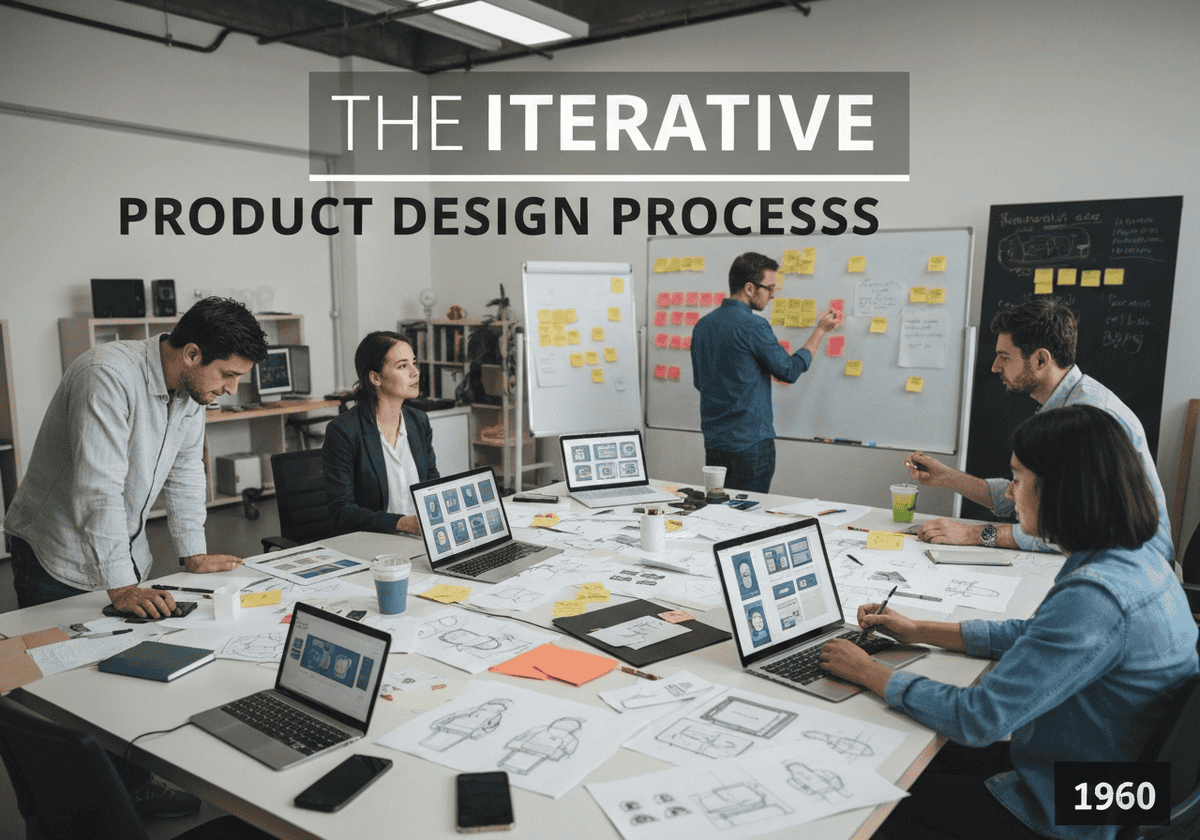
Studio de design moderne où des designers industriels collaborent au développement de produits.

(Image générée à titre d'illustration uniquement)

Une méthodologie structurée de création de nouveaux produits, comprenant généralement l'analyse, le développement du concept et la synthèse. Il s'agit d'un cycle itératif où les concepteurs étudient les besoins des utilisateurs, génèrent des idées, créent des prototypes et les testent afin d'affiner le produit final. Ce processus garantit que le produit final est à la fois fonctionnel et répond efficacement aux exigences du marché avant sa production à grande échelle.

The product design process is a framework that guides designers and engineers from an initial idea to a market-ready product. It begins with the ‘Analysis’ phase, which involves deep market research, competitive analysis, and understanding user needs through methods like interviews and surveys. This phase defines the problem and sets the design constraints and goals. The subsequent ‘Concept’ phase is a creative exploration where designers brainstorm a wide range of potential solutions. Techniques like sketching, mind-mapping, and storyboarding are common. Multiple ideas are generated without initial judgment to foster innovation. Following this, the ‘Synthesis’ phase involves refining and combining the most promising concepts into a tangible design. This is where detailed specifications are created, and early prototypes, such as mockups or 3D models, are built. The process is inherently iterative; feedback from testing these prototypes is used to circle back to earlier stages for refinement. For example, a utilisabilité test might reveal a flaw that requires a return to the concept phase to explore alternative solutions. This cyclical nature ensures continuous improvement and reduces the risk of market failure by validating the design against real-world user feedback and technical feasibility before committing to mass production.

UNESCO Nomenclature: 3305
- Technologie industrielle

Taper

Système abstrait

Perturbation

Fondamentaux

Usage

Utilisation généralisée

Précurseurs

  • la méthode scientifique
  • traditions artisanales et modèles d'apprentissage
  • les premiers dessins d'ingénierie et les techniques de dessin
  • l'accent mis par la révolution industrielle sur les processus de production de masse

Applications

  • développement des smartphones
  • création de mobilier de bureau ergonomique
  • la conception des automobiles modernes
  • développement d'applications logicielles (ui/ux)

Brevets:

NA

Idées d'innovations potentielles

  • ai-driven design process that automates user research analysis and suggests initial concepts
  • a subscription box service that sends users monthly prototype kits to test and provide feedback on
  • a collaborative vr platform for global teams to co-design and synthesize product concepts in real-time
  • an open-source platform for sharing and iterating on sustainable product designs
  • gamified mobile app for crowdsourcing design concepts for social impact projects
  • a modular product design system with interchangeable components for ultimate customization
  • a blockchain-based system for tracking design iterations and propriété intellectuelle droits
  • a bio-integrated design process that uses living organisms as part of the product’s function
Lié à : processus de conception de produits, conception itérative, analyse, conception, synthèse, prototypage, recherche utilisateur, développement de produit.

Contexte historique

Le processus de conception itératif de produits

1950
1955
1956
1960
1960
1960
1960
1950
1950
1955
1958
1960
1960
1960
1960

(si la date est inconnue ou non pertinente, par exemple « mécanique des fluides », une estimation arrondie de son émergence notable est fournie)

10e année anniversaire

Les images en pleine résolution et les téléchargements sont uniquement disponibles, et 100% gratuits, pour les membres inscrits.





























