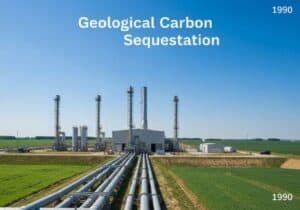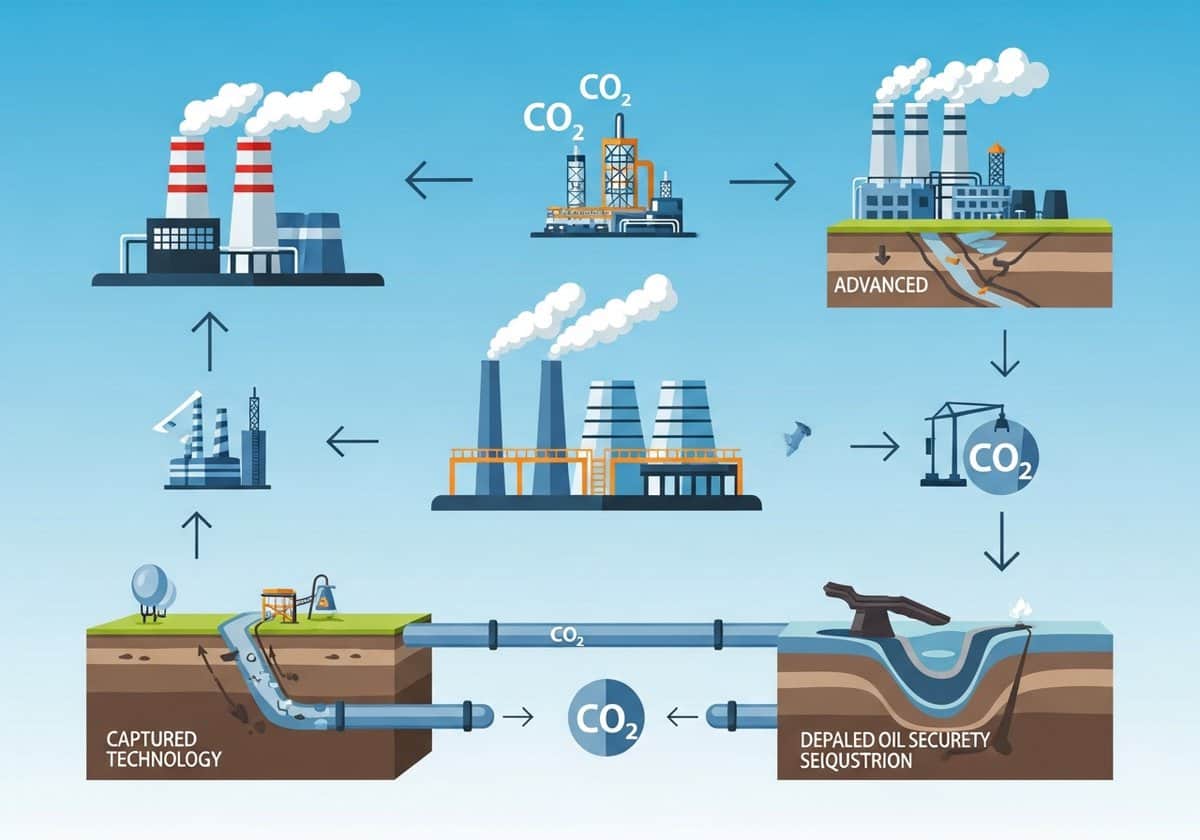
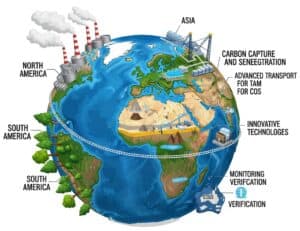
Capture et séquestration du carbone (CCS) focuses on the separation of carbon dioxide from industrial and energy-related sources, its transport, and long-term storage in geological formations to mitigate atmospheric emissions. This field integrates advances in capture technologies including post-combustion, pre-combustion, and oxy-fuel processes, alongside innovations in CO2 transport infrastructure and secure subsurface storage methods such as saline aquifers, depleted oil and gas reservoirs, and mineral carbonation. Monitoring, vérification, and risk assessment protocols ensure storage integrity and environmental safety. Our following collection compiles the most recent scientific publications and patented technologies addressing capture materials, process optimization, scale-up strategies, and regulatory frameworks critical for advancing CCS deployment and climate mitigation efforts:
Il s'agit de notre dernière sélection de publications et de brevets mondiaux en anglais sur la capture et la séquestration du carbone (CCS), parmi de nombreuses revues scientifiques en ligne, classées et axées sur la capture du carbone, la séquestration du carbone, le stockage du CO2, la séquestration géologique, l'injection de dioxyde de carbone, la récupération assistée du pétrole, la techno capture du carbone, la capture post-combustion, le captage avant combustion, l'oxycombustion, la minéralisation du carbone, le solvant de captage du carbone, le transport du CO2 par pipeline, le stockage du CO2, la membrane de captage du carbone, le sorbant de captage du carbone, l'adsorption de captage du carbone, le catalyseur de captage du carbone, le processus de captage du carbone, la modernisation du captage du carbone, le cadre réglementaire du captage du carbone et l'impact du captage du carbone sur l'environnement.
System and method for predicting soil organic carbon dynamics using historical climate-based microbial response modeling
Patent published on the 2026-06-11 in US under Ref US20260160748 by PERENNIAL CLIMATE INC [US] (Donovan Mitchell [us], Rustowicz Rose [us])
Abstract: [0000] The present invention provides a novel solution for predicting soil organic carbon dynamics by combining historical climate data with current ecological indicators through a reduced complexity modeling approach. The method and system of the present invention efficiently predicts where and at what rate carbon sequestration is likely to occur by incorporating a crucial insight: soil microbial communities adapt to local climate conditions over time, creating distinct patterns of carbon seque[...]
Our summary: The invention predicts soil organic carbon dynamics by integrating historical climate data with ecological indicators. It utilizes a reduced complexity modeling approach to forecast carbon sequestration rates and locations. The system also tracks various soil health indicators, enhancing agricultural and ecological assessments.
soil organic carbon, microbial response modeling, climate data, carbon sequestration potential
Patent
Hollow fiber reactor for carbon capture and method thereof
Patent published on the 2026-06-04 in WO under Ref WO2026114988 by NEOCARBON GMBH [DE] (Toromanoff Silvain [de], Shamu Andrew [de], Stergiou Georgios [de], Kuanr Nirmalendu [de], Karela Anastasia [de])
Abstract: A hollow fiber reactor comprises a hollow fiber module that includes a plurality of hollow fiber bundles (201, 201A, 201B), each hollow fiber bundle including a plurality of hollow fibers capable of carbon dioxide sorption. The plurality of hollow fiber bundles comprises at least two bundles arranged in a parallel configuration or in a V-shaped configuration. A method of operating the hollow fiber reactor.[...]
Our summary: A hollow fiber reactor utilizes multiple hollow fiber bundles for efficient carbon dioxide sorption. The bundles can be arranged in parallel or V-shaped configurations. The method focuses on optimizing the operation of the reactor for enhanced carbon capture.
hollow fiber reactor, carbon capture, sorption, parallel configuration
Patent
Carbon capture
Patent published on the 2026-06-04 in FI under Ref FI20246413 by ANDRITZ OY [FI] (Mikkanen Pirita [fi], Kangasmaa Kalle [fi], Kiuru Jukka [fi], Lehtinen Jere [fi], EngstrÖm Johan [fi], Rath Andreas [fi], Tikka Olli [fi], Fagerudd Simon [fi], GrÖnqvist Henrik [fi])
Abstract: According to an example aspect of the present invention, there is provided a system for an industrial process, comprising a combustion apparatus configured to burn a fuel to convert water into steam at a first pressure, a mechanical device and/or chemical process, driven by the steam at the first pressure, configured to exhaust steam at a second pressure, and a carbon capture arrangement (20, 430, 435), driven by a pressurized fluid obtained in the system, configured to extract carbon dioxide fr[...]
Our summary: The system includes a combustion apparatus that converts water into steam. It utilizes steam at different pressures to drive a mechanical or chemical process. A carbon capture arrangement extracts carbon dioxide from the exhaust of the industrial process.
Carbon capture, combustion apparatus, steam generation, carbon dioxide extraction
Patent
Liquid carbon dioxide injection
Patent published on the 2026-06-04 in WO under Ref WO2026117544 by FORTUNATO WILLIAM [US] (Tan Joo [my], Williamson Stephen [my], Halil Hafiy [my], Sevajee Christina [my], Juhari Fauziah [my])
Abstract: Liquid Carbon Dioxide (LCO2) injection may be provided by a system including a storage vessel: an injection pump, configured to pump an LCO2 stream to a wellhead in communication with a reservoir: a first heating stage, disposed between the injection pump and the wellhead, configured to heat the LCO2 stream to an intermediate temperature below a target injection temperature; a second heating stage, disposed between the first heating stage and the wellhead, configured to heat the LCO2 stream from[...]
Our summary: Liquid carbon dioxide (LCO2) injection involves a system with a storage vessel and an injection pump. It includes two heating stages to raise the LCO2 stream to the target injection temperature. A vaporizer is used to convert part of the LCO2 stream into gas for recycling.
Carbon dioxide, Injection system, Heating stages, Vaporizer
Patent
Hollow fibers and processes for the production of hollow fibers
Patent published on the 2026-06-04 in WO under Ref WO2026114990 by NEOCARBON GMBH [DE] (Toromanoff Silvain [de], Shamu Andrew [de], Stergiou Georgios [de], Kuanr Nirmalendu [de], Karela Anastasia [de])
Abstract: The present invention relates to hollow fibers and processes for the production of hollow fibers. The present invention also relates to carbon capture using the hollow fibers. In one aspect, we describe a HF for capturing carbon dioxide. The HF comprises a hollow fiber structure capable of carbon dioxide capture; and a semi-permeable layer coating an inside of a lumen disposed within the hollow fiber structure. We also describe a process for manufacturing a HF for capturing carbon dioxide. The p[...]
Our summary: The invention focuses on hollow fibers designed for carbon dioxide capture. It includes a hollow fiber structure with a semi-permeable layer for effective gas separation. A specific manufacturing process involves extruding a dope mixture and applying the semi-permeable coating.
Hollow fibers, carbon capture, semi-permeable layer, manufacturing process
Patent
Atmospheric carbon dioxide capture system
Patent published on the 2026-05-27 in EP under Ref EP4748476 by BOSCH GMBH ROBERT [DE] (Schmidt Helmut [de], Gorlin Yelena [us], Baldizzone Claudio [de])
Abstract: [0001] A thermochemical reactor for receiving a source of atmospheric carbon dioxide and reducing the atmospheric carbon dioxide is provided. In one or more embodiments, the thermochemical reactor may be part of an atmospheric carbon capture system that includes a solid sorbent and an exchange fluid that is cycled between the solid sorbent and the thermochemical reactor.[...]
Our summary: The system captures atmospheric carbon dioxide using a thermochemical reactor. It incorporates a solid sorbent for CO2 absorption. An exchange fluid circulates between the solid sorbent and the reactor for efficient processing.
carbon capture, thermochemical reactor, solid sorbent, exchange fluid
Patent
case study of renewing the Chongqing Power Plant district
Published on 2026-02-26 by @OXFORD
Abstract: AbstractUnder the background of global urban stock updating and in-depth adjustment of industrial structure, the decline of traditional industry has spawned a large number of industrial heritage sites. Due to topographic constraints, hydrological impact, and ecological sensitivity, the types of mountainous waterfront face multiple contradictions that have become the key difficult points in the field of industrial heritage protection, such as: “serious spatial fragmentation,” “complex ecolo[...]
Our summary: This study analyzes the renewal of the Chongqing Power Plant district, focusing on industrial heritage protection amidst urban development. It employs GIS spatial analysis and value quantification to address challenges in terrain adaptability and cultural locality. The proposed strategies enhance accessibility by 30% and increase green space to 39%, balancing heritage preservation with urban growth.
industrial heritage, GIS analysis, ecological restoration, urban renewal
Publication
Assessing Native Vegetation Suitability While Tackling Water Management Strategies
Published on 2026-02-03 by Teresa A. Pao @MDPI
Abstract: Green roofs in Southern Europe are interest-growing nature-based solutions, capable of improving urban sustainability by positively impacting the water cycle, biodiversity, pollution, and, in some cases, energy consumption and carbon sequestration. Native plants adapted to Mediterranean climates exhibit drought-resistant traits, making them highly suitable for the challenging microclimate of green roofs. This microclimate features intense solar radiation, strong winds, and higher temperatures, i[...]
Our summary: This study evaluates the suitability of native plants for green roofs in Southern Europe, emphasizing their drought-resistant traits. It highlights the challenges of water management in the region s climate and identifies a significant knowledge gap in research on native species. The findings aim to enhance sustainable urban design by promoting efficient water use and biodiversity through appropriate plant selection.
native vegetation, green roofs, water management, Mediterranean climate
Publication