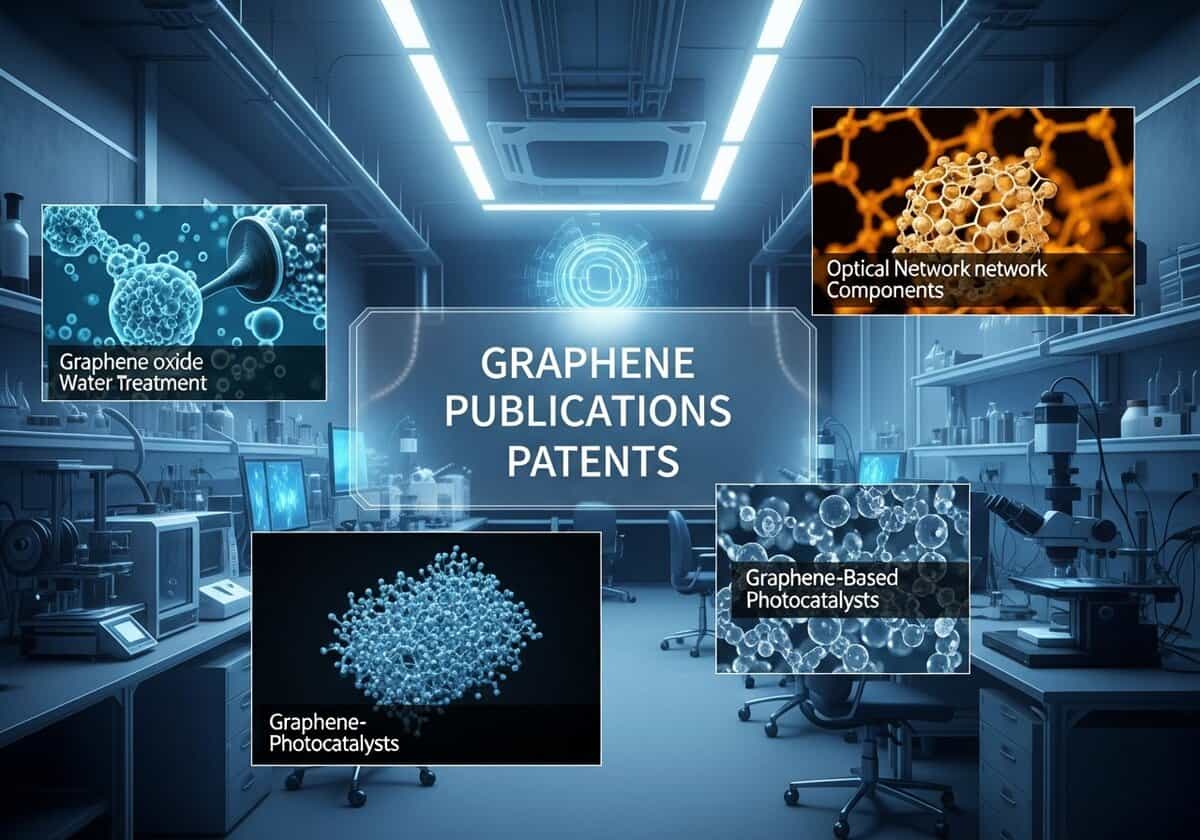
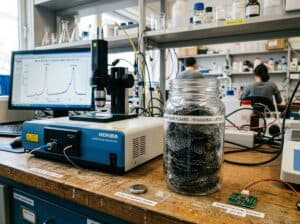
Graphène is a single layer of carbon atoms arranged in a hexagonal lattice. It conducts electrons with very high mobility, shows a Dirac cone band structure and is mechanically strong. These properties prompted research in spintronics, Klein tunneling and phonon transport. Souche effects such as heterostrain and wrinkles are now studied as tools to tune behavior.
Production is the practical limit. dépôt chimique en phase vapeur yields large-area films, molecular beam epitaxy offers control for research and exfoliation supplies flakes. Raman spectroscopie is the standard way to check layer number and quality. Commercial uses focus on composites, coatings, sensors and batteries more than on transistors. Patents and papers below follow the field.
Le graphène est rarement utilisé seul dans un produit. Ses cousins bidimensionnels sont recouverts de MXènes, qui ajoutent une chimie de surface ajustable, tandis que la page plus générale sur les nanomatériaux Il le place parmi les tubes, les fils et les particules. Les chercheurs en énergie devraient également ouvrir super condensateurs, où les électrodes en graphène sont un élément essentiel, et chemical vapor deposition, la voie principale vers de grandes feuilles propres.
Il s'agit de notre dernière sélection de publications et de brevets mondiaux en anglais sur le graphène, parmi de nombreuses revues scientifiques en ligne, classées et axées sur le graphène, le wrinklon, la straintronique, l'hétérostrain, le phonovoltaïque, la spectroscopie Raman, l'effet tunnel de Klein, la spintronique, le dépôt chimique en phase vapeur, l'épitaxie par faisceaux moléculaires, le cône de Dirac et le transport des phonons.
Raman spectroscopy detection system
Patent published on the 2026-11-05 in WO under Ref WO2026231454 by BOARD OF TRUSTEES OF MICHIGAN STATE UNIV [US] (Dantus Marcos [us])
Abstract: A Raman spectroscopy detection system and method remove background signals to obtain a desired signal, such as by software instructions including calculating a difference. A further aspect of a Raman spectroscopy detection system and method remove background signals to obtain a desired signal, by subtracting the raw spectrum from a version of itself with a small shift in the frequency domain to find at least one Raman signal and then isolate it. In another aspect, a Raman spectroscopy detection [...]
Our summary: A Raman spectroscopy detection system utilizes software instructions to remove background signals for accurate signal detection. It involves subtracting a shifted raw spectrum to isolate Raman signals. The system also employs numerical integration and filtering to enhance the visibility of Raman features.
Raman spectroscopy, background signal removal, signal isolation, numerical integration
Patent
Methods and systems for active electrochemical perturbation and time-resolved raman spectroscopic response measurement for biochemical characterizatio
Patent published on the 2026-11-05 in WO under Ref WO2026232121 by THE BOARD OF TRUSTEES OF THE LELAND STANFORD JUNIOR UNIV [US] (Pavagada Suraj [us], Durmus Naside [us], Demirci Utkan [us], Parlatan Ugur [us])
Abstract: A method of detecting and assessing one or more biomarkers of interest using a combined electrochemical - Raman spectroscopy device, as well as a related system. A biofluid is presented to an electrode surface of one or more electrodes of the device. The electrode surface is electrochemically perturbed to enhance sensitivity and detection of the one or more biomarkers of interest by selectively pre-concentrating one or more biomarkers of interest at the electrode surface. Raman spectroscopy is p[...]
Our summary: This method combines electrochemical perturbation with Raman spectroscopy for enhanced biomarker detection. It focuses on pre-concentrating biomarkers at an electrode surface to improve sensitivity. The system is particularly useful for diagnosing and monitoring MASLD/MASH conditions.
Electrochemical perturbation, Raman spectroscopy, biomarker detection, diagnostic systems
Patent
Compositions comprising a metal salt of a functionalized graphene oxide and layers produced from said compositions
Patent published on the 2026-11-05 in WO under Ref WO2026229266 by SURVENTIS SURFACE TREAT GMBH [DE] (Gindele Maxim [de], Roth Nicole [de], Poehlker Sebastian [de], Keil Patrick [de], Natke Dominik [de], Schwamb Michael [de], Toboll Petra [de], Gelbrich Thorsten [de])
Abstract: The present invention relates to compositions having improved corrosion protection to reduce the negative environmental impact associated with the corrosion of substrates due to environmental influences. In particular, the present invention relates to a composition comprising at least one functionalized graphene oxide containing at least one functional group covalently and/or non-covalently attached to the graphene oxide via at least one anchor group and at least one mono- and/or polyvalent meta[...]
Our summary: The invention involves compositions with functionalized graphene oxide and metal salts that enhance corrosion resistance. It details methods for producing these compositions and applying them as protective layers on substrates. The technology aims to mitigate environmental impacts from substrate corrosion.
functionalized graphene oxide, metal salt, corrosion protection, coating layers
Patent
Passive inter-surface cavity device with high-curvature geometric features
Patent published on the 2026-11-05 in US under Ref US20260353610 by ATOMBEAM TECH INC [US] (Galvin Brian [us])
Abstract: [0000] A passive nanoscale cavity device comprising a substrate supporting one or more high-curvature geometric features, such as but not limited to frustums, cones, nanowires, ridges, or graphene edges, positioned opposite an opposing surface across a nanoscale gap. The high-curvature features create a confined cavity region in which electromagnetic mode trajectories differ substantially from those in parallel-plate geometries. The cavity geometry produces geometry-dependent forces and thermal [...]
Our summary: A passive nanoscale cavity device utilizes high-curvature geometric features to create a confined cavity region. This geometry leads to unique electromagnetic mode trajectories and allows for passive thermal energy redistribution. The device can be implemented in various configurations and integrated with electronic systems for effective thermal management.
nanoscale cavity, high-curvature features, passive thermal management, electromagnetic modes
Patent
Spintronic device capable of improving spin torque by combination of magnetic domains, and electronic devices including the same
Patent published on the 2026-11-04 in EP under Ref EP4835896 by UIF UNIV INDUSTRY FOUNDATION YONSEI UNIV [KR] (Hong Jongill [kr], Jeong Jaegyu [kr])
Abstract: Provided is a spintronic device. The spintronic device includes a magnetic free layer having magnetic domains formed to have a magnetic anisotropy energy gradient and whose magnetization direction is switched by spin torque, and a spin Hall effect layer formed below or above the magnetic free layer and configured to generate a spin current from a charge current by a spin Hall effect and generate the spin torque in the magnetic free layer based on the spin current, wherein the magnetization direc[...]
Our summary: The spintronic device enhances spin torque through a combination of magnetic domains and electronic components. It features a magnetic free layer with a magnetic anisotropy energy gradient. The device operates without an external magnetic field, utilizing a spin Hall effect layer to generate spin current and torque.
spintronics, spin torque, magnetic domains, spin Hall effect
Patent
Hydrophobic composite materials
Patent published on the 2026-11-04 in EP under Ref EP4835192 by FREYZEIN FLEXCO [AT] (Ghanbarnezhad Solmaz [at], Cozzoni Enrico [at], Caven Barnaby [at])
Abstract: The present invention relates to the application of cyclodextrins as surface property modifiers - optionally in conjunction with graphene oxide reduced in situ - for the hydrophobization of substrates. The invention also relates to a method for preparing a composite material, a composite material, use of the composite material and a textile comprising the composite material.[...]
Our summary: The invention utilizes cyclodextrins to modify surface properties for hydrophobization. It includes a method for preparing a composite material that may incorporate reduced graphene oxide. The resulting composite material can be used in various applications, including textiles.
hydrophobic, composite materials, cyclodextrins, graphene oxide
Patent
Graphene-integrated flexible films with a three-dimensional elastic network and photothermal responsiveness
Published on 2026-09-30 by Jiahui Dong, Yu-I Hsu, Hiroshi Uyama @NATURE
Abstract: Polymer Journal, Published online: 30 September 2026; doi:10.1038/s41428-026-01255-5A biodegradable PLCL-PEG-PLCL elastic network was constructed by PETMP-assisted thiol-ene photocrosslinking and integrated with graphene for photothermal functionality. The network structure regulated the mechanical deformability and degradation behavior of the films, while graphene enhanced toughness and enabled rapid light-to-heat conversion. These findings demonstrate that combining network engineering with gr[...]
Our summary: The study presents a biodegradable PLCL-PEG-PLCL elastic network integrated with graphene. This integration enhances mechanical properties and enables photothermal responsiveness. The findings highlight a strategy for developing flexible, degradable films with improved performance.
Graphene, Photothermal, Biodegradable, Elastic Network
Publication
Intrinsic phase-locking of terahertz auto-oscillations in the easy-plane antiferromagnet Mn2Au
Published on 2026-09-11 by Yiyue Wang, Wenbo Zhang, Hao-Hsuan Chen, Milad Jalali, Andrea Meo and Yaowen Liu @IOP SCIENCE
Abstract: Antiferromagnets offer a promising platform for ultrafast spintronic emitters owing to their intrinsic terahertz ( ) spin dynamics, yet the mechanisms governing the onset and coherence of current-driven oscillations remain poorly understood. Here we develop a multiscale theoretical framework for the collinear antiferromagnet Mn2Au driven by a perpendicularly polarized spin current. Using a momentum-dependent canonical transformation of the coupled macrospin Hamiltonian, we show that the emergenc[...]
Our summary: This study develops a theoretical framework for the antiferromagnet Mn2Au under spin current. It identifies intrinsic phase-locking in auto-oscillations, stabilized by easy-plane anisotropy and AFM exchange. The findings suggest Mn2Au as a coherent platform for continuous-wave generation in spintronic applications.
antiferromagnet, terahertz, auto-oscillation, phase-locking
Publication