Redundancia modular triple (TMR)
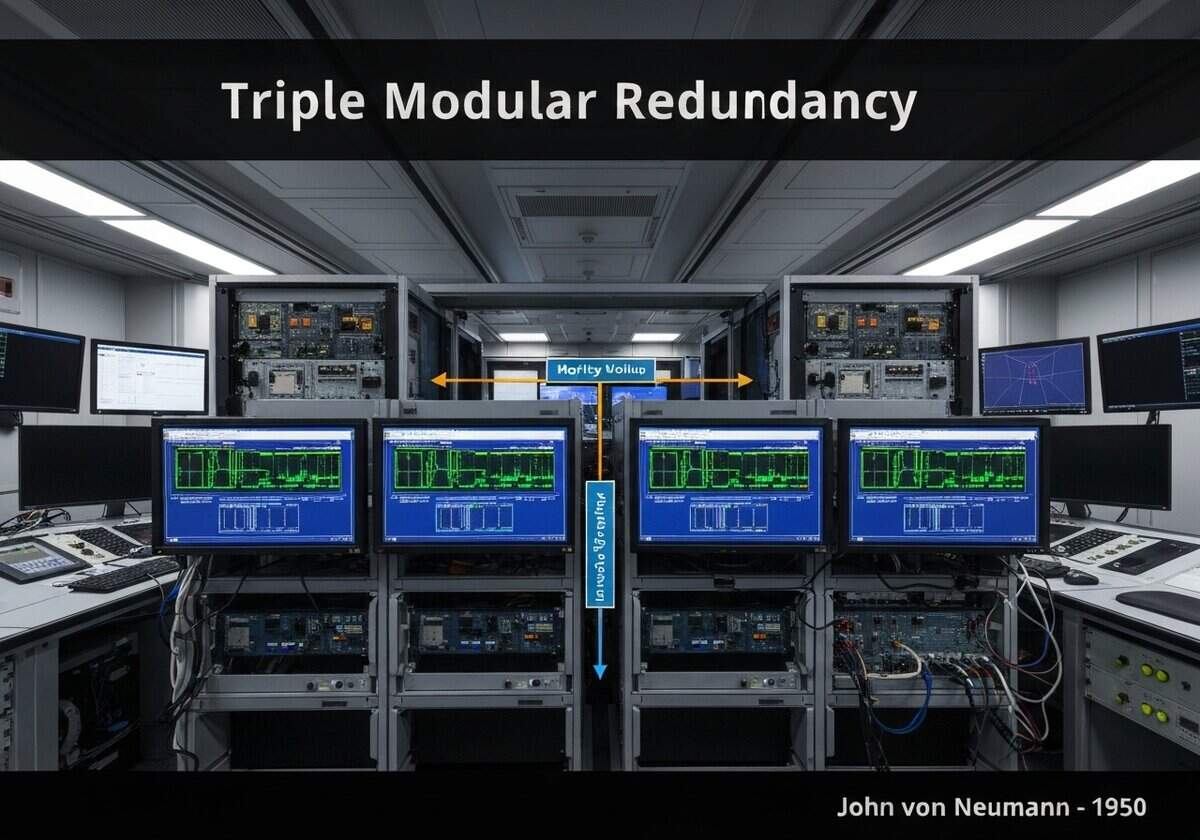
TMR (Triple Modular Redundancy) is a hardware fault-tolerance technique that uses three identical modules performing the same operation in parallel. Their outputs are fed into a majority-voting circuit. If one module fails and produces an incorrect output, the voter is still able to determine the correct output based on the other two modules, thus masking the fault and ensuring continuous operation.
Triple Modular Redundancy (TMR) is a classic example of N-modular redundancy, where N=3. The core idea is to replicate a critical component three times and have them all process the same input simultaneously. The results from these three modules are then passed to a voter. The voter implements a majority function; if at least two of the three inputs are identical, that value is selected as the final output. This mechanism effectively masks a single fault in any one of the modules. For instance, if Module A, B, and C produce outputs 1, 1, and 0 respectively, the majority voter will output 1.
La fiabilidad del sistema TMR depende no solo de los módulos, sino también del propio votante. Si el votante falla, todo el sistema falla. Por lo tanto, el votante debe ser significativamente más fiable que los módulos individuales que supervisa. En la práctica, los votantes suelen ser circuitos más simples que los módulos que gestionan, lo que contribuye a lograr esta mayor fiabilidad. La fiabilidad global del sistema puede modelarse matemáticamente. Si la fiabilidad de un solo módulo es [latex]R_m[/latex], la fiabilidad del sistema TMR (suponiendo un votante perfecto) viene dada por la probabilidad de que al menos dos módulos funcionen correctamente: [latex]R_{TMR} = R_m^3 + 3R_m^2(1-R_m) = 3R_m^2 – 2R_m^3[/latex]. Esta fórmula muestra que TMR mejora la fiabilidad solo si la fiabilidad de cada módulo individual [latex]R_m[/latex] es mayor que 0,5.
Historically, John von Neumann’s work in the 1950s laid the theoretical groundwork for building reliable systems from unreliable components, which directly led to concepts like TMR. It was first implemented in practice in systems where failure was not an option, such as the Saturn V launch vehicle’s digital computer and early fly-by-wire control de vuelo systems. While TMR increases hardware cost, power consumption, and weight by a factor of more than three (due to the voter), its simplicity and effectiveness in handling single random hardware faults make it a cornerstone of high-availability and safety-critical system design.
UNESCO Nomenclature: 1203
Ciencias de la computación
Precursores
- La teoría de la información de Claude Shannon y su trabajo sobre circuitos de relés.
- Las conferencias de John von Neumann sobre computación confiable con componentes no confiables
- Early concepts of redundancy in biological systems
- Basic principles of voting and majority logic
Aplicaciones
- aerospace systems (e.g., flight control computers)
- satellites
- nuclear power plant safety systems
- fault-tolerant computer architectures
Ideas para posibles innovaciones
- Redundancia modular cuádruple para gestionar dos fallos simultáneos
- Circuitos integrados autorreparables con células TMR reconfigurables
- Sistemas TMR adaptativos que pueden apagar módulos redundantes para ahorrar energía cuando el riesgo de falla es bajo
- Implementación de TMR en software para la validación de procesos críticos
- distributed TMR across networked microcontrollers for IoT device clusters
- TMR para proteger los cúbits de computación cuántica contra errores de decoherencia
- TMR dinámico donde los módulos de repuesto se activan solo al detectarse una falla
- Sistemas de memoria híbridos TMR-ECC para una mejor integridad de los datos
- TMR-based red neuronal architectures for robust AI decision-making
- Sistemas TMR verificables que utilizan métodos formales para aplicaciones de seguridad certificadas
Relacionado con: redundancia modular triple, TMR, enmascaramiento de fallos, redundancia de hardware, redundancia N-modular, votación por mayoría, sistemas críticos para la seguridad, industria aeroespacial, von Neumann, ingeniería de fiabilidad.