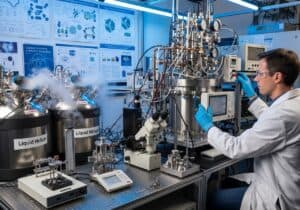
La criogenia studia il comportamento di materiali e sistemi a temperature inferiori a -150 °C, concentrandosi sulla produzione, il mantenimento e l'applicazione di temperature estremamente basse. Implica l'uso di fluidi criogenici come elio liquido e azoto liquido, tecniche di refrigerazione specializzate e metodi di isolamento per raggiungere e mantenere condizioni criogeniche. Le applicazioni spaziano dalla superconduttività alla tecnologia spaziale, dalla conservazione medica alla liquefazione dei gas. Questo campo integra termodinamica, fluidodinamica e scienza dei materiali per affrontare fenomeni specifici degli ambienti criogenici. La nostra raccolta di seguito raccoglie le pubblicazioni e i brevetti più recenti che descrivono in dettaglio le innovazioni in apparecchiature, processi, materiali e strumentazione criogenici.
Questa è la nostra ultima selezione di pubblicazioni e brevetti mondiali in inglese sulla criogenia, tra numerose riviste scientifiche online, classificate e focalizzate su fluido criogenico, elio liquido, azoto liquido, criocooler, superconduttori, isolamento criogenico, criostato, smagnetizzazione adiabatica, pompa criogenica, valvole criogeniche, stoccaggio criogenico, criogenia, ingegneria criogenica, refrigerazione criogenica, vuoto criogenico, liquefazione criogenica, materiali criogenici e distillazione criogenica.
Reusable launch vehicle with auxiliary propellant tanks for non-ascent burns
Patent published on the 2026-07-02 in US under Ref US20260184442 by BLUE ORIGIN LLC [US] (Grayson Gary [us], Wuerl Adam M [us], Degenhardt David [us])
Abstract: A reusable launch vehicle comprising auxiliary tanks for non-ascent burns, such as orbital maneuver burns, reorientation burns, deorbit burns, or landing burns, and/or power generation. The auxiliary tanks may provide propellants for an orbital maneuvering system, an orbital reaction control system, a reentry reaction control system, and/or a power generation system. The tanks are configured to maintain cryogenic properties of auxiliary fuel and auxiliary oxidizer for the duration of the mission[...]
Our summary: The content describes a reusable launch vehicle designed with auxiliary propellant tanks for non-ascent burns. These tanks support various functions, including orbital maneuvers and power generation, while maintaining cryogenic properties. The configuration of the tanks allows for optimal positioning and insulation of cryogenic fluids during the mission.
reusable launch vehicle, auxiliary propellant tanks, non-ascent burns, cryogenic properties
Patent
Battery pack and operating method therefor
Patent published on the 2026-07-02 in WO under Ref WO2026141895 by LG ENERGY SOLUTION LTD [KR] (Ahn Moon Youl [kr], Lee Yong Hun [kr], Lee Sang Joon [kr], Seo Sung Won [kr])
Abstract: The disclosed battery pack includes: a lower plate; a sidewall surrounding the lower plate; a support plate spaced apart from the lower plate to form a venting flow path and having a venting hole; battery cell assemblies disposed on the support plate; and a nitrogen gas system including a liquid nitrogen tank, a vaporizer, and multiple nitrogen gas injection holes. The multiple nitrogen gas injection holes may be disposed in at least one of the lower plate and the support plate.[...]
Our summary: The battery pack features a lower plate and sidewall, with a support plate creating a venting flow path. It includes a nitrogen gas system with a liquid nitrogen tank and vaporizer. Multiple nitrogen gas injection holes are integrated into the lower plate and support plate.
Battery pack, nitrogen gas system, venting flow path, battery cell assemblies
Patent
Technologies for closed-loop qubit calibration
Patent published on the 2026-07-01 in EP under Ref EP4769246 by INTEL CORP [US] (Levinger Run [us], Subramanian Sushil [us], Shumaker Evgeny [il])
Abstract: [0001] Technologies for closed-loop calibration of pulses to control spin qubits are disclosed. In an illustrative embodiment, calibration circuitry generates a pulse from a pulse generator. The pulse passes through a variable filter controlled by a filter parameter. The pulse is provided to a qubit, and the qubit is measured. Depending on the measured state of the qubit, the filter parameter can be changed. In this manner, the control pulses can be quickly and continuously calibrated. The calib[...]
Our summary: Technologies for closed-loop calibration of spin qubits are presented. The calibration circuitry adjusts filter parameters based on qubit measurements. This approach minimizes noise and is scalable for multiple qubits.
closed-loop calibration, qubit control, pulse generation, integrated circuit
Patent
Cryogenic cooling module and cryogenic cooling system
Patent published on the 2026-06-28 in FI under Ref FI20246554 by BLUEFORS OY [FI] (Roschier Leif [fi], Vorselman Pieter [fi])
Abstract: A modular cryogenic cooling system comprises an at least horizontal array of cryogenic modules (501, 502, 503, 504, 601, 701, 702, 703, 704, 1301, 1302, 1303, 1304, 1305) that together form a vacuum chamber. It comprises means (507, 707) for evacuating the vacuum chamber through an end of the horizontal array.[...]
Our summary: A modular cryogenic cooling system consists of a horizontal array of cryogenic modules. These modules collectively create a vacuum chamber. The system includes means for evacuating the vacuum chamber from one end of the array.
Cryogenic cooling, modular system, vacuum chamber, evacuation means
Patent
A system for deposition of dry ice for maintaining vacuum during desorption in direct air capture applications
Patent published on the 2026-06-24 in EP under Ref EP4763310 by SIEMENS ENERGY GLOBAL GMBH & CO KG [DE] (Hjalmarsson Christer [se], Jaksch Peter [se])
Abstract: A method of capturing carbon dioxide for use with a sorbent media includes the steps of configuring the sorbent media to receive a flow of a carbon dioxide containing gas within a pressure vessel, absorbing carbon dioxide from the carbon dioxide containing gas within the sorbent media during an absorption cycle, configuring the pressure vessel to be sealed with at least one lid, configuring the at least one lid to include at least one cryogenic heat exchanger, releasing an amount of carbon dioxi[...]
Our summary: The system captures carbon dioxide using sorbent media in a pressure vessel. It employs a cryogenic heat exchanger to freeze and isolate carbon dioxide during desorption. The process involves circulating a heat transfer fluid to maintain optimal temperature and pressure conditions.
carbon capture, sorbent media, cryogenic heat exchanger, desorption cycle
Patent
A cryostat end fitting
Patent published on the 2026-06-24 in EP under Ref EP4764290 by SUPERNODE LTD [IE] (Mcnally Leo [ie], Doyle Stephen [ie], Stringer Peter [ie], Conroy Joseph [ie], O'reilly Brian [ie], Volschenk Deon [ie], Sanborn Conrad [ie], Pereira Reinaldo [ie], Acin Marcos [ie], Dunn Dwain [ie])
Abstract: The present invention provides a cryostat end fitting adapted to provide a vacuum tight interface between components across which interface a cryogen flows, the cryostat end fitting comprising a cryostat including a thermoplastic inner conduit, a connector at an end of the inner conduit comprising a cylindrical sidewall secured to or formed integrally with the end of the inner conduit, the connector further comprising a cylindrical coupling having a compliant interface with the cylindrical sidew[...]
Our summary: The invention describes a cryostat end fitting designed for a vacuum-tight connection between components. It features a thermoplastic inner conduit and a connector with a cylindrical sidewall. The connector includes a cylindrical coupling that has a compliant interface with the sidewall.
cryostat, vacuum interface, thermoplastic conduit, cryogen flow
Patent
Continuous thermochemical sources of AlF molecules
Published on 2026-06-09 by Pulkit Kukreja, Priyansh Agarwal, Maximilian Doppelbauer, Jionghao Cai, Xiangyue Liu, Eduardo Padilla, Sebastian Kray, Henrik Haak, Russell Thomas, Stefan Truppe, Boris G Sartakov, Gerard Meijer and Sid Wright @IOP SCIENCE
Abstract: The AlF molecule, currently subject to laser cooling and trapping efforts, has the advantage that it can be efficiently produced in a thermochemical reaction between sublimated aluminum trifluoride and aluminum metal. Here we present a series of experiments with continuous molecular beam sources of AlF, utilizing this reaction. We demonstrate a compact AlF molecular beam oven whose total far-field brightness is molecules per steradian per second at 923 K, just below the melting temperature of al[...]
Our summary: This study presents continuous thermochemical sources for AlF molecules using a reaction between aluminum trifluoride and aluminum metal. A compact molecular beam oven is demonstrated, achieving high brightness and excellent signal-to-noise ratios in spectroscopy experiments. The output is further optimized by cooling the beam in a cryogenic Ne buffer gas cell, enabling potential applications in molecular magneto-optical traps.
AlF molecules, thermochemical reaction, molecular beam sources, laser cooling
Publication
Numerical analysis of superconductivity in quasi-one-dimensional A2Mo3As3 (A = K, Rb, Cs)
Published on 2026-04-07 by Lin Wu, Yating Hu and Xiangang Wan @IOP SCIENCE
Abstract: Recent experiments have discovered superconductivity in the ternary molybdenum pnictide materials A2Mo3As3 (A = K, Rb, Cs). In this work, we investigate the superconducting properties of the A2Mo3As3 family based on an effective five-band Hubbard model and using the fluctuation exchange approximation. By solving the linearized Eliashberg equation for various interaction parameters, we find that the spin-singlet and spin-triplet pairings dominate as the leading pairing symmetries in the weak and [...]
Our summary: This study analyzes superconductivity in A2Mo3As3 materials using a five-band Hubbard model. The research identifies spin-singlet and spin-triplet pairings as dominant pairing symmetries under varying electron interactions. Findings align well with recent experimental observations.
Superconductivity, Quasi-one-dimensional, Hubbard model, Eliashberg equation
Publication