Product Design, Manufacturing & Innovation Resources
Heim » Das Spiralmodell (SW-Prozess)

Das Spiralmodell (SW-Prozess)

1986-01-01
  • Barry Boehm
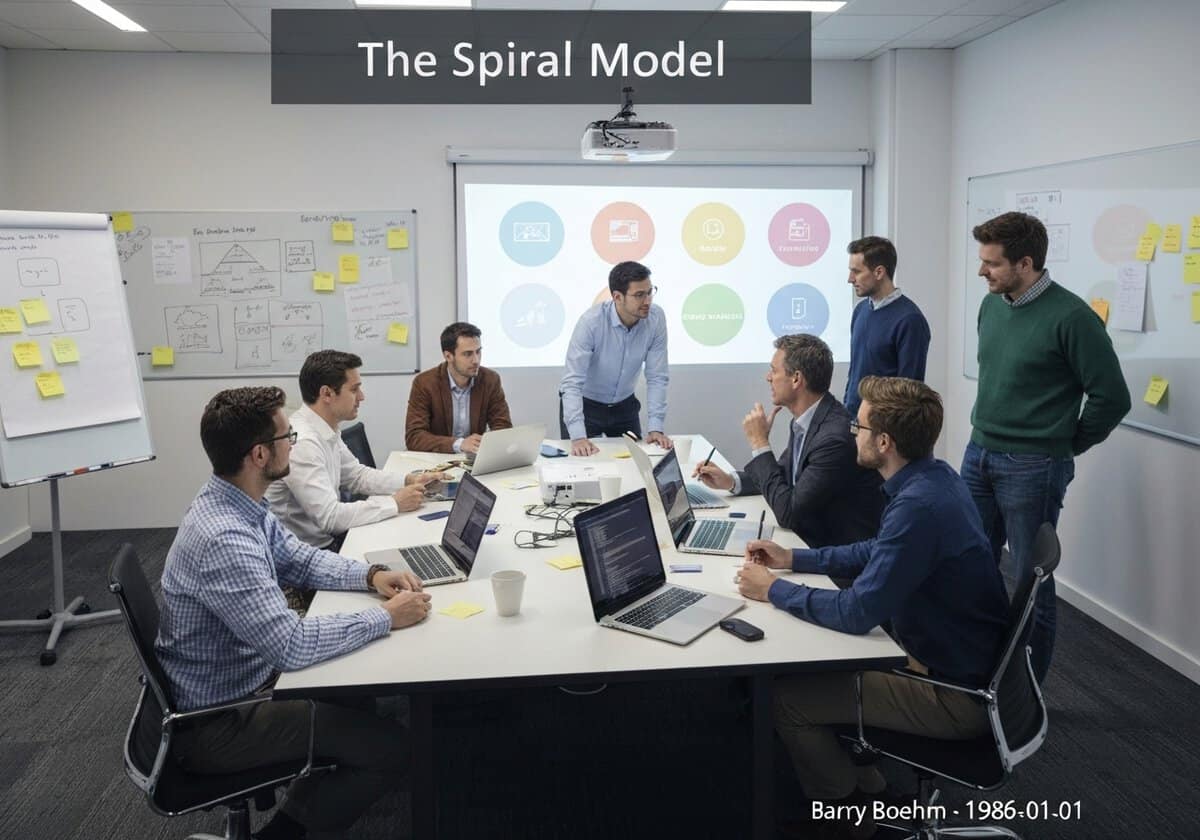
Ein Software-Entwicklungsteam diskutiert das Spiralmodell in einer modernen Büroumgebung.

(Abbildung dient nur zur Veranschaulichung)

The Spiral Model is a risk-driven software development process model that combines elements of both prototyping and the WasserfallmodellEs handelt sich um eine iterative Entwicklungsmethode, bei der das Projekt in jeder Iteration vier Phasen durchläuft (Spirale): Ziele festlegen, Risiken identifizieren und beheben, entwickeln und testen sowie die nächste Iteration planen. Der Schwerpunkt liegt auf der kontinuierlichen Risikoanalyse.


Introduced by Barry Boehm in 1986, the Spiral Model was designed to address the shortcomings of the traditional Waterfall model, particularly for large, complex projects. Each loop of the spiral represents a phase of the software process. Unlike other models, it doesn’t start with a full set of requirements. Instead, the initial spiral might focus on developing a proof-of-concept to test feasibility. Each subsequent loop builds upon the last, moving from a conceptual level to a fully engineered product. The four key activities in each cycle are: 1) Determine objectives, alternatives, and constraints for the iteration. 2) Evaluate alternatives; identify and resolve risks. This is the most critical part, involving activities like prototyping, simulation, and benchmarking to mitigate high-risk elements. 3) Develop and verify the next-level product. This involves the actual coding, integration, and testing, similar to a mini-waterfall process for that iteration’s deliverable. 4) Plan the next iteration. The project is reviewed, and plans are drawn up for the next spiral. This model allows for the incremental release of the product and refinement of requirements throughout the development lifecycle, making it highly flexible and suitable for projects where risk management is paramount.

UNESCO Nomenclature: 1208
– Software

Typ

Abstraktes System

Störung

Inkremental

Verwendung

Nische/Spezialisiert

Vorläufer

  • Wasserfallmodell
  • Prototyping-Modelle
  • Grundsätze des Risikomanagements
  • inkrementelle Entwicklungsmodelle

Anwendungen

  • große, teure und komplizierte Regierungsprojekte
  • risikoreiche Softwareentwicklung
  • Projekte, bei denen die Anforderungen unklar oder komplex sind
  • Forschungs- und Entwicklungsprojekte

Patente:

NA

Potenzielle Innovationsideen

  • Spiralmodelle für die Entwicklung von Geschäftsstrategien mit Fokus auf Marktrisiken
  • Lernsoftware, die ihre Lehrspirale an das Misserfolgsrisiko der Schüler anpasst
  • iterative klinische Studie design that spirals through phases based on risk-benefit analysis
  • Luft- und Raumfahrtprojektmanagement mit Spiralentwicklung für komplexe Subsysteme
  • Entwicklung von Finanzprodukten mithilfe eines Spiralmodells zur Steuerung von Regulierungs- und Marktrisiken
  • Große Infrastrukturprojekte (z. B. Smart Cities), die in risikobewerteten Spiralen geplant werden
  • Cybersicherheit system development that iteratively adds layers of defense based on evolving threat analysis
  • Katastrophenschutzplanung, die sich spiralförmig entwickelt, wenn mehr Informationen und Risiken klar werden
  • Entwicklung von KI-Modellen, bei denen sich jede Spirale auf die Minderung einer bestimmten Art von Verzerrung oder Fehler konzentriert
  • Gesetzgebungsentwicklung, bei der Gesetzesentwürfe spiralförmig ausgearbeitet werden und in jeder Phase eine Risikoanalyse durchgeführt wird
Verwandt mit: Spiralmodell, Barry Boehm, risikogetrieben, Softwareentwicklung, iterativ, Prototyping, Wasserfallmodell, Risikoanalyse, Software-Engineering, Projektmanagement.

Historischer Kontext

Das Spiralmodell (SW-Prozess)

1980
1980
1980
1986-01-01
1990
1990
1993
1980
1980
1980
1982-07-01
1988-06-01
1990
1993
1997-04-23

(wenn das Datum unbekannt oder nicht relevant ist, z. B. „Strömungsmechanik“, wird eine gerundete Schätzung seines bemerkenswerten Auftretens bereitgestellt)

10. Jahr Jubiläum

Bilder in voller Größe und Downloads sind nur für registrierte Mitglieder 100% kostenlos verfügbar.

> Login <