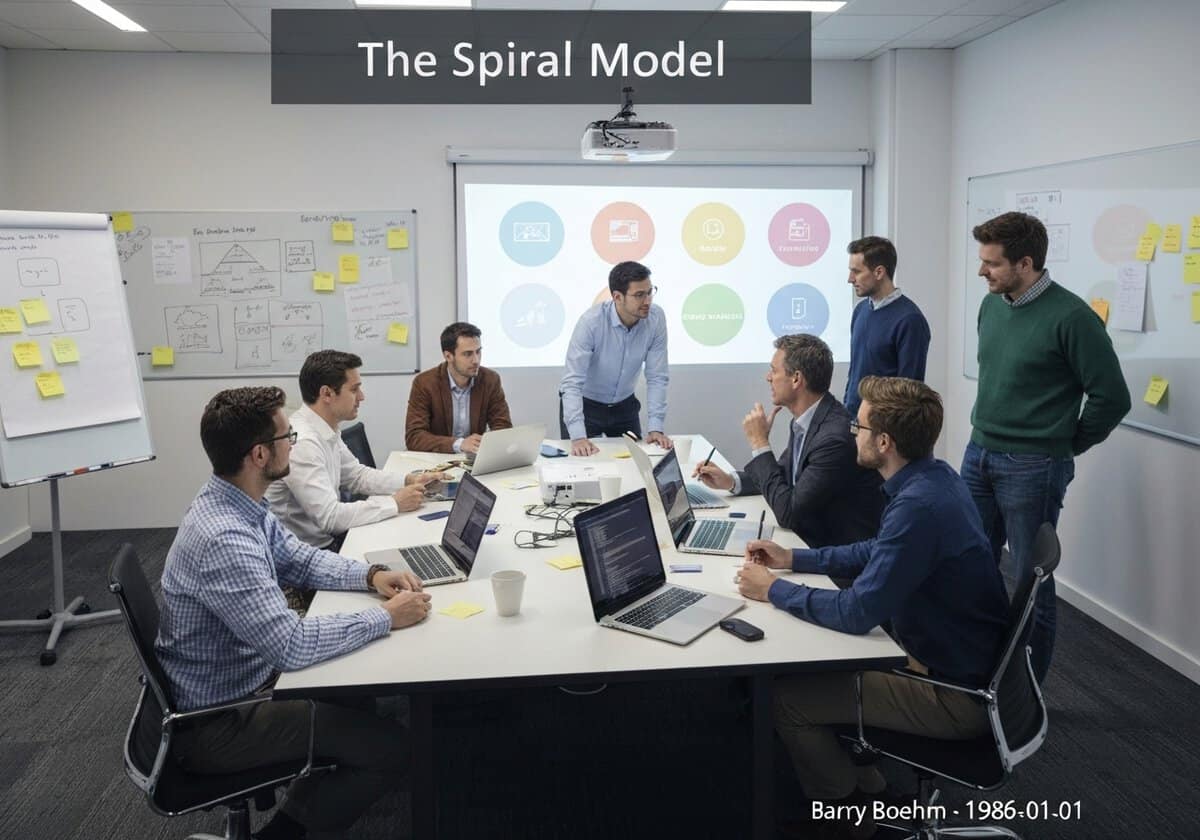
The Spiral Model is a risk-driven software development process model that combines elements of both prototyping and the 瀑布模型这是一种迭代开发模式,项目在每次迭代中经历四个阶段(螺旋式):确定目标、识别并解决风险、开发和测试,以及规划下一次迭代。它强调持续的风险分析。


(图片仅供参考)
The Spiral Model is a risk-driven software development process model that combines elements of both prototyping and the 瀑布模型这是一种迭代开发模式,项目在每次迭代中经历四个阶段(螺旋式):确定目标、识别并解决风险、开发和测试,以及规划下一次迭代。它强调持续的风险分析。

Introduced by Barry Boehm in 1986, the Spiral Model was designed to address the shortcomings of the traditional Waterfall model, particularly for large, complex projects. Each loop of the spiral represents a phase of the software process. Unlike other models, it doesn’t start with a full set of requirements. Instead, the initial spiral might focus on developing a proof-of-concept to test feasibility. Each subsequent loop builds upon the last, moving from a conceptual level to a fully engineered product. The four key activities in each cycle are: 1) Determine objectives, alternatives, and constraints for the iteration. 2) Evaluate alternatives; identify and resolve risks. This is the most critical part, involving activities like prototyping, simulation, and benchmarking to mitigate high-risk elements. 3) Develop and verify the next-level product. This involves the actual coding, integration, and testing, similar to a mini-waterfall process for that iteration’s deliverable. 4) Plan the next iteration. The project is reviewed, and plans are drawn up for the next spiral. This model allows for the incremental release of the product and refinement of requirements throughout the development lifecycle, making it highly flexible and suitable for projects where risk management is paramount.
螺旋模型(SW过程)
(如果日期未知或不相关,例如“流体力学”,则提供其显著出现的近似估计)

只有注册会员才能免费获得 100% 的全尺寸图片和下载。.
> 登录 <